1.2 - Variety of Living Organisms
Eukaryotic and prokaryotic organisms
- Living things come in a huge range of shapes and sizes, from a single bacterium too small to see to a blue whale.
- They can be sorted into a small number of large groups based on shared features. The largest of these groups are called kingdoms.
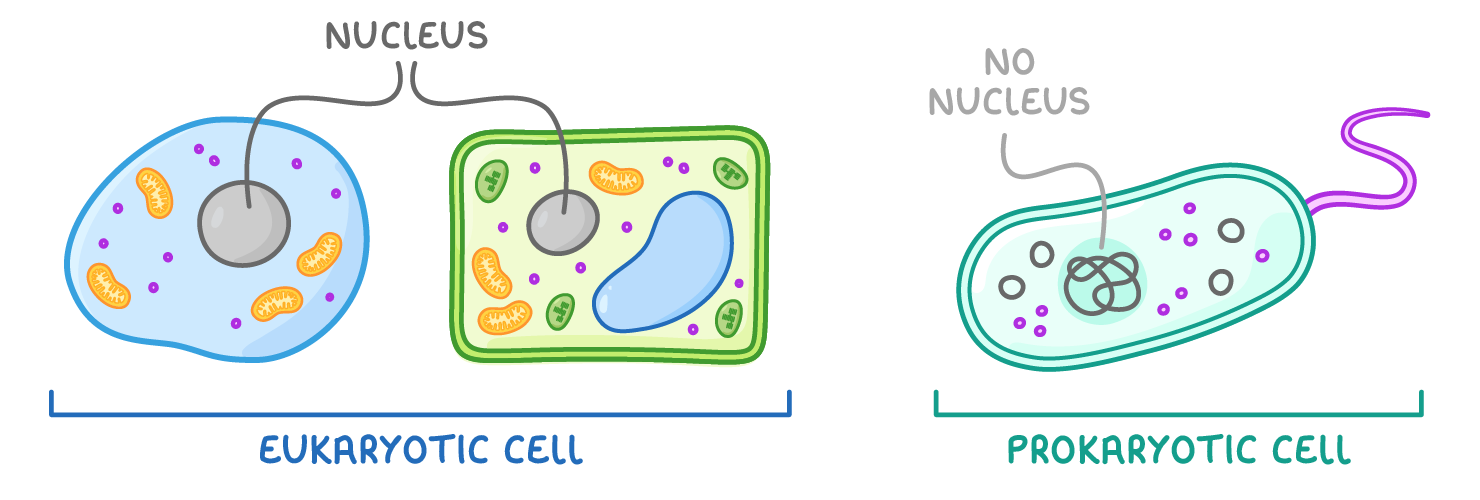
- The most basic division is into two types of organism, based on whether their cells contain a nucleus.
Eukaryotes vs prokaryotes
- Eukaryotic organisms - Made of cells that keep their genetic material inside a nucleus. They range from single cells to large many-celled bodies. They include animals, plants, fungi, and protoctists - four of the kingdoms.
- Prokaryotic organisms - Made of cells with no nucleus; their genetic material is instead loose in the cell. They are single cells, and are smaller and simpler. Bacteria are the main example and make up the prokaryote kingdom.
Features that define a kingdom
- Each kingdom is defined by a set of features its members share:
- Whether they are made of one cell or many
- Whether their cells have walls, and what those walls are made of
- How they obtain their food
- Looking at these features lets you work out which group an organism belongs to.
The features of animals and plants
- Animals and plants are the two most familiar kingdoms.
- Both are multicellular - made of many cells.
- They differ mainly in how they get their food, and in features linked to this.
Features of plants
- Chloroplasts - Their cells contain chloroplasts, letting them carry out photosynthesis to make their own food from simpler raw materials.
- Cell wall - Cells are surrounded by a cell wall made of cellulose, which gives the plant support.
- Carbohydrate storage - Stored as sucrose or as starch.
- Examples - Flowering plants, such as cereals (e.g. maize) and herbaceous legumes (e.g. peas and beans).
Features of animals
- No chloroplasts - Cannot photosynthesise, so they take in ready-made food by eating other organisms.
- No cell wall - Their cells have no cell wall.
- Nervous coordination - Most have some form of nervous coordination, letting them respond quickly to changes in their surroundings.
- Movement - Most can move their whole bodies from one place to another.
- Carbohydrate storage - Stored as glycogen rather than starch.
- Examples - Mammals (e.g. humans) and insects (e.g. houseflies and mosquitoes).
The features of fungi and protoctists
Fungi and protoctists are two more eukaryotic kingdoms, each with its own distinguishing features.
Features of fungi
- Fungi cannot photosynthesise, so they obtain their food from other organisms.
- Most feed by saprotrophic nutrition: they secrete digestive enzymes out onto their food, breaking it down outside the body, then absorb the dissolved nutrients.
- Many fungi have a body organised into a network called a mycelium, made of thread-like structures called hyphae.
- The hyphae contain many nuclei rather than a single one.
- Some fungi, such as yeast, are instead single-celled.
- Cell walls are made of chitin (not the cellulose of a plant).
- Carbohydrate is stored as glycogen.
- Mucor, which has a mycelium and hyphae, is an example of a many-celled fungus.
Features of protoctists
- Protoctists are mostly microscopic single-celled organisms, though a few are larger and many-celled, such as seaweed.
- They are a varied group:
- Chlorella contains chloroplasts and is similar to a plant cell.
- Amoeba, which lives in pond water, is more like an animal cell.
- A few protoctists are pathogens - the best-known being Plasmodium, which causes malaria.
The features of bacteria and viruses
Bacteria
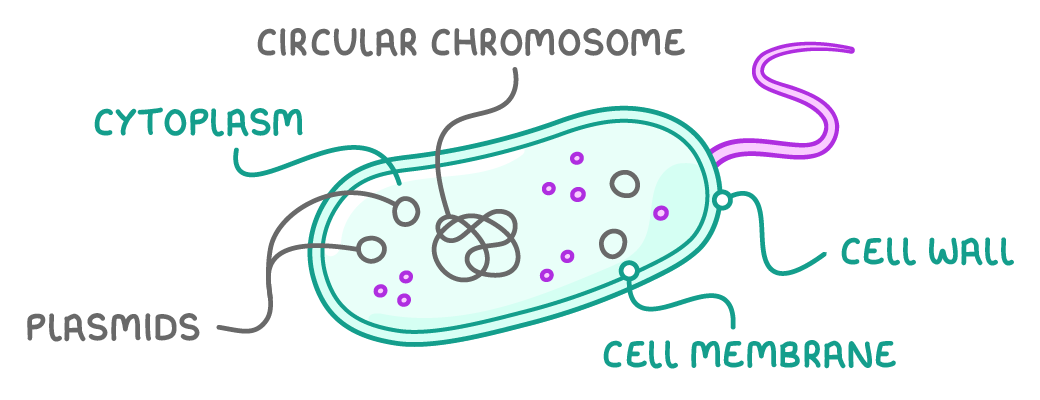
- Bacteria make up the prokaryote kingdom.
- A bacterium is a microscopic, single-celled organism.
- The cell has no nucleus - instead the genetic material is a single circular chromosome of DNA loose in the cell.
- Every bacterial cell has a cell wall, a cell membrane, and cytoplasm.
- Many also carry small separate rings of DNA called plasmids.
- Some bacteria can photosynthesise, but most feed off other organisms, living or dead.
Examples of bacteria:
- Lactobacillus bulgaricus - A rod-shaped bacterium used to turn milk into yoghurt
- Pneumococcus - A spherical bacterium that causes pneumonia
Viruses
- Viruses are not living organisms and are not placed in any kingdom.
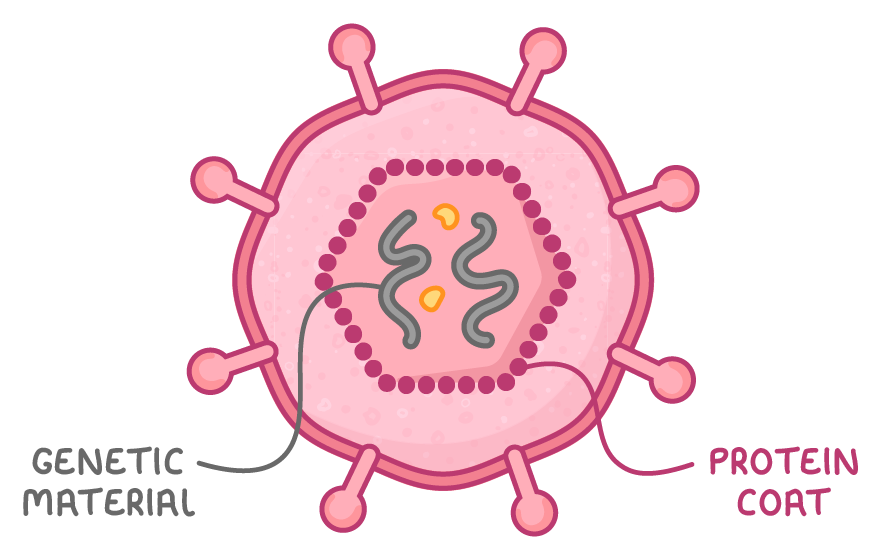
- A virus is a particle, much smaller than a bacterium, with no cellular structure at all.
- It is simply a protein coat wrapped around a small amount of genetic material, which can be either DNA or RNA.
- Viruses come in a wide variety of shapes and sizes, and the one shown below is just one of them.
How viruses reproduce
- A virus cannot reproduce on its own.
- It can only reproduce inside the living cells of another organism, which it takes over.
- A virus therefore depends entirely on a host and acts as a parasite.
- Because of this, all viruses are pathogens - they cause disease.
- A pathogen is any organism that causes disease. Pathogens can be fungi, bacteria, protoctists, or viruses.
- Viruses aren't living organisms, but they still count as pathogens.
Examples of viruses:
- Tobacco mosaic virus - Discolours the leaves of tobacco plants by stopping them making chloroplasts
- Influenza virus - Causes flu
- HIV - Causes AIDS
TermDefinition
KingdomOne of the large groups that living things are sorted into based on their shared features.
Eukaryotic organismAn organism made of cells that keep their genetic material inside a nucleus.
Prokaryotic organismA single-celled organism whose cell has no nucleus, so its genetic material is loose in the cell.
Saprotrophic nutritionFeeding by secreting digestive enzymes onto food outside the body and absorbing the dissolved nutrients.
MyceliumA network of thread-like structures called hyphae that makes up the body of many fungi.
HyphaeThread-like structures that make up the body (mycelium) of many fungi.
PathogenA microorganism that causes disease.