1.3 - Species & Naming
How classification has changed
- Organisms were originally classified by similarities and differences in their observable internal and external features.
- As microscopes and other technology improved, scientists could compare organisms in far more detail.
- The modern aim of a classification system is to reflect the evolutionary relationships between organisms - grouping each organism with its closest relatives so the classification mirrors how the organisms are actually related by descent.
DNA as evidence for classification
- The most powerful evidence for evolutionary relationships now comes from DNA.
- Scientists can determine the sequence of bases in different organisms' DNA and compare them.
- The more similar the base sequences of a gene, the more closely related the organisms, and the more recent their shared ancestor.
- Organisms that share a recent common ancestor have more similar sequences than those whose common ancestor is far in the past.
Evolutionary trees
- Evolutionary relationships are often shown as an evolutionary tree, which links species and groups through their common ancestors.
- The more recent the common ancestor of two groups, the more closely related they are - and the more characteristics and DNA they share.
- Each point where a line splits in two represents a common ancestor dividing into two separate groups.
- For example, humans and mice share a recent common ancestor, so are closely related to each other. Both are only distantly related to elephants, whose shared ancestor with them lies much further back.
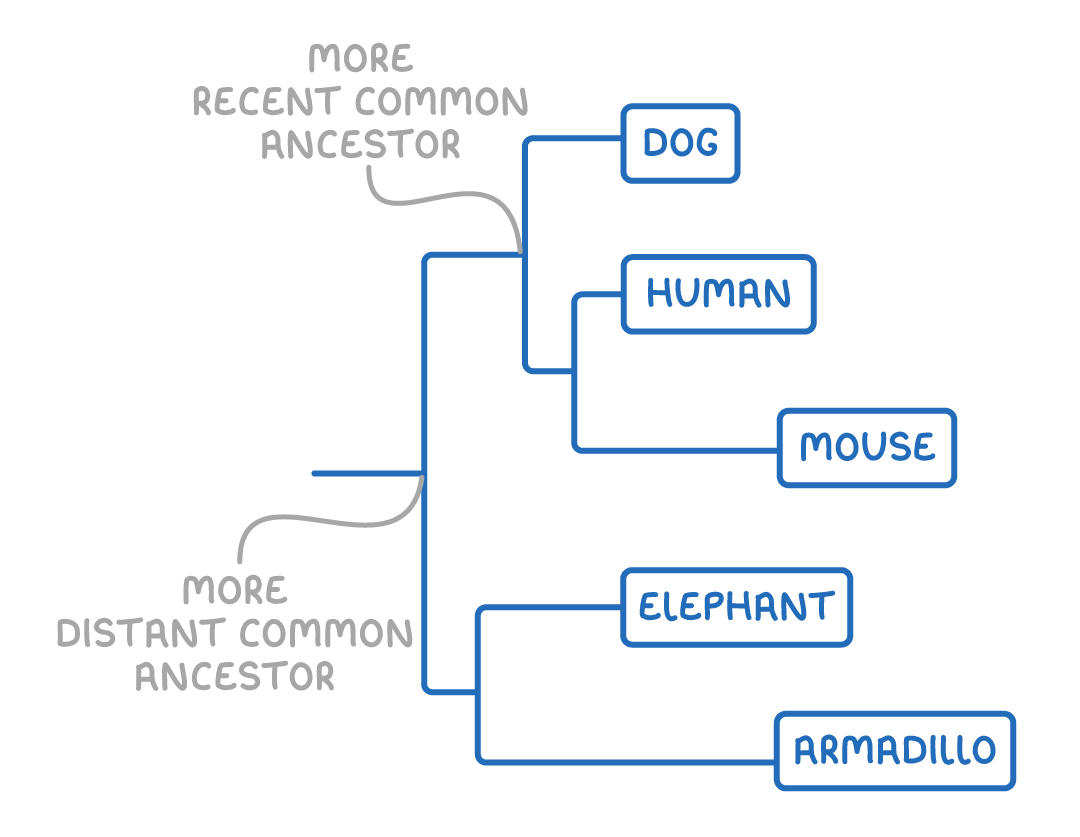
An evolutionary tree for five mammals, showing recent and distant common ancestors.
Species and scientific naming
- A species is the smallest group organisms are sorted into.
- It's a group of similar organisms that can reproduce with one another to give fertile offspring - offspring that can themselves go on to reproduce.
- This makes a species a natural unit: its members breed together, while members of different species generally don't produce fertile offspring.
The binomial system
- Because there are so many species, each is given its own scientific name using the binomial system - an internationally agreed, two-part naming system, mostly in Latin.
- The two parts are:
- Genus - The first part, shared with closely related organisms, giving information about ancestry
- Species - The second part, the species itself
- Example: humans are Homo sapiens - Homo is the genus and sapiens is the species.
- Writing conventions:
- The whole name is written in italics
- Only the first letter of the genus is capitalised
Why the system is used
- The point is consistency.
- The same organism is often given many different common or local names in different places and languages - over a hundred plant species are commonly called raspberries, for instance - which causes confusion.
- A single agreed scientific name means scientists anywhere in the world refer to a species by exactly the same name, so there's no doubt about which organism is meant.
Broad grouping and the five-kingdom scheme
- Living organisms vary enormously in size, features, and complexity - from tiny simple bacteria to large complex animals and plants.
- They can be sorted into groups according to the features they share.
Familiar broad groups
At the broadest, most familiar level, living things are placed into a few large descriptive groups:
- Plants - Divided into flowering plants (e.g. daisies and grasses) and non-flowering plants (e.g. ferns and mosses)
- Animals - Divided into vertebrates, which have a backbone (e.g. mammals and birds), and invertebrates, which have no backbone (e.g. insects)
The five kingdoms
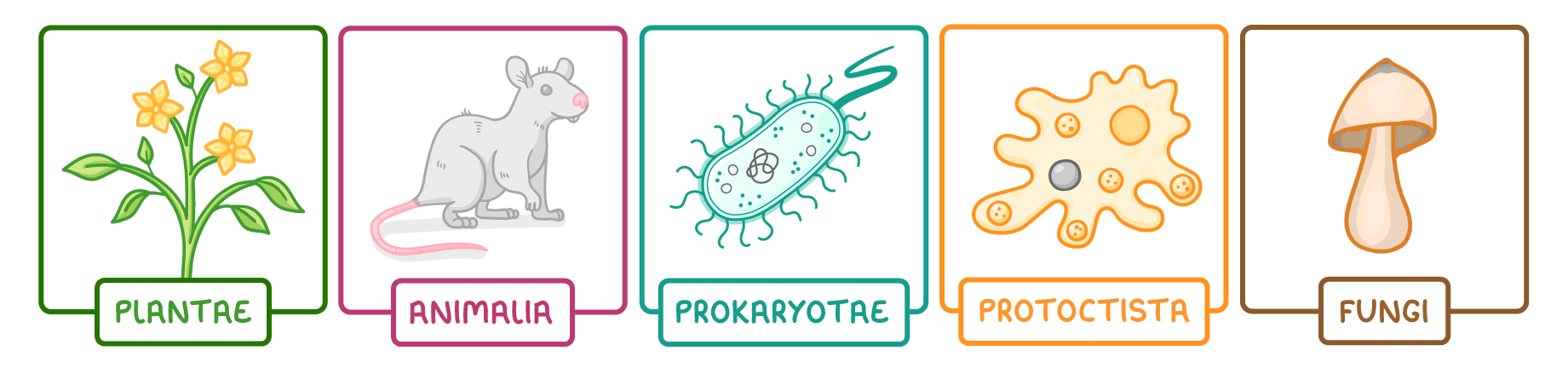
- Above these familiar groups, one widely used scheme places every organism into one of five large groups called kingdoms.
- The five kingdoms are:
- Animal kingdom (Animalia)
- Plant kingdom (Plantae)
- Fungus kingdom (Fungi)
- Prokaryote kingdom (Prokaryotae) - single-celled organisms without a nucleus
- Protoctist kingdom (Protoctista)
- Each kingdom is subdivided into smaller and smaller groups whose members share more and more features, until the smallest groups each contain only a single type of organism.
- This is the top-level framework of the classification system: an organism is first assigned to a kingdom, then placed into the finer groups within it.
TermDefinition
Evolutionary treeA diagram that shows how different species and groups are related through common ancestors.
Binomial systemAn internationally agreed system that gives each organism a two-part scientific name made up of its genus and species.
SpeciesA group of similar organisms that can reproduce with one another to produce fertile offspring.
InvertebrateAn animal without a backbone.
VertebrateAn animal that has a backbone and an internal skeleton.