1.4 - Animal & Plant Groups
The main groups of vertebrates
- Vertebrates are animals that have a backbone and an internal skeleton.
- They are divided into five main groups: mammals, birds, reptiles, fish, and amphibians.
- Each group is recognised by a set of shared features - the key ones being body covering, how they breathe, whether they're warm- or cold-blooded, and how they reproduce.
- Warm-blooded - The animal keeps a constant body temperature.
- Cold-blooded - The animal cannot keep a constant body temperature on its own.
Features of the five groups
| Group | Body covering | Breathing | Body temperature | Reproduction |
|---|---|---|---|---|
| Mammals | Hair or fur; sweat glands in skin; external ears | Lungs | Warm-blooded (constant body temperature) | Most give birth to live young (a few lay eggs); females feed young on milk from mammary glands |
| Birds | Feathers, scaly feet; wings (most can fly); beak for feeding | Lungs | Warm-blooded | Lay eggs |
| Reptiles | Dry, scaly skin (stops water loss); mostly live on land | Lungs | Cold-blooded (can't keep a constant body temperature alone) | Most lay soft-shelled eggs; some give birth to live young |
| Fish | Scales; fins for swimming; live in water | Gills | Cold-blooded | Most lay eggs, fertilised externally |
| Amphibians | Smooth, moist, permeable skin; live on land and in water | Skin (can breathe through it); adults usually have lungs, some young have gills | Cold-blooded | Most lay eggs in water, fertilised externally |
The main groups of arthropods
- Arthropods are invertebrates - animals without a backbone.
- They all share two features:
- An exoskeleton - a hard skeleton on the outside of the body
- A segmented body made of repeating parts
- They're split into four main groups, told apart mainly by the number of legs and the number of body parts: myriapods, insects, arachnids, and crustaceans.
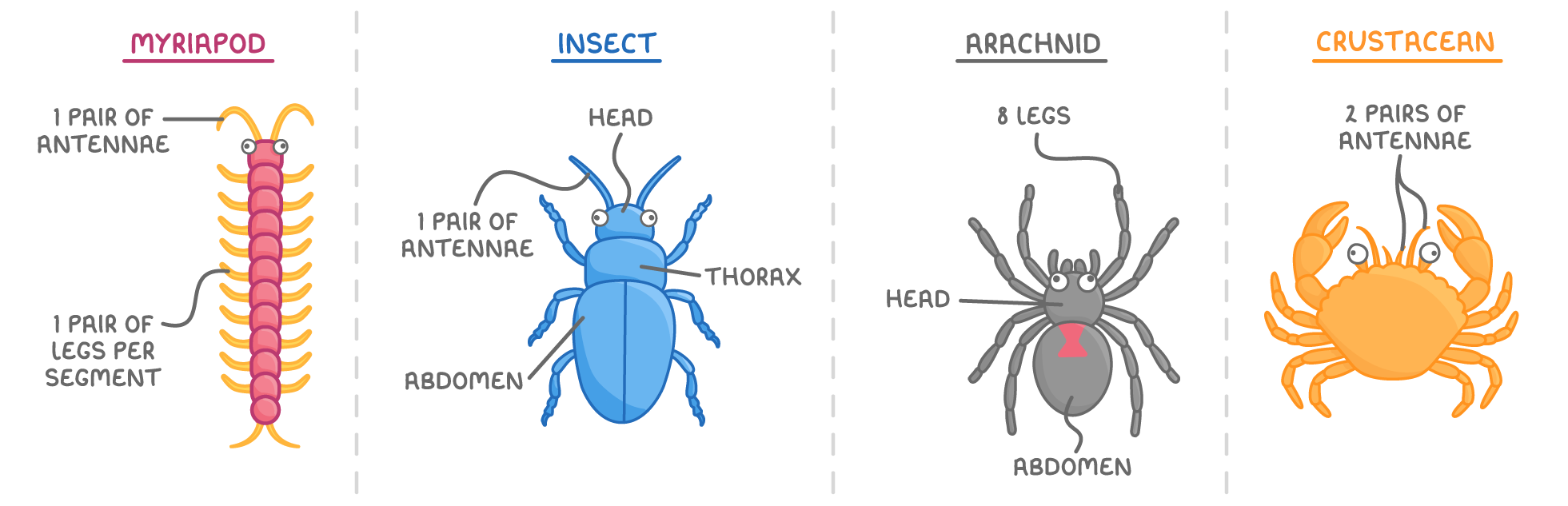
The four groups compared
| Group | Body parts | Legs | Antennae | Wings | Examples |
|---|---|---|---|---|---|
| Myriapods | Long body of many segments | Many in total - every segment carries legs | One pair | - | Centipedes, millipedes |
| Insects | Three - head, thorax, abdomen | Three pairs (six) | One pair | Usually present | Beetles, ants, bees, butterflies |
| Arachnids | Two - combined head and thorax, plus abdomen | Four pairs (eight) | None | None | Spiders, scorpions, mites |
| Crustaceans | - | Five or more pairs (ten or more), jointed, some branching into two at the ends | Two pairs | None | Crabs, lobsters, shrimps, woodlice |
Crustaceans mostly live in water.
Groups within the plant kingdom
- The plant kingdom can be divided into groups according to how the plants reproduce.
- Two of these groups are the ferns and the flowering plants.
Ferns
- Non-flowering plants - they do not produce flowers or seeds.
- Reproduce using spores instead.
- Their leaves are called fronds.
Flowering plants
- Reproduce using flowers and seeds.
- Divided into two further groups based on the number of cotyledons - a structure in the plant embryo that usually forms the plant's first leaf.
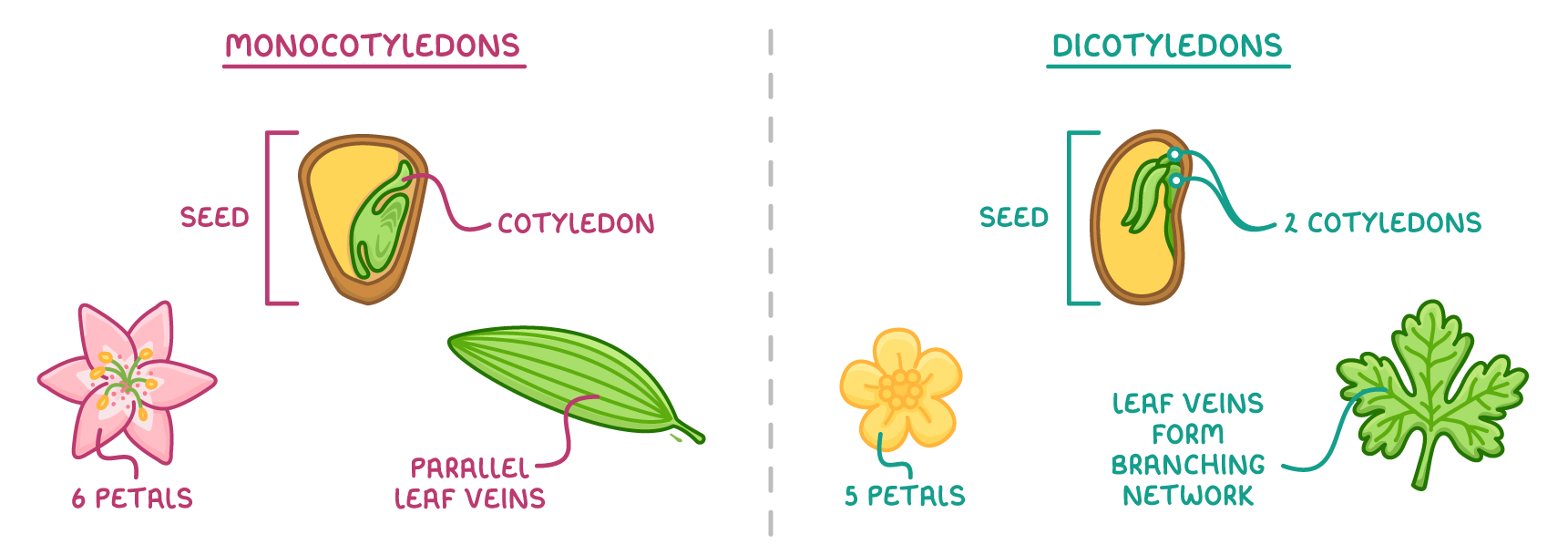
| Feature | Monocotyledons | Dicotyledons |
|---|---|---|
| Cotyledons | One | Two |
| Flower parts (e.g. petals) | Usually in multiples of three | Usually in multiples of four or five |
| Leaf veins | Run parallel to one another | Form a branching network |
| Example | Lily (six petals) | Buttercup (five petals) |
TermDefinition
VertebrateAn animal that has a backbone and an internal skeleton.
Warm-bloodedDescribes an animal that keeps a constant body temperature.
Cold-bloodedDescribes an animal that cannot keep a constant body temperature on its own.
InvertebrateAn animal without a backbone.
ArthropodAn invertebrate with jointed legs, a hard exoskeleton and a segmented body.
ExoskeletonA hard skeleton on the outside of the body.
MyriapodAn arthropod with a long body of many segments, most of which carry legs.
InsectAn arthropod with three body parts and three pairs of legs.
ArachnidAn arthropod with two body parts and four pairs of legs.
CrustaceanAn arthropod with two pairs of antennae and jointed legs. Most crustaceans live in water.
FrondThe leaf of a fern.
CotyledonA structure in a plant embryo that usually forms the plant's first leaf.
MonocotyledonA flowering plant with one cotyledon, flower parts in multiples of three, and parallel leaf veins.
DicotyledonA flowering plant with two cotyledons, flower parts in multiples of four or five, and a branching network of leaf veins.