18.3 - Adaptations
Adaptations and their types
- An adaptation (or adaptive feature) is an inherited characteristic that helps an organism survive and reproduce in the environment where it normally lives.
- Because adaptations are inherited, they're passed on from parents to offspring.
- This means life can exist in a huge range of environments, from freezing poles to hot deserts.
- Adaptations are usually grouped into types.
Structural adaptations
- Also called morphological adaptations - features of an organism's body structure, such as its shape, size or colour.
- Example: the Arctic fox has white fur, so it's camouflaged against the snow. This helps it avoid predators and creep up on prey.
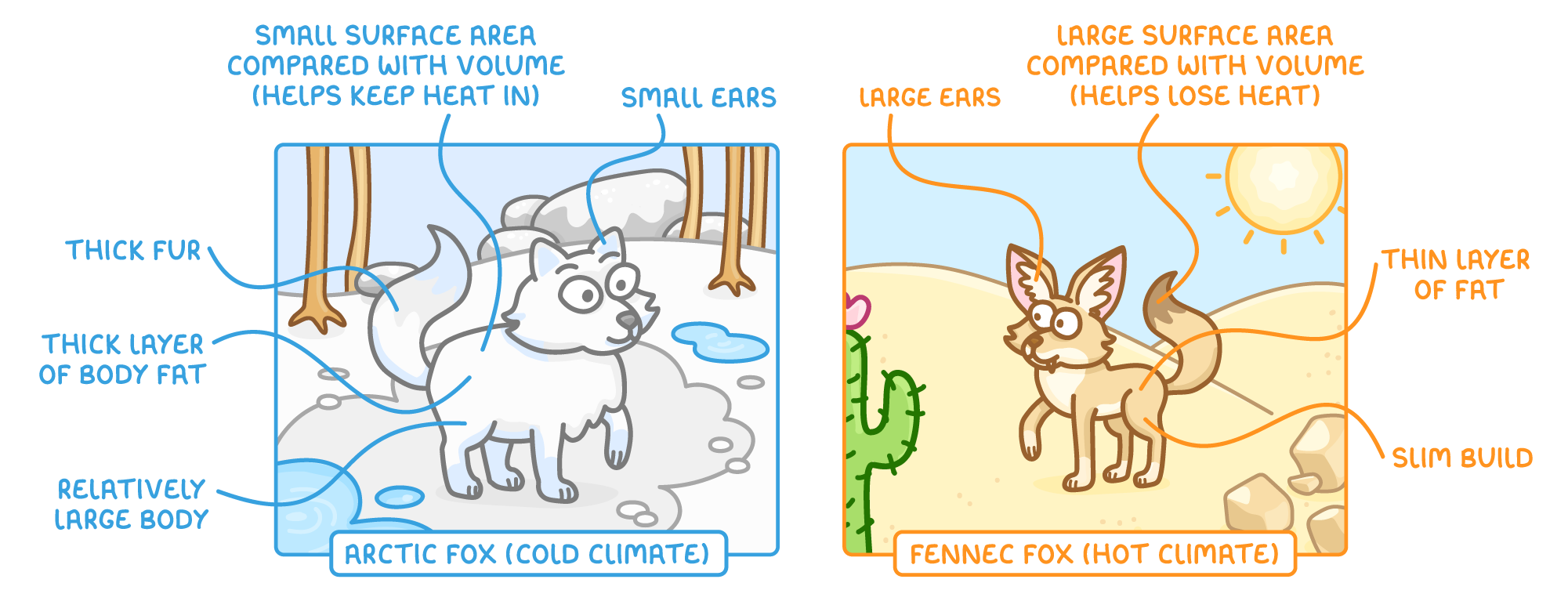
Animals in cold and hot places have contrasting features linked to keeping or losing heat:
| Cold-climate animals (e.g. Arctic fox, whale) | Hot-climate animals (e.g. fennec fox) |
|---|---|
| Thick layer of body fat or blubber | Thin layer of body fat |
| Thick fur | Large ears |
| Relatively large body, rounded compact shape, small features (e.g. small ears) | Slim build |
| Small surface area compared with volume - helps keep heat in | Large surface area compared with volume - helps lose heat |
Behavioural adaptations
- The ways in which an organism behaves.
- Living in groups - Antelope live in groups, so more eyes watch for predators, raising each individual's chance of survival.
- Migration - Many birds, such as swallows, migrate to warmer places in winter to avoid the cold and the shortage of food.
Working out an organism's adaptations
You can work out an organism's likely adaptations by thinking about:
- The environment it lives in - hot or cold, wet or dry, in water or on land.
- How it interacts with other organisms - for example, whether it needs to catch prey or escape from predators.
Plant adaptations - Xerophytes and hydrophytes
- Adaptation is the process by which, through natural selection acting over many generations, a population becomes more suited to its environment.
- The features this produces are especially clear in plants, where some species are adapted to dry conditions and others to living in water:
- Xerophyte - A plant adapted to live in dry conditions
- Hydrophyte - A plant adapted to live in water
Xerophytes - Marram grass
Marram grass grows on sand dunes and is a xerophyte. Its adaptations reduce the amount of water it loses by transpiration (the evaporation of water from the leaves):
- Sunken stomata - Stomata sit in pits in the leaf surface, surrounded by hairs. Both the pits and the hairs trap a layer of humid air close to the surface, slowing transpiration and reducing water loss.
- Rolled leaves - The leaves roll up, which also traps humid air and cuts water loss further.
- Thick, waxy layer - The epidermis (the outer layer of the leaf) is covered by a thick, waxy layer that reduces water loss by evaporation.
Hydrophytes - The water lily
- Large air spaces - These are found in the leaves and keep them buoyant, so they float on the surface where they are exposed to the most light.
- Stomata on the upper surface - Stomata are usually only on the upper surface of the floating leaves, the surface in contact with the air, so gas exchange is as efficient as possible.
- Flexible stems - These help stop the stems being damaged by water currents.
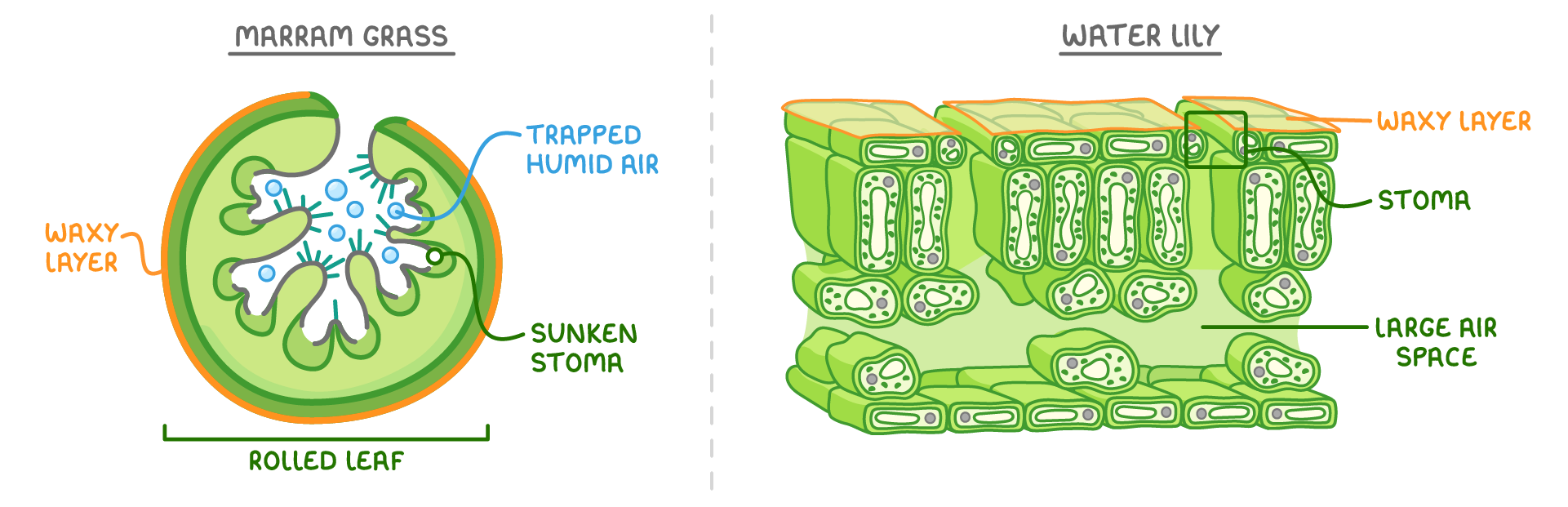
Cross sections through a marram grass leaf and a water lily leaf.
TermDefinition
AdaptationAn inherited characteristic that helps an organism survive and reproduce in the environment where it normally lives.
Adaptation (process)The process in which a population becomes better suited to its environment over many generations, as a result of natural selection.
XerophyteA plant adapted to survive in very dry conditions.
HydrophyteA plant adapted to live in water.