18.4 - Natural Selection
Natural selection
- Within any population, individuals show genetic variation - they have different combinations of alleles (different versions of their genes).
- New alleles arise by mutation. Occasionally a new allele gives an individual a characteristic that makes it better adapted to its environment.
The struggle for survival
- Organisms tend to produce more offspring than the environment can support.
- Resources such as food, water, space, and mates are limited, so not all offspring survive - individuals compete with one another and also face pressures such as predation and disease.
- These environmental factors that decide which individuals survive are called selection pressures, and the result is a struggle for survival.
How natural selection works
- Individuals whose characteristics make them better adapted to the conditions have a better chance of surviving the struggle.
- Because they are more likely to survive, they are also more likely to reproduce successfully, passing on the alleles for their helpful characteristics to the next generation.
- Less well-adapted individuals are less likely to survive and reproduce, so they pass on their alleles less often.
- This process - better-adapted individuals surviving and reproducing more - is called natural selection, sometimes described as "survival of the fittest".
- Over many generations, alleles for beneficial characteristics become more common while less helpful ones become rarer, so the characteristics of the population gradually change.
The three essential parts
- Variation between the phenotypes, or traits, in a population
- Differential survival of the better-adapted individuals
- Differential reproductive success that passes their alleles on
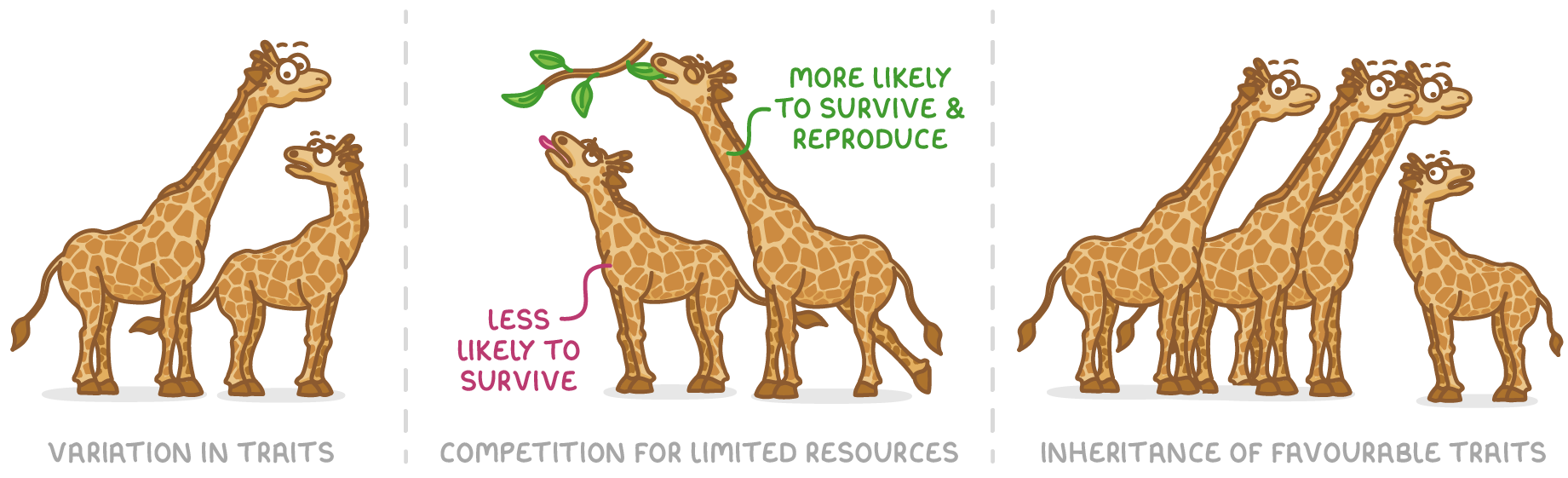
Giraffes with longer necks reach more food, survive, and pass on their alleles.
Example - Fast-running grey squirrels
- In a population of grey squirrels, some can run faster than others.
- When predators are a selection pressure, the faster squirrels are more likely to escape, survive, and breed.
- The alleles for fast running are passed on more often and become more common in later generations.
TermDefinition
Natural selectionThe process in which individuals with characteristics best suited to their environment are more likely to survive, breed, and pass on their genes.
Selection pressureAn environmental factor that affects an individual's chance of surviving and reproducing.