3.8 - Operant Conditioning
The fundamental principles of operant conditioning
Operant conditioning is a learning process through which behaviors are influenced by their consequences. Unlike classical conditioning, which focuses on involuntary responses, operant conditioning deals with voluntary behaviors and how they can be modified by what happens after them.
The Law of Effect
At the core of operant conditioning is the Law of Effect, proposed by Edward Thorndike. This principle states that behaviors followed by positive or rewarding outcomes are more likely to be repeated, while behaviors followed by negative or unpleasant outcomes are less likely to be repeated.
How the Law of Effect works:
- Reinforcing consequences - Behaviors followed by positive or rewarding outcomes are more likely to be repeated.
- Punishing consequences - Behaviors followed by negative or unpleasant outcomes are less likely to be repeated.
This means that the consequences of an action play a crucial role in determining whether that action will occur again in the future. For example, if a child cleans their room and receives praise, they are more likely to clean it again to gain that positive feedback.
The role of reinforcement and punishment in shaping behavior
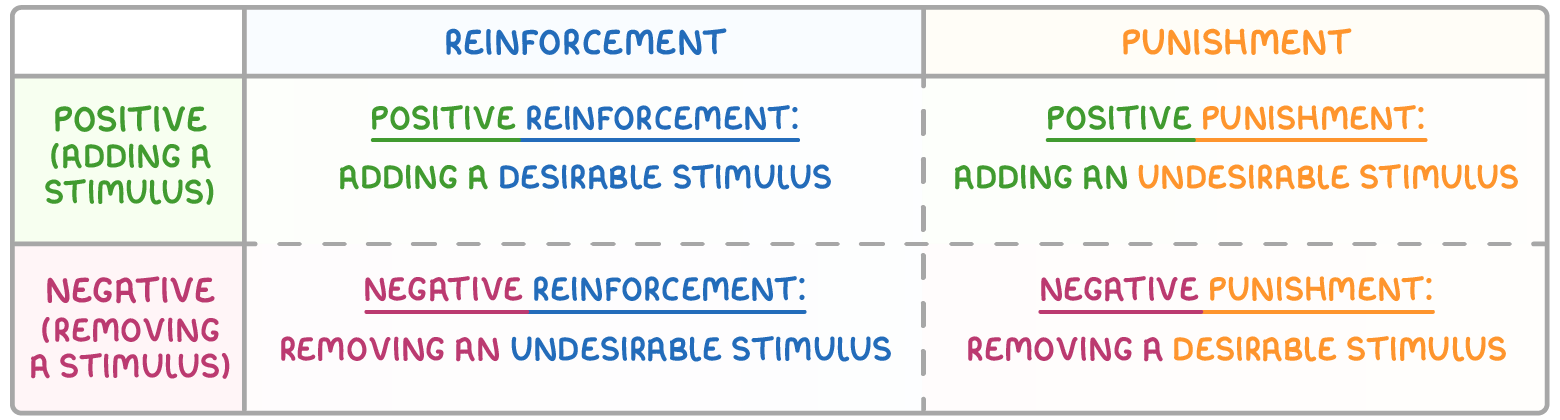
In operant conditioning, consequences are categorized into reinforcement and punishment, each of which can be positive or negative. These mechanisms are essential tools for modifying behavior.
Types of consequences
- Reinforcement - Increases the likelihood of a behavior occurring again.
- Positive reinforcement - Adding a desirable stimulus after a behavior (e.g., giving a treat for completing homework).
- Negative reinforcement - Removing an undesirable stimulus after a behavior (e.g., turning off a loud alarm when a task is done, encouraging timely completion).
- Punishment - Decreases the likelihood of a behavior occurring again.
- Positive punishment - Adding an undesirable stimulus after a behavior (e.g., assigning extra chores for misbehaving).
- Negative punishment - Removing a desirable stimulus after a behavior (e.g., taking away screen time for breaking rules).
These consequences help individuals learn which behaviors are beneficial and which are not, guiding their actions over time.
Primary and secondary reinforcers, discrimination, and generalization
Reinforcement isn't just a simple reward; it can come in different forms and be applied in complex ways. Understanding these nuances helps explain how behaviors are learned and maintained.
Types of reinforcers
- Primary reinforcers - Naturally satisfying stimuli that meet basic biological needs, such as food, water, or sleep. These don't require learning to be effective.
- Secondary reinforcers - Stimuli that become rewarding through association with primary reinforcers, like money or praise. These gain value through experience.
Behavioral nuances in reinforcement
- Discrimination - The ability to distinguish between similar stimuli and respond only to the one associated with reinforcement. For instance, a dog may learn to sit only when a specific person gives the command.
- Generalization - Responding to stimuli similar to the one associated with reinforcement. For example, a child might say "please" to different adults after being rewarded for politeness with one caregiver.
These processes show how learning can be specific or broadly applied, depending on the context and experience.
The concept of shaping and limitations like instinctive drift
Shaping is a powerful technique in operant conditioning used to teach complex behaviors. However, there are natural limitations to what can be shaped.
Shaping
Shaping involves rewarding successive approximations of a desired behavior. This means breaking down a complex action into smaller, achievable steps and reinforcing each step until the final behavior is reached.
How shaping works:
- Step-by-step process - For example, to teach a dog to roll over, you might first reward it for lying down, then for turning to one side, and finally for completing the full roll.
- Gradual progression - Each small success is reinforced, guiding the learner closer to the ultimate goal.
Instinctive drift
Not all behaviors can be shaped equally due to biological constraints. Instinctive drift refers to the tendency of an organism to revert to instinctual behaviors, even when trained otherwise.
Limitations of shaping:
- Biological predispositions - Research with animals shows that certain behaviors tied to natural instincts can override learned responses. For instance, pigs trained to drop coins into a box may start rooting the coins with their snouts, a natural foraging behavior, instead of following the trained action.
- Impact on training - This demonstrates that operant conditioning must sometimes work within the limits of an organism's innate tendencies.
Superstitious behavior and learned helplessness
Operant conditioning can lead to unexpected behavioral outcomes when consequences are misunderstood or uncontrollable. Two key phenomena illustrate these effects.
Superstitious behavior
Superstitious behavior occurs when an individual associates a behavior with a consequence, even though the two are unrelated.
Characteristics of superstitious behavior:
- Accidental reinforcement - For example, an athlete might wear a "lucky" shirt after winning a game while wearing it, believing it influences success, even though the shirt has no real impact.
- False associations - This happens because a behavior is coincidentally followed by reinforcement, leading to a mistaken belief in cause and effect.
Learned helplessness
Learned helplessness develops when an organism repeatedly experiences aversive consequences they cannot control, leading them to stop trying to escape or improve their situation.
Effects of learned helplessness:
- Loss of control - For instance, if a student fails multiple tests despite studying hard and believes they can't change the outcome, they may stop studying altogether.
- Impact on mental processes - This concept, studied extensively by Martin Seligman, shows how perceived helplessness can contribute to depression and passivity in both animals and humans.
The impact of reinforcement schedules on behavior strength
The timing and frequency of reinforcement significantly affect how strongly a behavior is learned and maintained. Reinforcement schedules determine when a reward is given, influencing the pattern and persistence of responses.
Types of reinforcement schedules
- Continuous reinforcement - Reinforcement is provided after every correct response. This leads to rapid learning but also quick extinction if reinforcement stops (e.g., a vending machine dispensing a snack every time money is inserted).
- Partial reinforcement - Reinforcement is provided only some of the time, leading to slower learning but greater resistance to extinction. There are four subtypes based on time or number of responses:
- Fixed-interval (FI) - Reinforcement after a set time period (e.g., a weekly paycheck), producing a scalloped graph with responses increasing near the reinforcement time.
- Variable-interval (VI) - Reinforcement after varying time periods (e.g., checking email for a reply), leading to steady, moderate responding.
- Fixed-ratio (FR) - Reinforcement after a set number of responses (e.g., a factory worker paid per 10 items produced), resulting in high, consistent responding with pauses after reinforcement.
- Variable-ratio (VR) - Reinforcement after a varying number of responses (e.g., slot machines), producing very high, persistent responding due to unpredictability.
Effects of schedules on behavior
Each schedule creates distinct patterns of behavior, observable through graphs. Partial reinforcement schedules, especially variable-ratio ones, tend to create the strongest and most enduring behaviors because the unpredictability keeps the learner engaged, hoping for the next reward.