3.9 - Social, Cognitive & Neurological Factors in Learning
Social learning theory and behavior
Social learning theory is a framework that explains how individuals acquire behaviors and mental processes through observing others rather than through direct experience. This theory highlights the importance of social interactions in shaping how we think and act, showing that personal consequences are not always necessary for learning to occur.
Core principles of social learning theory
- Observation as learning - Learning happens by watching others, known as models, without needing to experience the behavior or its outcomes personally.
- Role of models - Models are individuals whose behaviors are observed and imitated. This can include parents, peers, or even characters in media.
- Similarity matters - The likelihood of adopting a behavior increases when the model is similar to the observer in terms of age, gender, or other characteristics. This similarity fosters a sense of relatability and relevance.
- Application to mental processes - Observing models not only influences actions but also shapes attitudes, beliefs, and expectations about certain behaviors.
This theory demonstrates that much of human behavior is learned socially, through watching and mimicking others in our environment, rather than solely through trial and error.
Vicarious conditioning in social learning
A key component of social learning theory is vicarious conditioning, which refers to learning by observing the consequences of someone else's behavior. This process allows individuals to acquire new behaviors or modify existing ones without directly experiencing rewards or punishments themselves.
How vicarious conditioning works
- Observation of consequences - An individual watches a model experience a positive or negative outcome after a behavior.
- Learning without direct experience - The observer learns to associate the behavior with the consequence, influencing their likelihood of performing that behavior.
- Examples in everyday life - Seeing a peer get praised for helping others might encourage similar helpful behavior, or witnessing someone being scolded for tardiness might deter lateness.
This mechanism shows how social contexts can powerfully shape behavior through indirect experiences, expanding the ways in which learning can occur beyond personal interaction with the environment.
Cognitive factors in learning: insight learning
Cognitive factors play a significant role in learning, focusing on mental processes rather than just behavioral responses. One important concept is insight learning, a type of problem-solving that happens suddenly without relying on prior associations, consequences, or observable models.
Understanding insight learning
- Sudden realization - Insight learning occurs when a solution to a problem emerges abruptly, often described as an "aha!" moment, without gradual trial and error.
- Mental restructuring - This process involves mentally reorganizing information to see a problem in a new way, leading to a novel solution.
- Impact on behavior - Once the insight is gained, it can lead to immediate changes in behavior as the individual applies the new understanding to similar situations.
- Classic example - Wolfgang Köhler's experiments with chimpanzees demonstrated insight learning when a chimp suddenly used a stick to reach a banana outside its cage, solving the problem without prior training.
Insight learning underscores the role of cognitive processes in behavior, showing that learning is not always a result of external stimuli but can stem from internal mental breakthroughs.
Cognitive factors in learning: latent learning
Another cognitive aspect of learning is latent learning, which refers to knowledge acquired without immediate demonstration or reinforcement. This type of learning remains hidden until a situation arises where it can be applied, revealing that learning occurred even without visible behavior change at the time.
Key features of latent learning
- Learning without reinforcement - Information or skills are gained without any apparent reward or punishment at the time of learning.
- Delayed demonstration - The learned behavior or knowledge becomes evident only when there is a reason or motivation to use it.
- Significance for mental processes - Latent learning shows that the mind can store information passively, ready to be activated when needed, highlighting the complexity of cognitive storage and retrieval.
This concept challenges traditional views of learning that emphasize immediate reinforcement, proving that the brain can absorb and retain information for future use.
Cognitive maps and latent learning
Latent learning is often demonstrated through the use of cognitive maps, which are mental representations of physical spaces or environments. These maps allow individuals to navigate or solve problems based on previously learned but unexpressed knowledge.
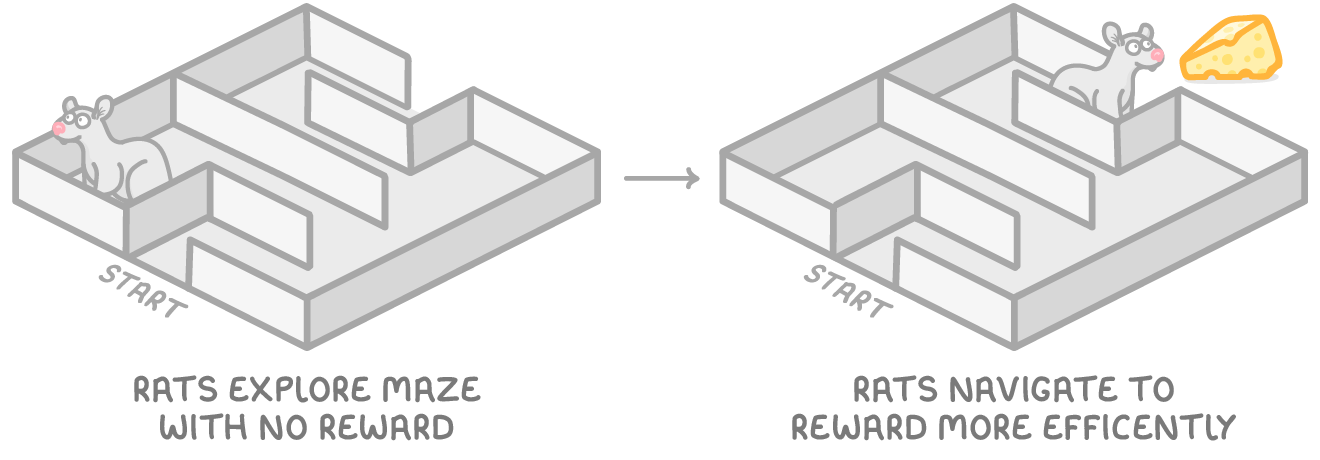
How cognitive maps illustrate latent learning
- Mental spatial representation - A cognitive map is a mental layout of an area, such as a city or maze, that an individual forms through exploration or observation, even without immediate need or reward.
- Evidence from research - Edward Tolman's experiments with rats in mazes showed that rats could learn the layout of a maze without food rewards. When a reward was later introduced, they navigated the maze efficiently, demonstrating latent learning through their cognitive map.
- Application to behavior - Cognitive maps enable quick adaptation to environments when circumstances change, such as finding a new route when a familiar path is blocked.
This connection between cognitive maps and latent learning illustrates how mental processes underpin behaviors that may not be immediately observable, reinforcing the importance of cognition in understanding learning.