3.4 - Cognitive Development Across the Lifespan
Piaget's theory of cognitive development: an overview
Cognitive development refers to the growth and change in mental processes like thinking, reasoning, and problem-solving over a person's lifetime. One of the most influential theories in this area comes from Jean Piaget, a Swiss psychologist who proposed that children progress through distinct stages of cognitive development. Each stage represents a qualitative shift in how children think and understand the world, building on previous knowledge and abilities.
Piaget's theory emphasizes that cognitive development is not just about acquiring more information but about fundamental changes in the way thoughts are structured. This progression happens through active interaction with the environment, leading to the development of mental frameworks that shape behavior and mental processes.
Key processes in Piaget's theory: schemas, assimilation, and accommodation
Before diving into the specific stages, it's essential to understand the foundational concepts Piaget used to explain how cognitive development occurs. These processes describe how children build and adapt their understanding of the world.
Schemas
Schemas are mental structures or frameworks that organize knowledge and guide how we interpret and interact with the world. For example, a child might have a schema for "dog" that includes four legs and barking.
Assimilation and accommodation
The two key processes that drive cognitive development:
- Assimilation - This is the process of incorporating new information into existing schemas. If a child sees a new breed of dog, they assimilate it into their "dog" schema without changing the framework.
- Accommodation - When new information doesn't fit an existing schema, the schema must be modified or a new one created. For instance, if a child encounters a wolf and realizes it doesn't fully match their "dog" schema, they might create a new schema for "wolf" or adjust their understanding of dogs.
These processes often occur together, reflecting a balance between fitting the world into our existing ideas (assimilation) and changing our ideas to fit the world (accommodation). This dynamic interaction drives cognitive development through continuous and discontinuous changes.
Piaget's stages of cognitive development
Piaget identified four distinct stages of cognitive development, each characterized by specific abilities and limitations. These stages are sequential, meaning children must pass through each one in order as they grow.
Stage 1: Sensorimotor stage (infancy through toddlerhood)
This stage spans from birth to about 2 years of age. During this period, infants and toddlers learn about the world primarily through their senses and physical actions.
Key characteristics:
- Key focus - Learning through sensory experiences (seeing, touching, tasting) and motor actions (grasping, crawling).
- Major milestone: Object permanence - This is the understanding that objects continue to exist even when they are out of sight. For example, a child learns that a toy hidden under a blanket is still there, even if they can't see it. This typically develops toward the end of this stage.
At this stage, thinking is tied to immediate experiences, and children lack the ability to represent objects or events mentally in a symbolic way.
Stage 2: Preoperational stage (toddlerhood through early childhood)
From about 2 to 7 years old, children enter the preoperational stage, where they begin to use language and mental symbols to represent the world. However, their thinking is still limited in several key ways.
Key abilities:
- Children become proficient in using symbols, such as words and images, to think about things not physically present.
- They also engage in pretend play, like imagining a stick is a sword.
- Children start to develop theory of mind - an understanding that others have thoughts, feelings, and perspectives different from their own. This is a critical step in social development.
Limitations in thinking:
- Egocentrism - The inability to see things from another's perspective. A child might assume everyone sees a toy the same way they do, even if it's positioned differently for others.
- Animism - The belief that inanimate objects have feelings or intentions, such as thinking a table "hurts" when bumped into.
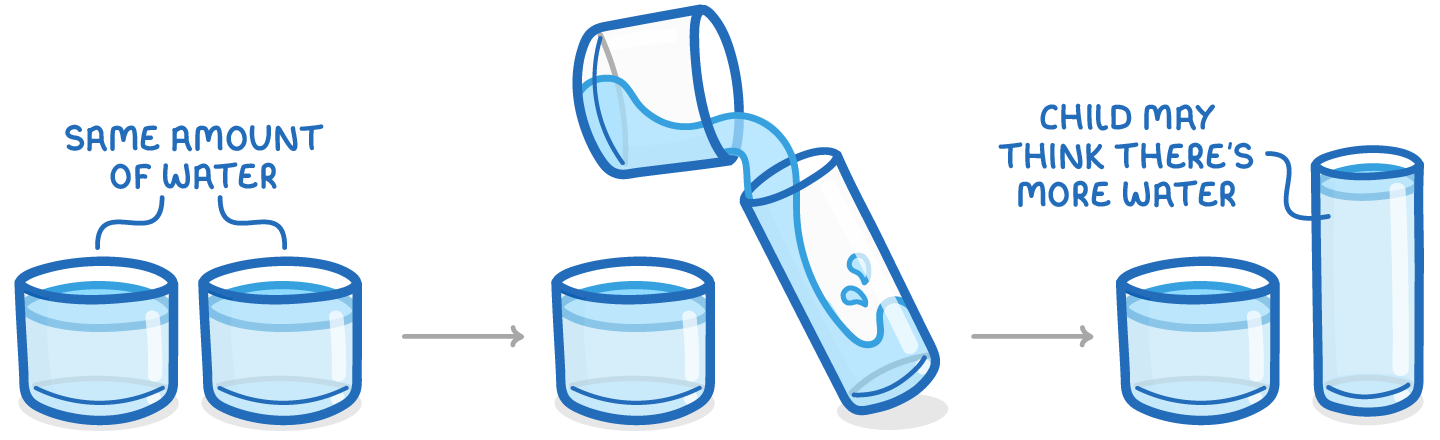
- Lack of conservation - The inability to understand that quantity remains the same despite changes in appearance. For example, if water is poured from a short, wide glass into a tall, thin one, a child might think there's more water in the tall glass.
- Lack of reversibility - The inability to mentally reverse actions. A child might not grasp that the water can be poured back into the original glass to look the same again.
This stage is defined more by what children cannot yet do than by advanced logical reasoning.
Stage 3: Concrete operational stage (early through late childhood)
Spanning from about 7 to 11 years, the concrete operational stage marks a significant leap in logical thinking, though it remains tied to concrete, tangible experiences.
Key abilities:
- Children can now correct many of the cognitive errors from the preoperational stage.
- They understand conservation (quantity doesn't change with appearance) and reversibility (actions can be undone mentally).
- Thinking becomes more logical and straightforward, grounded in real-world experiences. For example, they can organize objects by size or color systematically.
Limitations:
- Children struggle with abstract or hypothetical thinking.
- They find it hard to think systematically about possibilities that aren't directly observable.
This stage reflects a growing ability to reason logically about the physical world, setting the foundation for more complex thought processes.
Stage 4: Formal operational stage (late childhood through adulthood)
From around 12 years onward, individuals enter the formal operational stage, where thinking becomes abstract and hypothetical. This stage represents the pinnacle of cognitive development in Piaget's theory.
Key characteristics:
- Key abilities - People gain the capacity to think about abstract concepts (like justice or infinity) and hypothetical scenarios (like "what if" situations). They can test hypotheses systematically and consider multiple perspectives or outcomes.
- Not universal - Piaget believed that not everyone reaches this stage or fully develops formal operational thinking. Some individuals may remain tied to concrete thinking even in adulthood, depending on their experiences and education.
This stage allows for advanced problem-solving and reasoning, essential for complex tasks in science, philosophy, and everyday decision-making.
Vygotsky's sociocultural theory of cognitive development
While Piaget focused on individual discovery, Lev Vygotsky, a Russian psychologist, proposed a different perspective, emphasizing the role of social interaction in cognitive development. Vygotsky's theory highlights how learning occurs within cultural and social contexts.
Core ideas of Vygotsky's theory
- Social learning - Children learn through interactions with more knowledgeable individuals, such as parents, teachers, or peers. These interactions shape their understanding and skills.
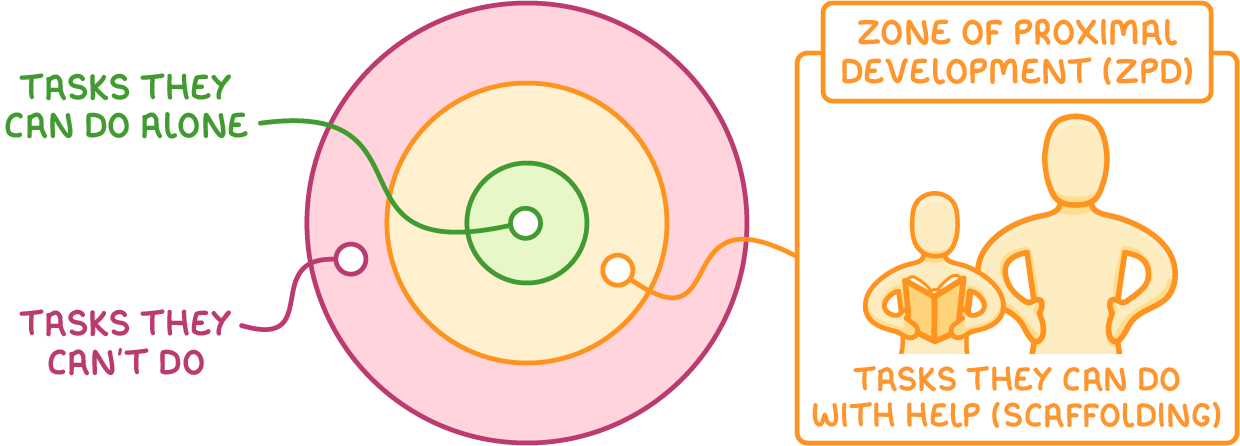
- Scaffolding - This is the support provided by a more skilled person to help a child achieve tasks they couldn't do alone. Over time, this support is gradually reduced as the child becomes more competent.
- Zone of proximal development (ZPD) - This refers to the range of tasks a child can perform with guidance but not independently. Learning is most effective within this zone, as it stretches the child's abilities just beyond their current level. For example, a child might not solve a math problem alone but can do so with hints from a teacher.
Vygotsky's theory underscores that cognitive development is deeply tied to cultural tools (like language) and social relationships, contrasting with Piaget's focus on individual exploration.
Cognitive changes in adulthood: intelligence across the lifespan
Cognitive abilities continue to evolve beyond childhood, with distinct patterns emerging in adulthood. Unlike the rapid, stage-based changes in childhood, adult cognitive development involves more gradual shifts in specific types of intelligence.
Types of intelligence and their trajectories
- Crystallized intelligence - This refers to accumulated knowledge and skills, such as vocabulary, cultural understanding, and expertise in specific areas. It tends to remain stable or even improve with age as adults gain more life experience.
- Fluid intelligence - This involves the ability to solve novel problems, think abstractly, and adapt to new situations. It often declines with age, particularly in later adulthood, due to changes in processing speed and working memory.
These patterns show that while some cognitive abilities wane, others can persist or grow, reflecting the complexity of mental processes in adulthood.
Cognitive disorders in adults: understanding dementia
As adults age, some may experience significant cognitive decline beyond typical aging. One major concern is the development of cognitive disorders that impact daily functioning and quality of life.
What is dementia?
Dementia is a general term for a decline in cognitive ability severe enough to interfere with daily life. It is not a specific disease but a syndrome caused by various underlying conditions, such as Alzheimer's disease.
Symptoms and impact
- Common symptoms - Memory loss, difficulty with problem-solving, confusion with time or place, and challenges in communication. These impairments often progress over time.
- Impact on behavior and mental processes - Dementia can alter personality, cause mood swings, and impair decision-making, significantly affecting an individual's independence and relationships.
Understanding dementia is crucial as it highlights how cognitive development can be disrupted in later life, contrasting with the growth and stability seen in earlier stages.