3.5 - Communication & Language Development
Key components of language and communication
Language is a complex system that allows humans to share thoughts, emotions, and ideas through a mutually agreed-upon set of symbols. This system is essential for communication and plays a critical role in shaping behavior and mental processes.
Core elements of language
- Phonemes - The smallest units of sound in a language. For example, the word "cat" consists of three phonemes: /k/, /æ/, and /t/.
- Morphemes - The smallest units of meaning in a language. These can be whole words like "cat" or prefixes/suffixes like "un-" in "unhappy."
- Semantics - The meaning conveyed by words and combinations of words. Semantics allows us to understand the difference between "I love you" and "I hate you."
- Grammar - The set of rules that dictate the structure of language, including how words are formed and arranged.
- Syntax - A subset of grammar focusing on the arrangement of words to form meaningful sentences. For instance, "The dog chased the cat" has a different meaning from "The cat chased the dog" due to syntax.
Characteristics of language
- Shared system - Language is a collective agreement among a group of people to use specific symbols and rules for communication.
- Arbitrary symbols - The symbols used in language (words and sounds) have no inherent connection to the objects or ideas they represent; their meaning is based on cultural consensus.
- Rule-governed - Language follows structured rules (like grammar and syntax) to ensure clarity and mutual understanding.
- Generative - Language allows for creativity, enabling speakers to produce an infinite number of unique sentences and ideas by combining symbols in new ways.
Role of language in behavior and mental processes
Language is not just a tool for communication; it profoundly influences how we think, behave, and interact with the world. It shapes our mental processes by providing a framework for organizing and expressing thoughts.
Impact of language on behavior
- Social interaction - Language enables individuals to connect with others, form relationships, and follow social norms through verbal and written exchanges.
- Behavioral influence - The way language is used can affect actions. For example, encouraging words can motivate someone to try harder, while negative language might discourage them.
- Cultural transmission - Language passes down cultural values and behaviors across generations, shaping how individuals act within their society.
Impact of language on mental processes
- Thought organization - Language provides categories and labels that help structure thoughts, making complex ideas easier to process and remember.
- Problem-solving - Verbalizing a problem often aids in finding solutions, as it allows individuals to break down issues into manageable parts.
- Emotional expression - Language helps individuals articulate feelings, which can influence how they perceive and manage emotions, impacting mental well-being.
Stages of language development in humans
Language development is a universal process that occurs in distinct stages across all cultures. While the timeline may vary slightly, the sequence of stages remains consistent as children progress from basic sounds to complex sentences.
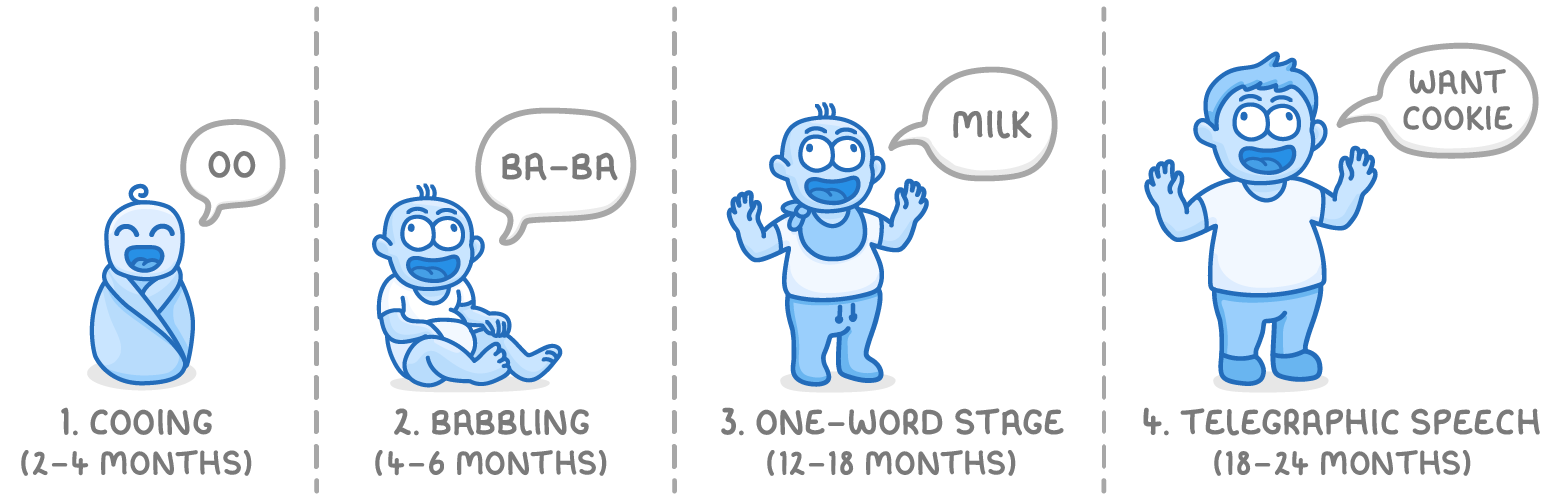
Stages of language acquisition:
- Cooing (around 2-4 months) - Infants produce soft, vowel-like sounds such as "oo" and "ah." This stage involves experimenting with vocal cords and is often a response to caregiver interactions.
- Babbling (around 4-6 months) - Babies begin to combine vowels and consonants, producing repetitive sounds like "ba-ba" or "da-da." This stage helps develop control over speech muscles and lays the foundation for meaningful words.
- One-word stage (around 12-18 months) - Children start using single words to convey whole ideas or needs, such as saying "milk" to request a drink. Vocabulary grows slowly but steadily during this period.
- Telegraphic speech (around 18-24 months) - Children begin combining two or more words into short, simple phrases that omit less critical words, like "want cookie" instead of "I want a cookie." This stage reflects an early understanding of syntax.
Common errors in language acquisition
As children learn a language, they often make predictable mistakes due to their attempts to apply rules they are still mastering. These errors provide insight into the learning process and are typically outgrown with time and exposure.
Types of language errors:
- Overgeneralization:
- Applying a language rule too broadly, resulting in incorrect usage.
- For example, a child might say "goed" instead of "went" by overapplying the regular past-tense rule of adding "-ed."
- This error shows the child is learning rules but has not yet grasped exceptions or irregular forms.
- Overextension - Using a word to refer to a broader category than it actually covers. For instance, calling all four-legged animals "dog" because the child associates the term with a familiar pet.
- Underextension - Restricting a word's meaning too narrowly, such as using "dog" only for the family pet and not for other dogs.
These errors are a natural part of language development, indicating that the child is actively trying to understand and use the rules of language.
Importance of nonverbal communication in language development
Before mastering verbal language, humans rely heavily on nonverbal cues to communicate. These early forms of interaction are crucial in the initial stages of language development and remain important even after verbal skills are acquired.
Role of nonverbal manual gestures:
- Early communication - Infants often use gestures like pointing to indicate objects or express needs before they can speak. For example, pointing at a toy can mean "I want that."
- Bridge to verbal language - Gestures help children convey meaning while their vocabulary is limited, serving as a stepping stone to forming words and sentences.
- Cultural universality - Across all cultures, nonverbal gestures play a significant role in early communication, demonstrating that humans share innate ways of expressing basic needs and intentions.
- Support for learning - Gestures often accompany early speech, reinforcing meaning. A child saying "up" while raising their arms helps caregivers understand the request to be picked up.
Nonverbal communication not only aids in early interactions but also supports the transition to formal language, highlighting the interconnected nature of different communication forms.