4.3 - Psychology of Social Situations
The impact of social situations on behavior and mental processes
Social situations play a powerful role in shaping how individuals think, feel, and act. The environment, including the people around us and the unwritten rules of society, can influence behavior in ways that might not align with personal beliefs or tendencies. This dynamic interaction between the individual and their social context is a cornerstone of social psychology.
Why social situations matter
- Contextual influence - Behavior often depends on the specific situation rather than just personal traits, as people adapt to the expectations or pressures of their surroundings.
- Mental processes - Social situations can affect emotions, decision-making, and perceptions, often without individuals being fully aware of these effects.
- Range of impact - From subtle cues to overt demands, social contexts can trigger a wide array of responses, shaping everything from daily interactions to major life choices.
Social norms and their role in shaping expectations
Social norms are the unwritten rules and expectations that guide behavior within a society. They define what is considered acceptable or appropriate in various situations, influencing how individuals act both alone and in groups.
Key aspects of social norms
- Behavioral expectations - Norms set standards for how people should behave, such as being polite in public or dressing appropriately for certain occasions.
- Roles in society - They often assign specific roles, like expecting teachers to educate or parents to nurture, which shape individual actions within those positions.
- Cultural variation - Norms differ across cultures and communities, meaning behavior considered normal in one place might be unacceptable in another.
This framework helps maintain order and predictability in social interactions, though it can sometimes pressure individuals to conform in ways that feel unnatural.
Social influence theory and types of social pressure
Social influence theory explains how individuals are swayed by others to think or behave in certain ways. This pressure can come from peers, authority figures, or societal expectations and operates through two primary mechanisms.
Types of social pressure
- Normative influence - This occurs when individuals conform to gain approval or avoid rejection from others. It's driven by a desire to fit in or be liked.
- Informational influence - This happens when individuals look to others for guidance in uncertain situations, assuming that the group possesses more accurate knowledge or expertise.
These influences highlight how social environments can shape decisions, often overriding personal judgment in favor of group consensus or perceived correctness.
Techniques and routes of persuasion
Persuasion involves using various methods to convince oneself or others to adopt specific ideas, actions, or beliefs. It's a key tool in social influence, often employed in advertising, politics, and personal interactions.
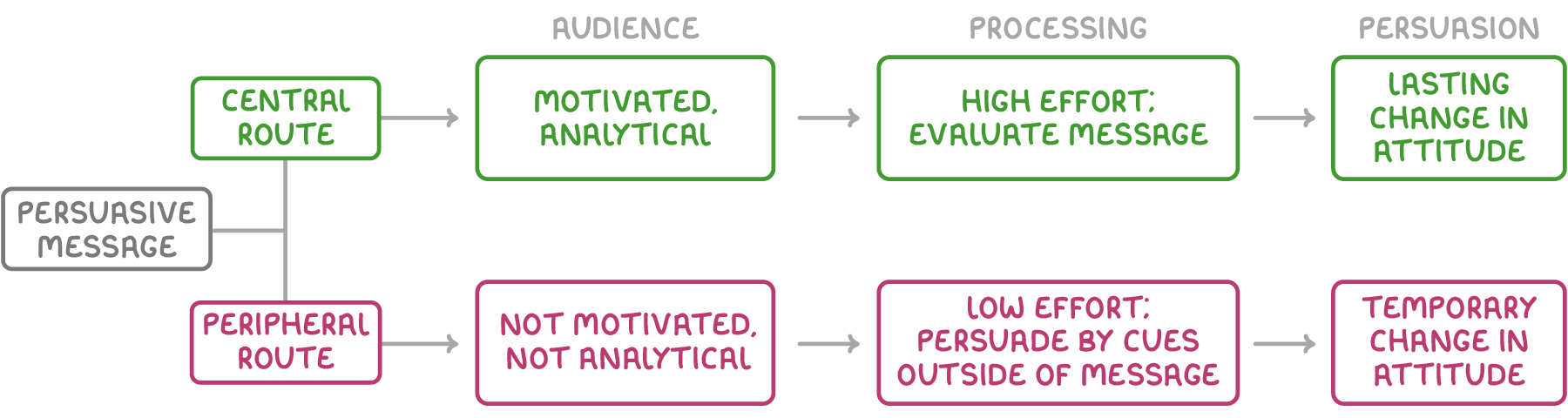
Routes to persuasion: Elaboration likelihood model
- Central route - Focuses on the content and logic of the message, engaging the audience through deep thinking and analysis. This route is effective when the audience is motivated and able to process the information through high effort, and results in a lasting change in attitude.
- Peripheral route - Relies on superficial cues like the attractiveness or credibility of the speaker rather than the message itself. An example is the halo effect, where a positive impression in one area (like physical appearance) influences opinions in unrelated areas (like intelligence), and it only results in a temporary attitude change.
Specific persuasion techniques
- Foot-in-the-door technique - Starts with a small request that is easy to agree to, followed by a larger, related request. Agreeing to the initial small ask increases the likelihood of complying with the bigger one due to a sense of commitment.
- Door-in-the-face technique - Begins with a large, often unreasonable request that is likely to be refused, followed by a smaller, more reasonable request. The contrast makes the second request seem more acceptable.
These strategies show how the framing and sequencing of information can significantly impact the success of persuasive efforts.
Research on conformity and obedience
Conformity and obedience are two powerful ways in which social situations compel individuals to align with group norms or authority directives. Research in these areas reveals the conditions under which people are most likely to comply.
Conformity
Conformity is the tendency to adjust one's behavior or thinking to match the group's standards or expectations, often without explicit instruction.
Key research - Asch's line judgment experiments:
- Studies in the 1950s showed that individuals often conform to a majority opinion even when they know it's incorrect, due to fear of standing out or being ridiculed.
- Conformity increases with group size (up to a point), unanimity of the group, and when the individual feels less confident or knowledgeable.
Obedience
Obedience involves following the direct orders or instructions of an authority figure, often overriding personal moral judgments.
Key research - Milgram's experiments:
- Experiments in the 1960s demonstrated that many people would administer what they believed were painful electric shocks to others simply because an authority figure instructed them to do so.
- Obedience is more likely when the authority figure is perceived as legitimate, when the individual feels less personal responsibility, and when the situation limits opportunities to resist.
These findings underscore the profound impact of social pressures on individual actions, often leading to behaviors that conflict with personal values.
Effects of group membership on individual behavior
Being part of a group can significantly alter how individuals behave and think. Group dynamics introduce unique phenomena that can amplify or suppress personal tendencies, depending on the context.
Key group effects on behavior
- Group polarization - When group discussions lead to more extreme decisions or attitudes than individuals would hold on their own, as like-minded members reinforce each other's views.
- Groupthink - A phenomenon where the desire for group harmony overrides critical thinking, leading to poor decision-making as dissenting opinions are suppressed.
- Diffusion of responsibility - In a group, individuals feel less accountable for actions or outcomes, often leading to inaction in emergencies because each person assumes someone else will act.
- Social loafing - The tendency for individuals to exert less effort on a task when working in a group compared to working alone, assuming others will pick up the slack.
- Deindividuation - A loss of self-awareness and personal identity in a group setting, often leading to impulsive or atypical behavior due to a sense of anonymity.
Additional group effects
- Social facilitation - The presence of others can enhance performance on simple or well-practiced tasks due to increased arousal, though it may hinder performance on complex tasks due to anxiety.
- False consensus effect - People tend to overestimate how much others share their beliefs or behaviors, assuming their own views are more common than they actually are.
These effects illustrate the complex interplay between individual identity and group influence, showing how group settings can both empower and constrain personal behavior.
Cultural influences on perception and behavior
Cultural context shapes how individuals see themselves and interact with others. Different cultural frameworks prioritize distinct values, which in turn affect social behaviors and mental processes.
Cultural phenomena affecting behavior
- Individualism - Emphasizes personal independence and self-reliance, often seen in Western cultures, where individual achievements and rights are prioritized.
- Collectivism - Focuses on group harmony and interdependence, common in many Eastern cultures, where family and community needs often take precedence over personal goals.
- Multiculturalism - Recognizes and values diverse cultural identities within a society, influencing behavior by promoting inclusivity and adaptation to varied perspectives.
These cultural lenses impact everything from decision-making to conflict resolution, highlighting the importance of understanding cultural norms in social psychology.
Prosocial behavior and altruism
Prosocial behavior refers to actions intended to benefit others, often driven by empathy or social expectations. Altruism, a subset of prosocial behavior, involves selfless acts without apparent personal gain, though its motivations are debated.
Altruism
Altruism is helping others without expecting anything in return, such as donating to charity or risking personal safety to save someone. Some researchers argue that altruistic acts may stem from a sense of social debt or personal satisfaction, suggesting hidden self-interest.
Social norms explaining prosocial behavior
- Social reciprocity norm - The expectation that helping others will lead to future help in return, creating a mutual support system.
- Social responsibility norm - The belief that individuals should help those in need, especially when they are dependent or vulnerable, regardless of personal gain.
These concepts reveal the complex motivations behind helping behaviors, blending genuine concern with societal expectations.
The bystander effect and helping behavior
The bystander effect is a social phenomenon where individuals are less likely to offer help in an emergency when others are present. This effect highlights how situational factors can override the impulse to assist.
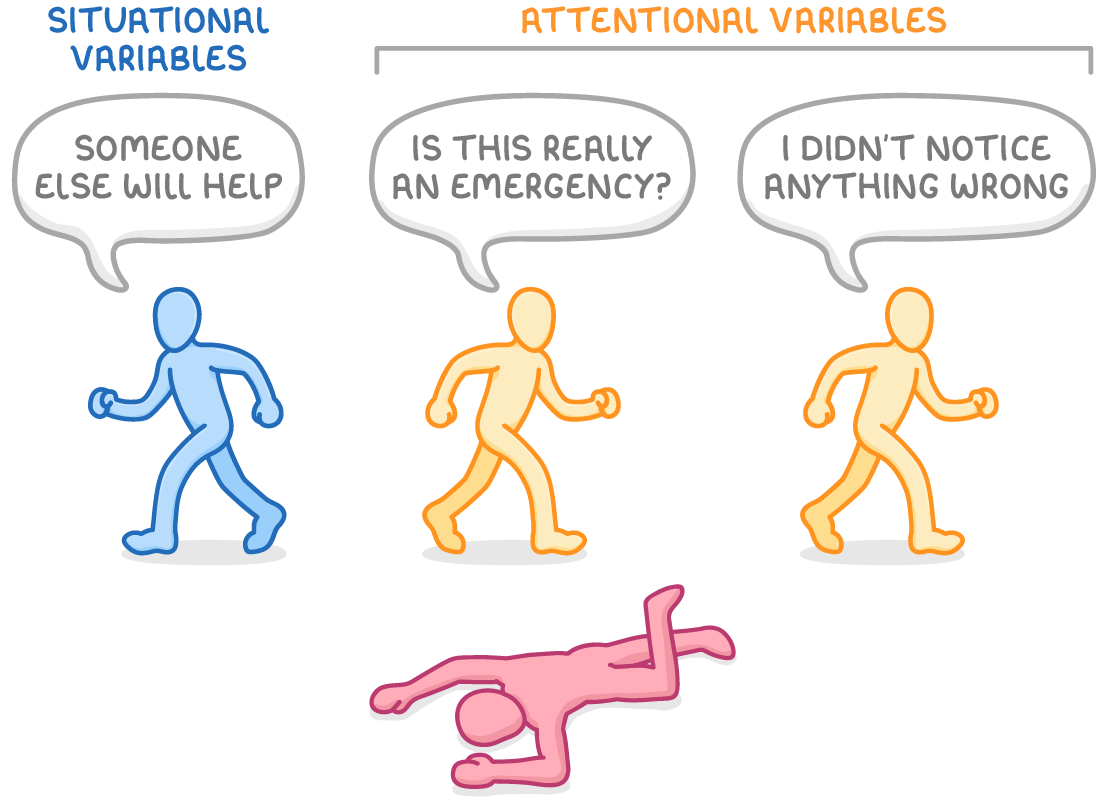
Key factors in the bystander effect
- Situational variables - The presence of others creates a diffusion of responsibility, where each person assumes someone else will take action, reducing personal urgency to help.
- Attentional variables - In crowded or ambiguous situations, individuals may fail to notice the emergency or may not interpret it as requiring intervention.
Studies, such as those inspired by the Kitty Genovese case in 1964, show that the likelihood of helping decreases as the number of bystanders increases, though clarity of the emergency can counteract this effect.
This phenomenon underscores the importance of situational awareness and personal responsibility in fostering helping behavior, demonstrating how social context can inhibit prosocial actions.