3.6 - Social–Emotional Development Across the Lifespan
The ecological systems theory and social development
Social development is deeply influenced by the environments in which individuals grow and interact. One key framework for understanding this is the ecological systems theory, developed by Urie Bronfenbrenner. This theory explains how different layers of social environments shape behavior and mental processes throughout a person's life.
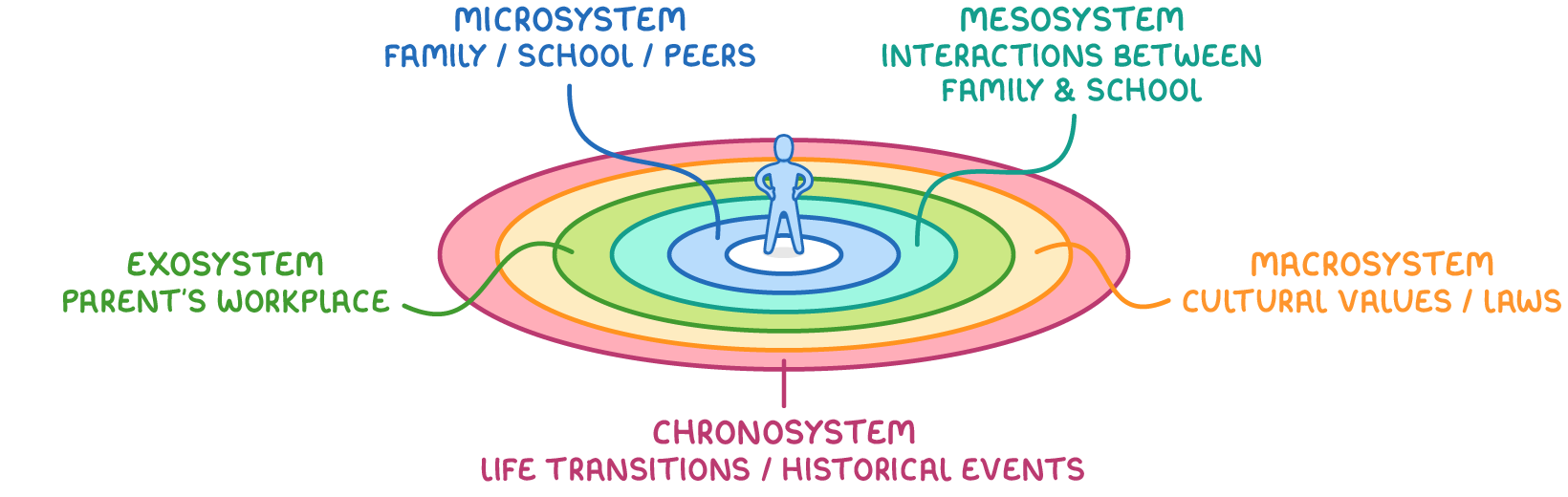
Layers of the ecological systems theory
- Microsystem - This is the immediate environment with direct contact, such as family, school, or peers. These relationships have a direct and significant impact on an individual's daily experiences and development.
- Mesosystem - This involves the interactions between different parts of the microsystem, like the relationship between parents and teachers. These connections can either support or hinder development based on their quality.
- Exosystem - These are indirect influences that don't involve the individual directly but still affect them, such as a parent's workplace policies or community resources. For example, a parent's job stress can impact family dynamics.
- Macrosystem - This encompasses broader cultural values, laws, and historical events that shape the individual's world. Cultural norms about education or gender roles are part of this system.
- Chronosystem - This refers to the timing of life events and transitions, such as the individual's age or historical period. For instance, growing up during a technological boom can shape one's social interactions differently than in earlier times.
These layers interact dynamically, showing that social development isn't just about personal relationships but also about wider environmental and cultural contexts.
Parenting styles and their influence on behavior
Caregivers play a critical role in shaping children's social and emotional development through their parenting styles. Research identifies three main styles, each with distinct characteristics and outcomes, often influenced by cultural contexts.
Types of parenting styles
- Authoritarian - Characterized by strict rules, high demands, and little warmth. Children may develop obedience but can struggle with self-esteem or social skills due to limited autonomy.
- Authoritative - Combines clear expectations with warmth and responsiveness. This style often leads to positive outcomes like independence and strong social skills, as children feel supported yet guided.
- Permissive - Marked by low demands and high warmth, where caregivers are lenient. Children may face challenges with self-discipline and responsibility due to a lack of structure.
Cultural differences affect how these styles are perceived and their impact. For instance, authoritarian parenting might be viewed as protective in some cultures, leading to different behavioral outcomes compared to others where it might be seen as overly harsh.
Attachment styles in infants and children
Attachment refers to the emotional bond between a child and their primary caregiver, significantly influencing social and emotional development. Different attachment styles emerge based on early interactions, with variations across cultures.
Categories of attachment styles
- Secure attachment - Children feel safe and confident with their caregiver, using them as a base to explore the world. This often results from consistent, responsive caregiving.
- Insecure-avoidant attachment - Children may avoid or ignore the caregiver, showing little distress during separation. This can stem from caregivers who are emotionally unavailable.
- Insecure-ambivalent attachment - Children display clinginess and distress when separated, often due to inconsistent caregiving that leaves them uncertain about support.
- Insecure-disorganized attachment - Children show confused or contradictory behaviors, often linked to unpredictable or frightening caregiver interactions.
Factors influencing attachment
- Temperament - A child's innate personality traits, such as being easygoing or irritable, can affect how they form attachments. For example, a more reactive child might show stronger separation anxiety.
- Separation anxiety - This is a common developmental stage where children experience heightened fear or distress when away from a caregiver or with strangers, often peaking around 8-18 months.
- Cultural variations - Attachment behaviors can differ based on cultural norms. For instance, independence might be encouraged earlier in some cultures, influencing attachment style.
Research on attachment: Harlow's monkey studies
Classic studies with monkeys by Harry Harlow highlighted the importance of comfort in attachment. In experiments, infant monkeys preferred a soft, cloth-covered surrogate mother over a wire one that provided food, demonstrating that emotional security often outweighs basic physical needs like nourishment in forming bonds.
Attachment styles in infants and children
Attachment refers to the emotional bond between a child and their primary caregiver, significantly influencing social and emotional development. Different attachment styles emerge based on early interactions, with variations across cultures.
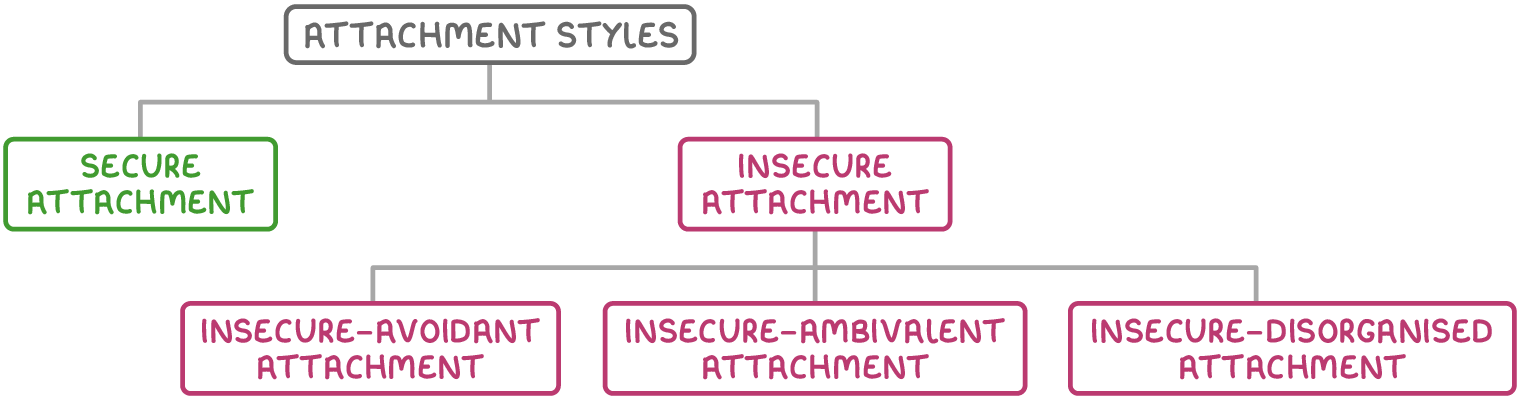
Categories of attachment styles
- Secure attachment - Children feel safe and confident with their caregiver, using them as a base to explore the world. This often results from consistent, responsive caregiving.
- Insecure-avoidant attachment - Children may avoid or ignore the caregiver, showing little distress during separation. This can stem from caregivers who are emotionally unavailable.
- Insecure-ambivalent attachment - Children display clinginess and distress when separated, often due to inconsistent caregiving that leaves them uncertain about support.
- Insecure-disorganized attachment - Children show confused or contradictory behaviors, often linked to unpredictable or frightening caregiver interactions.
Factors influencing attachment
- Temperament - A child's innate personality traits, such as being easygoing or irritable, can affect how they form attachments. For example, a more reactive child might show stronger separation anxiety.
- Separation anxiety - This is a common developmental stage where children experience heightened fear or distress when away from a caregiver or with strangers, often peaking around 8-18 months.
- Cultural variations - Attachment behaviors can differ based on cultural norms. For instance, independence might be encouraged earlier in some cultures, influencing attachment style.
Research on attachment: Harlow's monkey studies
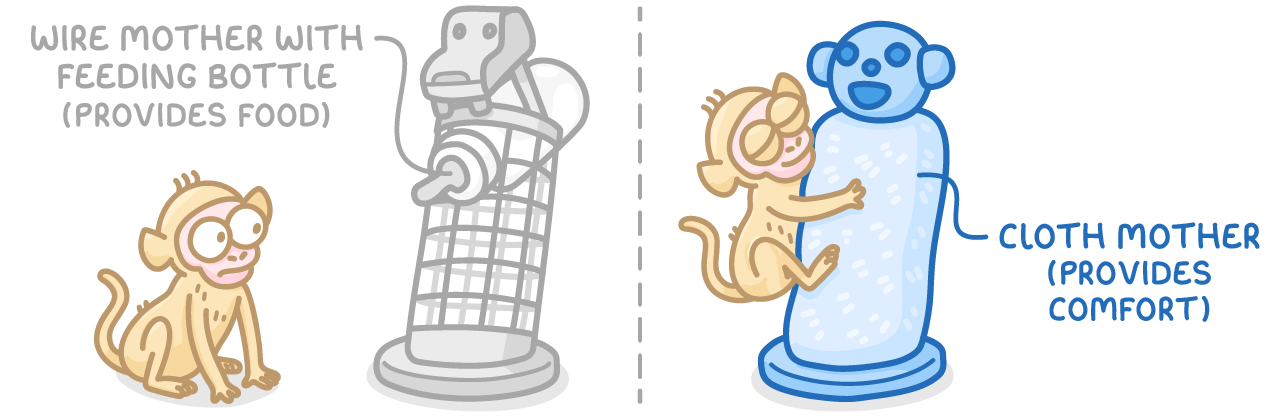
Classic studies with monkeys by Harry Harlow highlighted the importance of comfort in attachment. In experiments, infant monkeys preferred a soft, cloth-covered surrogate mother over a wire one that provided food, demonstrating that emotional security often outweighs basic physical needs like nourishment in forming bonds.
The role of peer relationships in development
Peer relationships are crucial for social development, evolving significantly from childhood through adolescence. These interactions help shape social skills, self-concept, and emotional regulation.
Peer interactions in childhood
- Parallel play - Young children often play alongside each other without direct interaction, learning social norms through observation.
- Pretend play - As children grow, they engage in imaginative play together, which fosters creativity, communication, and cooperation.
Peer relationships in adolescence
As children enter adolescence, peers become increasingly central to their social world. This shift brings unique challenges and influences on behavior.
Characteristics of adolescent peer relationships:
- Increased reliance on peers - Adolescents spend more time with friends, seeking validation and support outside the family.
- Adolescent egocentrism - This is a cognitive bias where teens believe they are the focus of others' attention, often manifesting in two ways:
- Imaginary audience - The belief that everyone is constantly watching and judging them, leading to self-consciousness.
- Personal fable - The idea that their experiences and feelings are unique and incomparable, sometimes fostering risk-taking behaviors due to a sense of invincibility.
These peer dynamics are essential for developing identity and independence, though they can also introduce pressures and conflicts.
Social development in adulthood and the social clock
Adulthood brings new social milestones and challenges influenced by cultural norms and personal history. Developmental psychologists study how adults form relationships and navigate life transitions.
Cultural influences on adulthood
- Social clock - This concept refers to the culturally defined timeline for major life events, such as marriage or career achievement. Different cultures have varying expectations for when these should occur.
- Emerging adulthood - In some cultures, there is a transitional period between adolescence and full adulthood, typically in the late teens to mid-20s, where individuals explore identity and independence before taking on adult responsibilities.
Adult relationships and attachment
Adults form significant bonds, often creating families or family-like structures that provide mutual care and support. The attachment styles developed in childhood can influence these adult relationships, affecting how individuals connect with partners or friends. For instance, a secure attachment in childhood might lead to healthier, more trusting adult bonds.
Erikson's stage theory of psychosocial development
Erik Erikson's theory of psychosocial development offers a framework for understanding social and emotional growth across the lifespan. Unlike earlier theories focused on childhood, Erikson proposed that development continues through adulthood, with each stage presenting a unique conflict to resolve.
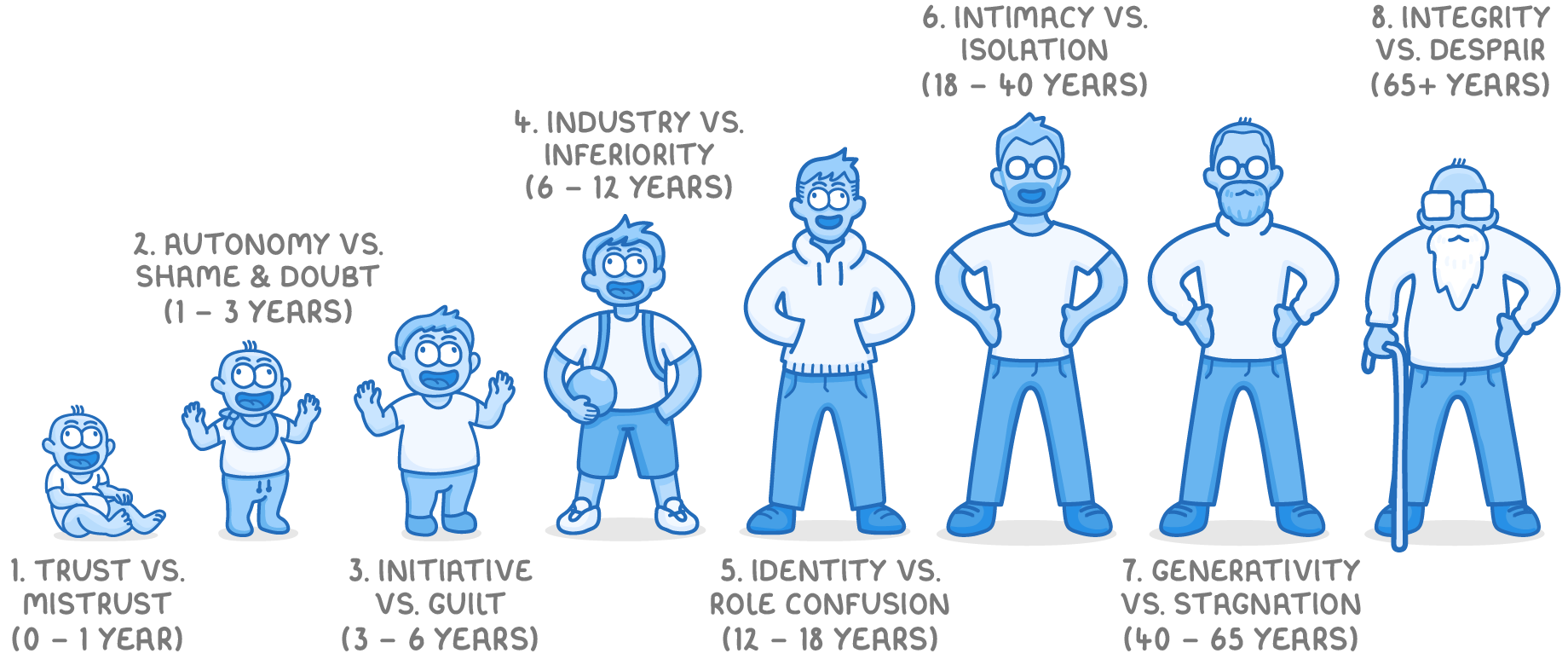
Stages of psychosocial development
- Trust vs. mistrust (infancy, 0-1 year) - Infants learn to trust caregivers for basic needs. Success leads to a sense of safety; failure results in mistrust.
- Autonomy vs. shame and doubt (early childhood, 1-3 years) - Children develop independence through exploration. Support fosters autonomy; criticism can lead to shame.
- Initiative vs. guilt (preschool, 3-6 years) - Children begin to assert themselves through play and goals. Encouragement builds initiative; overcontrol can cause guilt.
- Industry vs. inferiority (school age, 6-12 years) - Children gain competence through skills and tasks. Success builds industry; failure leads to feelings of inferiority.
- Identity vs. role confusion (adolescence, 12-18 years) - Teens explore who they are. Achieving a stable identity is key; confusion results from unclear self-concept.
- Intimacy vs. isolation (young adulthood, 18-40 years) - Adults seek close relationships. Success leads to intimacy; failure can result in isolation.
- Generativity vs. stagnation (middle adulthood, 40-65 years) - Adults focus on contributing to society or future generations. Generativity brings fulfillment; stagnation feels unproductive.
- Integrity vs. despair (late adulthood, 65+ years) - Older adults reflect on life. A sense of integrity comes from acceptance; despair arises from regret.
Each stage builds on the previous ones, shaping how individuals interact socially and emotionally throughout life.
The impact of adverse childhood experiences on relationships
Adverse childhood experiences (ACEs) are traumatic events or conditions, such as abuse, neglect, or household dysfunction, that occur before the age of 18. These experiences can have lasting effects on social and emotional development.
Effects of ACEs on relationships
- Long-term impact - ACEs can disrupt the ability to form healthy relationships, often leading to trust issues or difficulties with intimacy in adulthood.
- Sociocultural differences - What constitutes an ACE varies across cultures, as do the outcomes. For instance, community support in some cultures might buffer the negative effects, while in others, stigma can worsen them.
Understanding ACEs helps in addressing their long-term consequences through interventions and support systems, highlighting the importance of early social environments.
Identity development processes in adolescence
Adolescence is a critical period for forming a sense of identity, which shapes adult behavior and mental processes. This involves exploring various aspects of self and imagining future possibilities.
Processes of identity formation
- Achievement - Successfully exploring and committing to an identity, such as a career path or personal values.
- Diffusion - Lack of exploration and commitment, leading to a vague or undefined sense of self.
- Foreclosure - Committing to an identity without exploration, often based on others' expectations, like following a family tradition without question.
- Moratorium - Actively exploring different identities without yet committing, often seen as a period of experimentation.
Dimensions of identity development
Adolescents develop multiple facets of identity, influenced by social and personal factors:
Types of identity development:
- Racial/ethnic identity - Understanding one's cultural heritage and its role in self-concept.
- Gender identity - Defining oneself in terms of gender, which may align with or differ from biological sex.
- Sexual orientation - Recognizing and accepting one's romantic and sexual attractions.
- Religious identity - Exploring beliefs and spiritual values.
- Occupational identity - Considering future career paths and roles.
- Familial identity - Defining one's role within family structures and dynamics.
This exploration often involves considering "possible selves," or visions of who one might become, which guide decisions and behaviors during this formative stage.