3.7 - Classical Conditioning
The behavioral perspective and its focus on observable behavior
The behavioral perspective is a psychological approach that emphasizes the study of observable actions over internal mental processes. This perspective emerged from theories of learning through conditioning, focusing on how behaviors are shaped by environmental interactions rather than thoughts or feelings.
Core ideas of the behavioral perspective
- Observable actions - Behaviorists prioritize studying what can be directly seen and measured, such as physical responses, instead of unobservable mental states.
- Learning through conditioning - This perspective holds that most behaviors are learned through interactions with the environment, particularly through processes like conditioning.
- Exclusion of mental processes - Traditional behaviorists often disregarded internal thoughts or emotions, believing that only external behaviors provided reliable data for scientific study.
This focus on observable behavior laid the groundwork for understanding learning mechanisms like classical conditioning, which explores how associations between stimuli shape responses.
The fundamental principles of classical conditioning
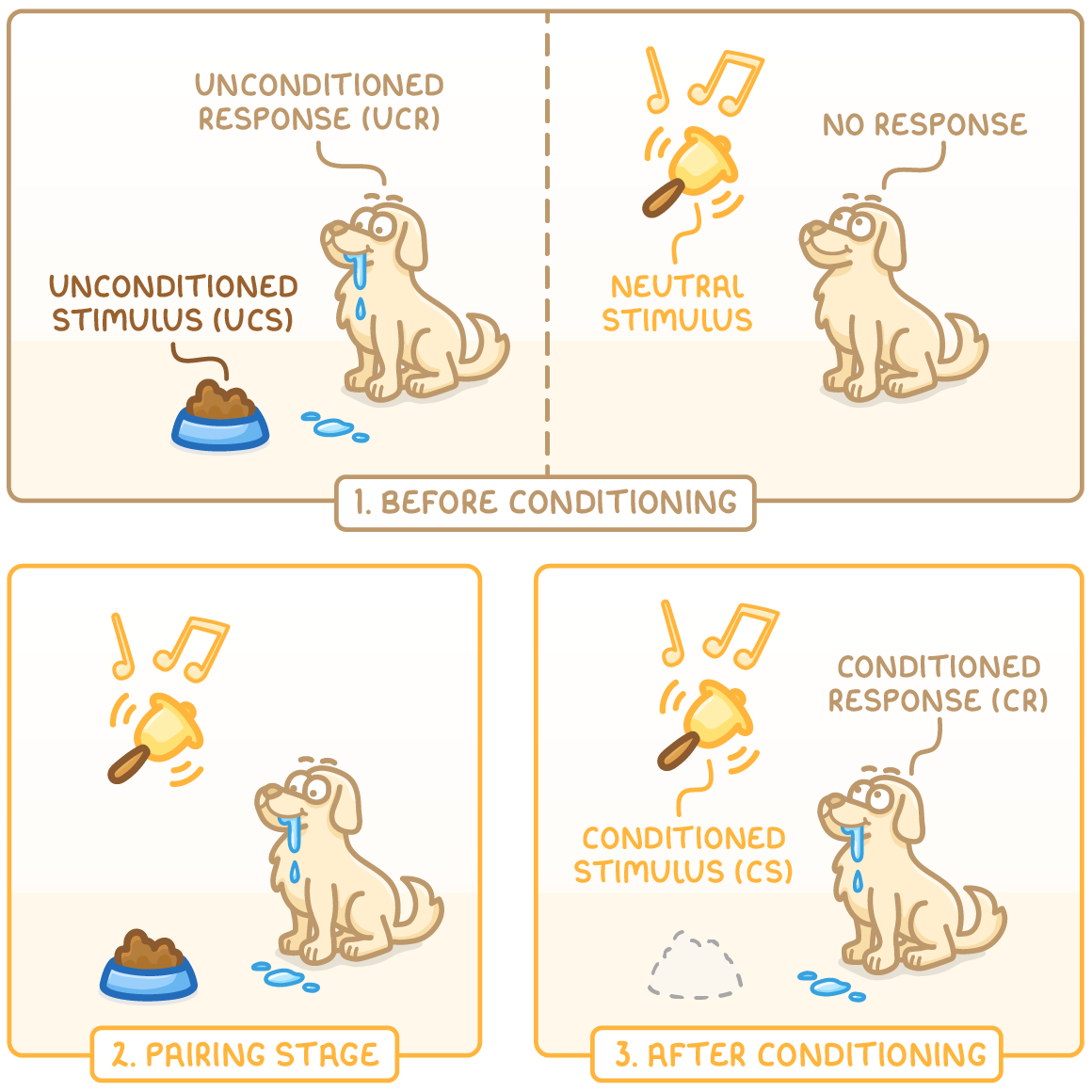
Classical conditioning is a type of learning where a neutral stimulus becomes associated with an unconditioned stimulus to elicit a specific response. First demonstrated by Ivan Pavlov through his experiments with dogs, this process shows how behaviors can be learned through repeated pairings of stimuli.
Key components of classical conditioning
- Unconditioned Stimulus (UCS) - A stimulus that naturally and automatically triggers a response without prior learning. For example, food causes salivation in dogs.
- Unconditioned Response (UCR) - The natural, unlearned reaction to the UCS. In the example, salivation in response to food is the UCR.
- Conditioned Stimulus (CS) - A previously neutral stimulus that, after being paired with the UCS, begins to trigger a learned response. For instance, a bell sound becomes the CS when associated with food.
- Conditioned Response (CR) - The learned reaction to the CS, which mirrors the UCR. Salivation in response to the bell alone is the CR.
This associative learning process shows how behaviors can be shaped by linking stimuli together, forming the basis for many learned responses in both animals and humans.
The process of acquisition, extinction, and spontaneous recovery
Classical conditioning involves several stages that demonstrate how learned behaviors are formed, lost, and sometimes regained. These stages are critical for understanding how associations between stimuli and responses develop over time.
Stages of classical conditioning
- Acquisition - This is the initial learning phase where the CS is repeatedly paired with the UCS, leading to the development of the CR. The timing and order of presentation are crucial; typically, the CS must precede the UCS for effective learning. For example, ringing a bell just before presenting food helps a dog associate the sound with feeding.
- Extinction - If the CS is presented repeatedly without the UCS, the CR weakens and eventually disappears. This process shows that learned behaviors can fade when the association is no longer reinforced. For instance, if the bell rings multiple times without food, the dog stops salivating.
- Spontaneous Recovery - After a period of rest following extinction, the CR can reappear when the CS is presented again. This suggests that the learned association isn't completely forgotten during extinction but can resurface under the right conditions.
These stages highlight the dynamic nature of learning, where associations can be built, broken, and sometimes restored through environmental cues.
Stimulus discrimination and generalization in conditioning
Once a conditioned response is learned, organisms don't always respond identically to every stimulus. Classical conditioning studies reveal two key phenomena that explain how responses can vary based on the similarity of stimuli to the original CS.
Understanding discrimination and generalization
- Stimulus Discrimination - This occurs when an organism learns to respond only to the specific CS and not to other similar stimuli. For example, a dog conditioned to salivate at a specific bell tone might not respond to a different pitch, showing it can distinguish between sounds.
- Stimulus Generalization - This happens when an organism responds to stimuli that are similar to the CS, even if they aren't identical. If the same dog salivates at tones close to the conditioned bell sound, it demonstrates generalization, as the response extends beyond the exact stimulus.
These concepts show how learning can be precise or broad, depending on the organism's ability to differentiate or equate stimuli, which has implications for how behaviors are applied in varied situations.
Higher-order conditioning and its applications
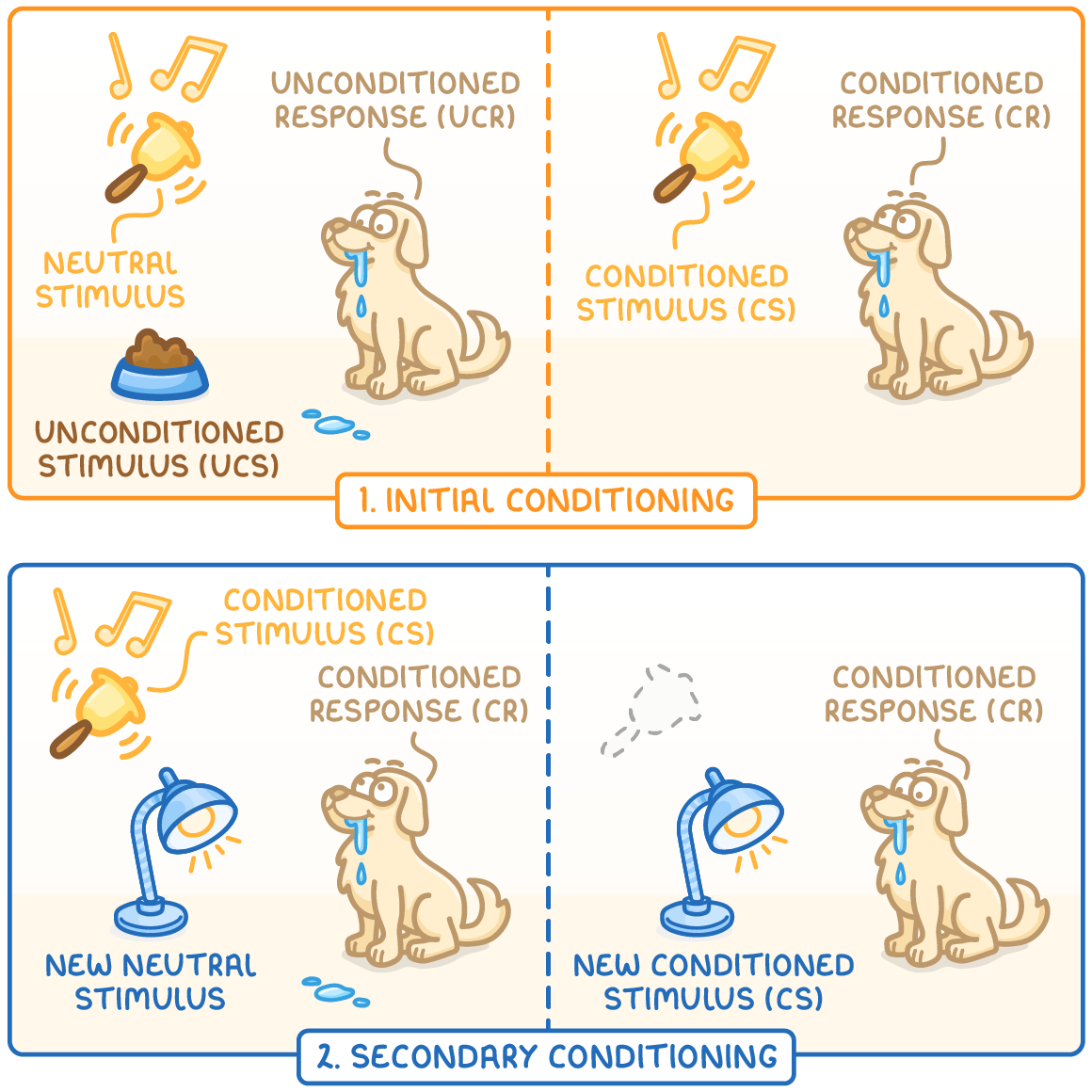
Classical conditioning can extend beyond a single association, leading to more complex learning through a process called higher-order conditioning. This shows how learned stimuli can themselves become triggers for new conditioning.
How higher-order conditioning works
- Initial conditioning - A neutral stimulus (like a bell) is paired with a UCS (food) to become a CS that elicits a CR (salivation).
- Secondary association - The original CS (bell) is then used as a UCS to condition a new neutral stimulus (like a light). Over time, the light alone can trigger the CR (salivation), even though it was never directly paired with the original UCS (food).
This process demonstrates the flexibility of classical conditioning, as it allows organisms to form chains of associations, expanding the range of stimuli that can influence behavior. It's often seen in advertising, where a product (new CS) is paired with a positive image (original CS) to evoke favorable feelings.
Emotional responses and therapeutic uses of classical conditioning
Classical conditioning isn't limited to physical responses like salivation; it can also shape emotional reactions. Research shows that emotions such as fear or pleasure can be conditioned, providing a foundation for therapeutic techniques to address mental health issues.
Conditioning emotional responses
- Fear conditioning - A neutral stimulus can become associated with a frightening event (UCS), leading to a fear response (CR) when the stimulus (CS) is encountered. For example, a loud noise paired with a scary image can make the image alone trigger fear.
- Positive emotions - Pleasant experiences can also be conditioned, such as associating a song with a happy memory, so the song alone brings joy.
Therapeutic applications
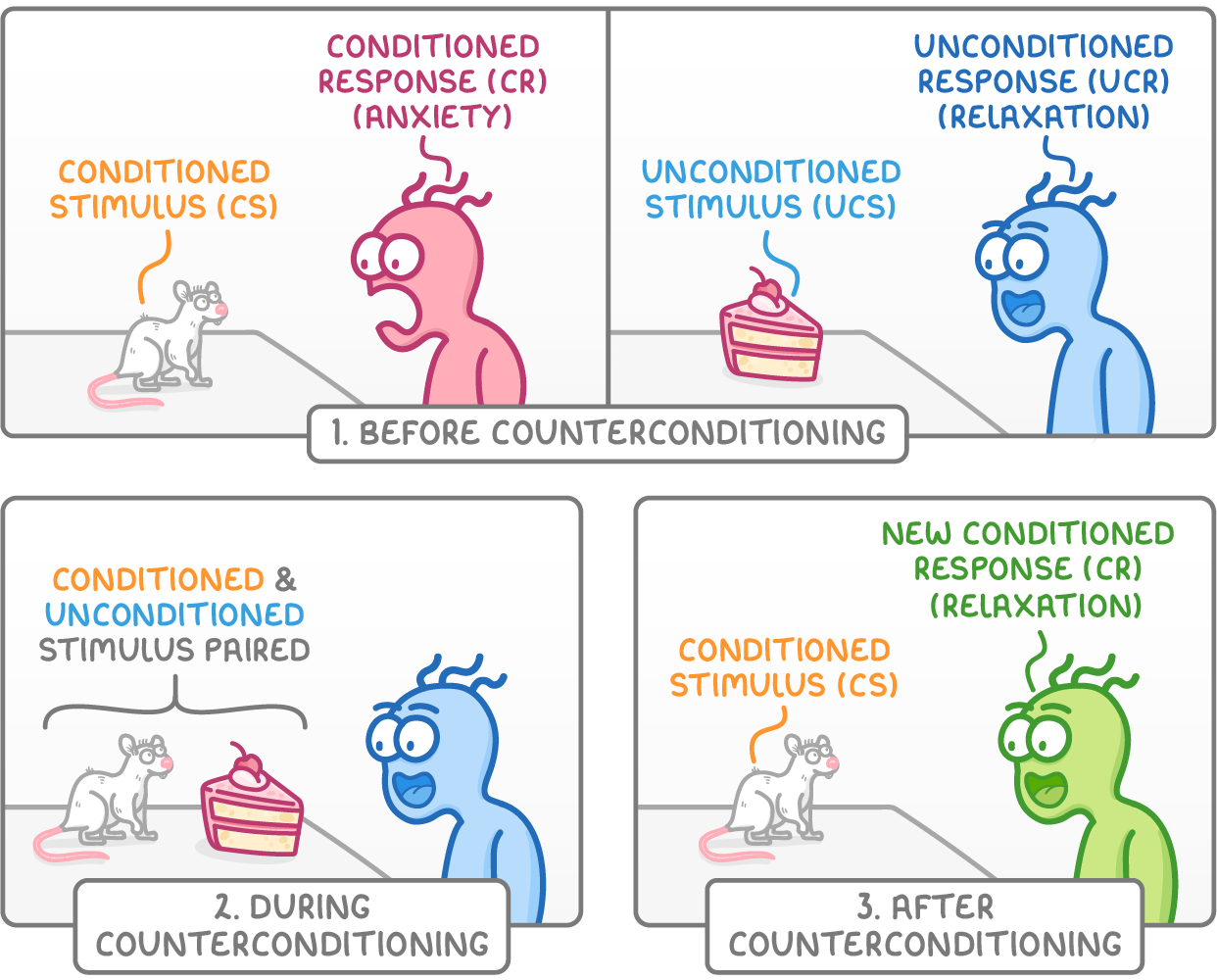
Counterconditioning uses classical conditioning to replace an undesirable response with a positive one. This can be useful in treating phobias, where a feared stimulus (CS) is paired with relaxation (new UCS) to create a calm response (new CR) instead of anxiety. This forms the basis for therapies like systematic desensitization, where gradual exposure to the feared stimulus reduces fear over time.
Key stages of counterconditioning:
- Before counterconditioning - The feared, conditioned stimulus, like a rat, causes a conditioned response like anxiety. Meanwhile, an unconditioned stimulus like a slice of cake produces an unconditioned response, like feeling relaxed.
- During counterconditioning - The conditioned and unconditioned stimuli are parired together to produce a calm response.
- After counterconditioning - The originally frightening conditioned stimulus now produces a conditioned, relaxed response.
These applications reveal how classical conditioning can be harnessed to modify emotional behaviors, offering practical solutions for managing psychological disorders.
Taste aversions, one-trial learning, and biological preparedness
Classical conditioning also explains unique learning phenomena like taste aversions, where strong associations form quickly due to biological factors. This type of conditioning often deviates from typical multi-trial learning, showcasing the role of innate predispositions.
Key aspects of taste aversions
- One-Trial Learning - Unlike standard conditioning that requires multiple pairings, taste aversions can develop after just one exposure. If eating a specific food (CS) is followed by illness (UCS), a strong aversion (CR) forms immediately, avoiding the food in the future. This rapid learning isn't strengthened by additional pairings.
- Biological Preparedness - Organisms are biologically wired to learn certain associations more easily due to evolutionary advantages. For instance, animals quickly associate specific tastes with illness because avoiding toxic foods enhances survival. Humans and animals are more likely to form aversions to novel foods than familiar ones, reflecting this preparedness.
This demonstrates how classical conditioning interacts with biology, enabling fast and adaptive learning in situations critical to survival, like food safety.
The concept of habituation and diminished responses
Habituation is a basic form of learning where an organism's response to a repeated or prolonged stimulus decreases over time. Unlike classical conditioning, it doesn't involve forming new associations but rather adapting to familiar environmental cues.
Characteristics of habituation
- Diminished response - When a stimulus is presented repeatedly without significant consequence, the organism stops reacting strongly. For example, if a loud noise occurs frequently with no harm, a person might eventually ignore it.
- Adaptation to environment - Habituation helps organisms focus on novel or important stimuli by filtering out irrelevant or constant ones, conserving energy and attention.
- Reversibility - If the stimulus changes or stops for a while, the response can return, showing that habituation isn't permanent forgetting but a temporary adjustment.
This process illustrates a fundamental way organisms cope with their surroundings, ensuring they respond primarily to stimuli that matter while tuning out the rest.