1.1 - Interaction of Heredity & Environment
The concept of heredity and environment in shaping behavior
Behavior and mental processes are shaped by a complex interplay between internal and external factors. This interaction determines how individuals think, feel, and act in various situations. Understanding this relationship is fundamental to exploring why people differ in their personalities, abilities, and emotional responses.
Key factors influencing behavior and mental processes
- Heredity (Nature) - Refers to the genetic or inherited traits that influence physical characteristics, behaviors, and mental processes. These are the predispositions individuals are born with, passed down from parents through biological mechanisms.
- Environment (Nurture) - Encompasses all external influences experienced throughout life, such as family dynamics, cultural background, education, and social interactions. These factors shape how innate traits are expressed or modified over time.
Neither heredity nor environment works in isolation though. Instead, they continuously interact, with genetic predispositions being influenced by life experiences, and environmental factors sometimes triggering or suppressing inherent traits. This means that a person's behavior cannot be fully explained by just one of these factors.
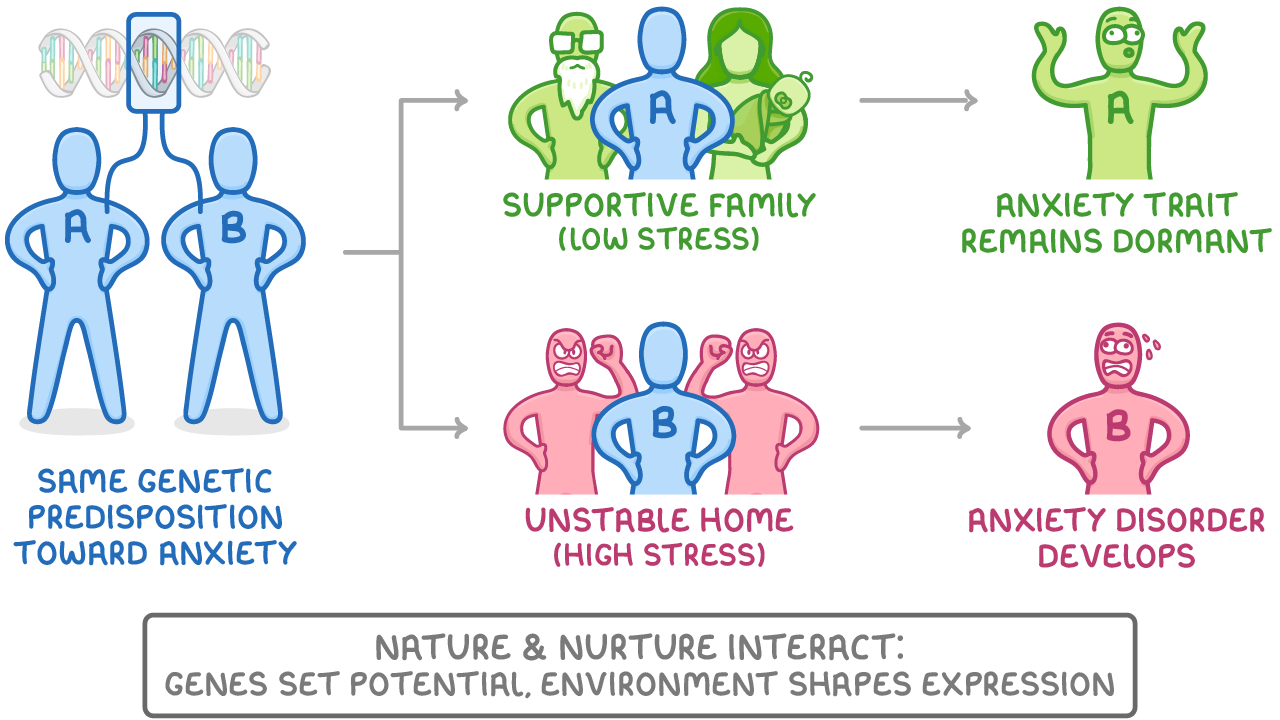
For instance, two identical twins with the same genetic predisposition towards anxiety might not develop it in the same way. If one twin is raised in a supportive family environment with low stress, while the other twin is raised in an unstable, high-stress home, the anxiety trait might remain dormant in the first twin but develop in the second twin.
In other words, the genes set the potential, while the environment shapes the gene's actual expression.
The roles of nature and nurture in psychological development
The debate over whether nature or nurture has a greater impact on behavior has been central to psychology for decades. While both contribute significantly, their influence varies depending on the trait or behavior in question.
Nature: Heredity's role
Heredity provides the biological foundation for many traits. It sets the potential for certain behaviors or mental processes, such as temperament or cognitive abilities. For example, a child might inherit a natural inclination for musical talent, but whether this talent develops depends on external opportunities and encouragement.
Nurture: Environmental influences
Environmental factors play a crucial role in shaping how hereditary traits are expressed. These influences begin from the moment of birth and continue throughout life.
These external influences that shape behavior include:
- Family interactions - The emotional support, parenting style, and values taught within a family can reinforce or alter innate tendencies.
- Education and learning - Access to education and stimulating experiences can enhance cognitive skills or shape attitudes and beliefs.
- Cultural and social contexts - The norms, traditions, and peer groups an individual is exposed to influence behaviors, such as communication styles or risk-taking tendencies.
As a result, two individuals with similar genetic makeups can exhibit very different behaviors if raised in contrasting environments.
The evolutionary perspective on behavior and survival
One way to understand the role of heredity in behavior is through the evolutionary perspective. This approach examines how behaviors and mental processes have developed over time to enhance survival and reproductive success.
Core ideas of the evolutionary perspective
- Natural selection - Behaviors and mental traits that increase an individual's chances of surviving and reproducing are more likely to be passed on to future generations. For example, fear responses to danger help protect individuals from harm, increasing survival odds.
- Adaptive behaviors - Traits like cooperation, problem-solving, and mate selection have evolved because they improve the likelihood of passing on genes. These behaviors are often rooted in genetic predispositions shaped by ancestral environments.
- Controversial applications - Some theorists have misused evolutionary principles to justify discriminatory practices, such as eugenics, which promotes selective breeding to "improve" human traits. This highlights the importance of ethical considerations in applying evolutionary theories.
This perspective helps explain why certain behaviors, like aggression or altruism, might be more common across populations—they served adaptive purposes in human history.
Research methods used to study the effects of heredity on behavior
To disentangle the influences of heredity and environment, psychologists use specific research designs that compare individuals with varying degrees of genetic and environmental similarity. These methods provide insights into how much of a behavior or mental process can be attributed to inherited factors versus life experiences.
Types of studies in heredity research
- Twin studies - These compare identical twins, who share nearly all their genetic material, with fraternal twins, who share about half. By observing similarities and differences in behavior between these groups, researchers can estimate the role of heredity. For instance, if identical twins show more similar levels of intelligence than fraternal twins, this suggests a stronger genetic influence.
- Family studies - These examine patterns of traits or behaviors across relatives within a family. Similarities in mental processes or disorders among close relatives can point to hereditary influences, though shared environments also play a role.
- Adoption studies - These analyze individuals who were adopted and raised apart from their biological parents. By comparing adoptees to their biological and adoptive families, researchers can separate the effects of genetics from environmental upbringing. For example, if an adoptee's behavior resembles their biological parents more than their adoptive ones, heredity likely plays a significant role.
Strengths and challenges of heredity research
- Strengths - These methods allow researchers to isolate genetic influences by controlling for shared environments (in twin studies) or separating genetic and environmental factors (in adoption studies).
- Challenges - It's difficult to fully account for all environmental variables, and ethical concerns limit experimental control. Additionally, behaviors are often influenced by complex interactions that are hard to measure precisely.
These research approaches provide valuable evidence about how heredity shapes behavior, helping psychologists understand the balance between nature and nurture in human development.