1.3 - The Neuron & Neural Firing
The building blocks of the nervous system
The nervous system forms the foundation of all behavior and mental processes, relying on specialized cells to communicate and coordinate responses. Two primary types of cells work together to make this possible: neurons and glial cells. Understanding their roles is crucial for grasping how the brain and body interact.
Neurons
Neurons are specialized cells that transmit information throughout the body via electrical and chemical signals. They are responsible for processing and sending messages that control thoughts, emotions, movements, and other behaviors.
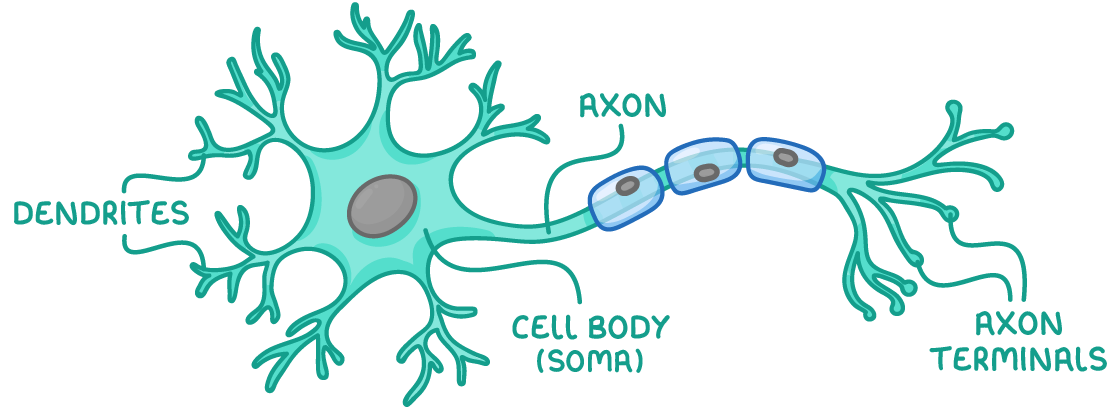
Structure of neurons:
- Dendrites - Branch-like structures that receive signals from other neurons.
- Cell body (soma) - The central part containing the nucleus, which integrates incoming signals.
- Axon - A long, thin fiber that carries signals away from the cell body toward other neurons or muscles.
- Axon terminals - End points of the axon that release chemical messengers to communicate with other cells.
Neurons enable everything from quick reflexes to complex decision-making by forming networks that process and respond to stimuli.
Glial cells
Glial cells are non-neuronal cells in the nervous system that support and protect neurons.
Key roles of glial cells:
- Structure - Provide physical support to hold neurons in place.
- Insulation - Form myelin, a fatty sheath around axons, to speed up signal transmission.
- Communication - Assist in signaling between neurons and help regulate the environment around them.
- Waste transport - Remove debris and maintain a healthy neural environment.
By maintaining optimal conditions for neurons, glial cells indirectly influence learning, memory, and overall brain function.
Reflex arcs: A coordinated response in the spinal cord
Reflex arcs demonstrate how the central nervous system (CNS) and peripheral nervous system (PNS) collaborate to produce rapid, automatic responses to stimuli, often without conscious thought. This mechanism is essential for survival, allowing quick reactions to potential harm.
What is a reflex arc?
A reflex arc is a neural pathway that controls an automatic, rapid response to a stimulus, known as a reflex. It enables immediate reactions, such as pulling your hand away from a hot surface, by bypassing the brain for speed. This primarily occurs in the spinal cord, connecting sensory input to motor output.
Three distinct types of neurons work together to complete a reflex arc:
- Sensory neurons - Detect stimuli (like heat or pain) from the environment and transmit signals to the spinal cord.
- Interneurons - Act as connectors within the spinal cord, processing the sensory input and relaying it to motor neurons.
- Motor neurons - Carry signals from the spinal cord to muscles or glands, triggering a response (like muscle contraction).
How a reflex arc works
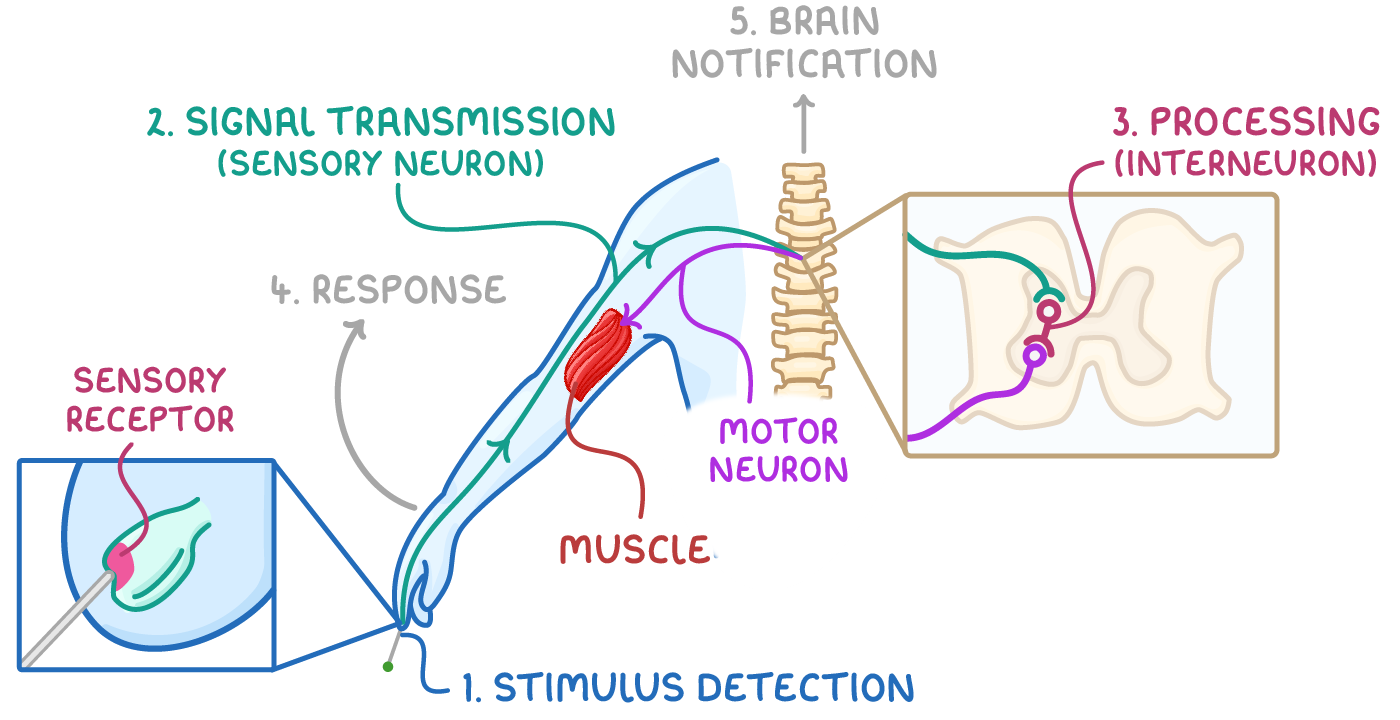
- Stimulus detection - A sensory receptor picks up a stimulus, such as touching something sharp.
- Signal transmission - The sensory neuron sends an electrical impulse to the spinal cord.
- Processing - An interneuron in the spinal cord receives the signal and immediately passes it to a motor neuron.
- Response - The motor neuron activates a muscle or gland, causing an action, such as pulling the hand away.
- Brain notification - After the reflex occurs, the brain is informed of the event, allowing for awareness but not initial control.
This streamlined process ensures quick protection from harm, illustrating how neural structures directly influence behavior.
The process of neural transmission
Neural transmission is the mechanism by which neurons communicate, sending signals that drive every thought, feeling, and action. This process follows a systematic sequence and is vital for understanding how disruptions can affect mental processes and behavior.
Key concepts in neural transmission
- Resting potential - The state of a neuron when it is not firing, with a negative electrical charge inside compared to outside (about -70 millivolts).
- Threshold - The minimum level of stimulation required to trigger a neural impulse, or action potential.
- Action potential - A brief electrical charge that travels down the axon when a neuron is stimulated past its threshold.
- Depolarization - The shift in a neuron's electrical charge from negative to positive as the action potential begins.
- All-or-nothing principle - A neuron either fires completely or not at all; there is no partial firing once the threshold is reached.
- Refractory period - A short time after firing during which a neuron cannot fire again, ensuring signals travel in one direction.
- Reuptake - The process by which unused neurotransmitters are reabsorbed by the sending neuron to be reused.
Stages of neural transmission
-
Resting state - The neuron maintains a resting potential, with a stable negative charge inside due to an imbalance of ions.
-
Stimulation and threshold - A stimulus causes the neuron to reach its threshold, triggering an action potential.
-
Depolarization - The inside of the neuron becomes positively charged as the action potential travels down the axon.
-
Signal propagation - The action potential moves along the axon to the axon terminals, following the all-or-nothing principle.
-
Refractory period - Immediately after firing, the neuron enters a brief refractory period, preventing backtracking of the signal.
-
Neurotransmitter release - At the axon terminal, chemical messengers called neurotransmitters are released into the synapse (the gap between neurons) to communicate with the next neuron.
When neural transmission is disrupted, it can lead to significant behavioral and mental health issues:
- Multiple sclerosis (MS) - A disorder where the immune system attacks myelin, the insulating layer around axons, slowing or blocking neural signals. This can result in motor difficulties, fatigue, and cognitive impairment.
- Myasthenia gravis - A condition affecting the neuromuscular junction (the connection between motor neurons and muscles), where communication is impaired, leading to muscle weakness and fatigue.
These examples show how the integrity of neural transmission directly affects physical and mental functioning.
Neurotransmitters and their role in behavior
Neurotransmitters are chemical messengers released by neurons to communicate across synapses. Their specific functions influence various aspects of behavior and mental processes, depending on their type and location in the nervous system.
Neurotransmitters can have two types of effects
- Excitatory - Increase the likelihood of the receiving neuron firing an action potential, promoting activity.
- Inhibitory - Decrease the likelihood of the receiving neuron firing, reducing activity.
Key neurotransmitters and their functions
| Neurotransmitter | Primary function(s) | Behavioral/mental impact |
|---|---|---|
| Dopamine | Involved in reward, motivation, and motor control | Influences pleasure, addiction, and movement disorders like Parkinson's disease |
| Serotonin | Regulates mood, sleep, and appetite | Linked to depression, anxiety, and sleep disorders |
| Norepinephrine | Affects arousal, alertness, and stress response | Contributes to attention and fight-or-flight responses |
| Glutamate | Major excitatory neurotransmitter, involved in learning and memory | Essential for cognitive functions; excess can lead to excitotoxicity |
| GABA (Gamma-aminobutyric acid) | Major inhibitory neurotransmitter, calms neural activity | Reduces anxiety; imbalances linked to seizures and anxiety disorders |
| Endorphins | Natural painkillers, promote feelings of well-being | Released during exercise or stress, reducing pain and enhancing mood |
| Substance P | Transmits pain signals | Plays a role in pain perception and inflammation |
| Acetylcholine | Involved in muscle movement, memory, and attention | Critical for learning; deficits linked to Alzheimer's disease |
Each neurotransmitter's balance of excitatory or inhibitory effects shapes how the nervous system governs behavior and mental states.
Hormones and their influence on mental processes
Beyond the nervous system, hormones act as chemical messengers that travel through the bloodstream, affecting behavior and mental processes in ways similar to neurotransmitters. They are produced by various glands and play significant roles in regulating physiological and psychological functions.
Key hormones and their functions
| Hormone | Primary function(s) | Behavioral/mental impact |
|---|---|---|
| Adrenaline | Triggers fight-or-flight response | Increases heart rate and energy during stress or danger |
| Leptin | Regulates hunger and energy balance | Signals satiety, reducing appetite |
| Ghrelin | Stimulates appetite | Increases hunger, especially when the stomach is empty |
| Melatonin | Regulates sleep-wake cycles | Promotes sleepiness, linked to circadian rhythms |
| Oxytocin | Facilitates bonding and trust | Enhances social connections, often called the "love hormone" |
These hormones demonstrate how chemical signals outside the nervous system can profoundly influence emotions, behaviors, and physiological states.
Psychoactive drugs and neural communication
Psychoactive drugs are substances that alter brain function, affecting perception, mood, consciousness, or behavior. They interact with neural communication by influencing neurotransmitter activity, leading to varied psychological and physiological effects.
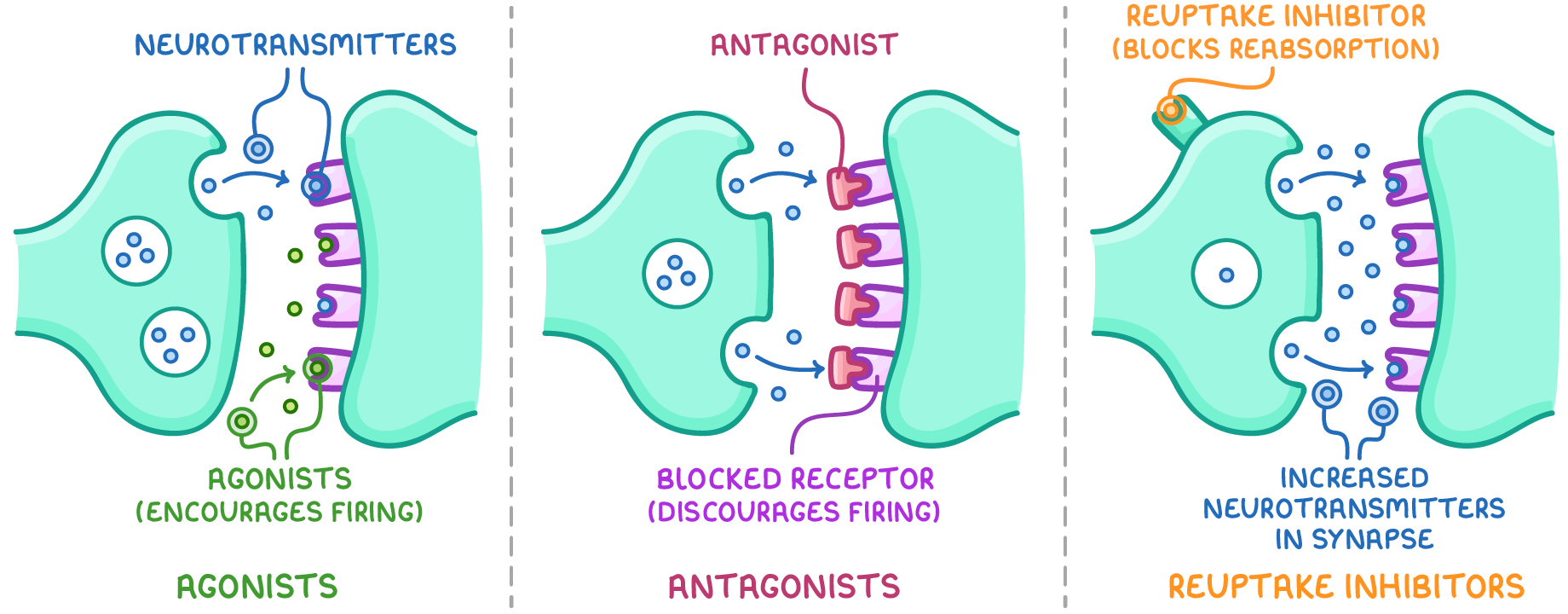
Psychoactive drugs work through three main mechanisms
- Agonists - Mimic neurotransmitters, binding to receptors and encouraging neural firing.
- Antagonists - Block receptors, discouraging neural firing by preventing neurotransmitters from binding.
- Reuptake inhibitors - Prevent the reabsorption of neurotransmitters back into the sending neuron, increasing their availability in the synapse.
Categories of psychoactive drugs and their effects
| Category | Examples | Effect on neural activity | Psychological/physiological impact |
|---|---|---|---|
| Stimulants | Caffeine, cocaine | Increase neural activity | Heighten alertness, energy, and focus; can cause anxiety or crashes |
| Depressants | Alcohol | Decrease neural activity | Slow reactions, reduce anxiety; risk of impaired coordination |
| Hallucinogens | Marijuana | Distort neural signaling | Alter perception and cognition, causing hallucinations or distorted reality |
| Opioids | Heroin | Mimic endorphins | Relieve pain, induce euphoria; high risk of dependency |
Long-term effects of psychoactive drug use
- Tolerance - Repeated use can reduce the drug's effectiveness, requiring higher doses to achieve the same effect.
- Addiction - Chronic use may lead to physical or psychological dependence, altering brain chemistry.
- Withdrawal symptoms - Stopping drug use can cause significant discomfort, such as anxiety, tremors, or cravings, as the brain struggles to regain balance.
These effects highlight how psychoactive drugs can disrupt normal neural transmission, profoundly impacting behavior and mental health over time.