2.1 - Perception
The concept of perception and its influencing factors
Perception is the process by which our brain interprets and organizes sensory information from the environment to create a meaningful experience of the world. It's not just about receiving raw data through our senses; it involves complex mental processes that shape how we understand and interact with our surroundings. Various factors influence how we perceive stimuli, leading to differences in interpretation among individuals.
How perception works
- Sensory input - Perception begins with sensory receptors detecting stimuli, such as light for vision or sound waves for hearing.
- Brain interpretation - The brain processes these sensory signals, turning them into recognizable patterns or objects.
- Subjective experience - Perception is not a perfect reflection of reality; it's shaped by personal and environmental factors, making it unique to each person.
This complex interplay means that two people can perceive the same stimulus differently based on how their brains process the incoming information.
Internal and external factors affecting perception
Perception isn't a passive process; it's actively influenced by both internal mental frameworks and external environmental conditions. These factors determine how we interpret sensory data and can lead to varied perceptions of the same situation.
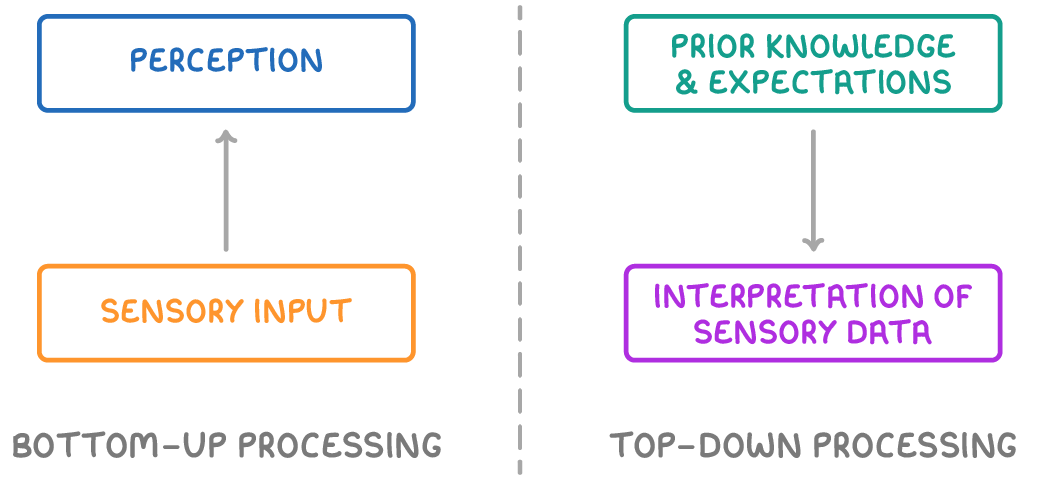
Internal factors shaping perception
- Bottom-up processing - This involves building perception from sensory input upward, relying on the raw data received by the senses to form a complete picture. For instance, seeing individual shapes and colors before recognizing a painting.
- Top-down processing - This relies on prior knowledge and expectations to interpret sensory information. If you expect to see a friend in a crowd, your brain might focus on familiar features to spot them quickly.
- Schemas - These are mental frameworks or organized patterns of thought about specific concepts. For example, your schema of a "dog" includes four legs and barking, helping you identify one even if it's partially hidden.
- Perceptual sets - These are predispositions to perceive things in a certain way based on expectations or past experiences. If you're told a vague image is a face, you're more likely to see facial features in it.
External factors shaping perception
- Contexts - The surrounding environment or situation can alter perception. A loud noise in a quiet library might seem more disruptive than the same noise at a concert.
- Experiences - Personal history influences how stimuli are interpreted. Someone who grew up near the ocean might perceive wave sounds as calming, while another might find them unsettling.
- Cultural expectations - Cultural background shapes how we view the world. In some cultures, direct eye contact is seen as respectful, while in others, it might be perceived as rude or aggressive.
These internal and external factors combine to create a personalized lens through which we experience reality, often leading to differences in perception among individuals.
Perceptual organization through Gestalt principles
Gestalt psychology emphasizes how humans naturally organize sensory information into meaningful wholes rather than perceiving disjointed parts. These principles explain how our brains group stimuli to form coherent perceptions, even when the input is incomplete or ambiguous.
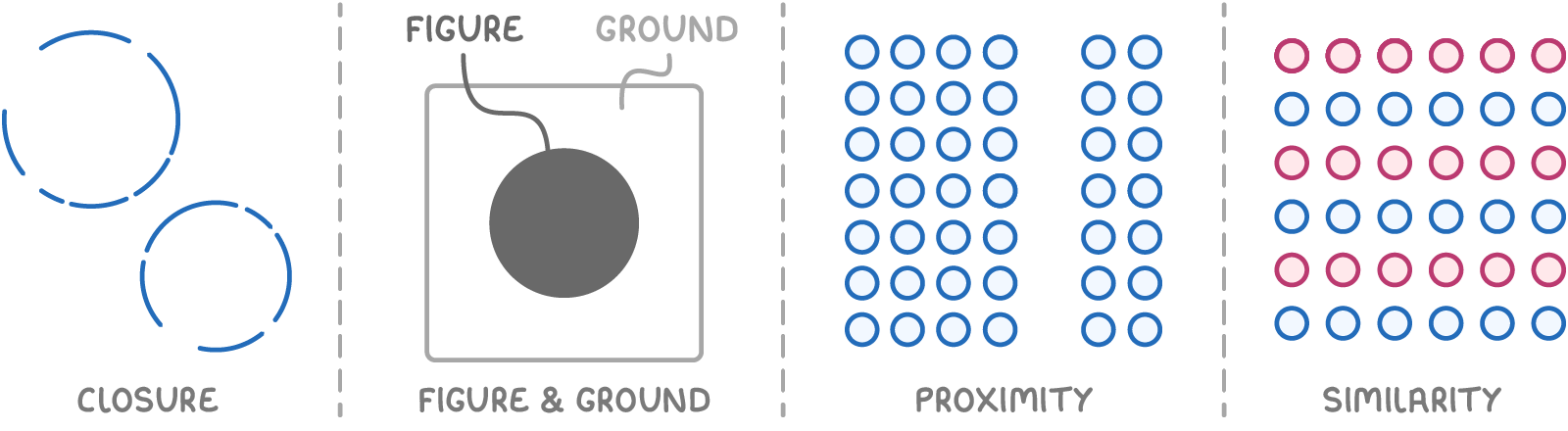
Key Gestalt principles of perception
- Closure - The brain tends to fill in missing parts of a figure to perceive a complete, whole object. For example, seeing a partially drawn circle as a full circle.
- Figure and ground - We distinguish an object (figure) from its background (ground). A black shape on a white page is perceived as the figure, while the white space is the ground.
- Proximity - Objects close to each other are perceived as a group. Dots spaced closely together appear as a single unit rather than separate points.
- Similarity - Items that look alike are grouped together. If red and blue dots are mixed, we tend to see them as separate groups based on color.
These principles help us make sense of complex visual environments by organizing raw sensory data into patterns and structures, simplifying the perceptual process.
The role of attention in perception
Attention is the process of focusing on specific aspects of the environment while ignoring others, acting as a bridge between sensation and perception. It's influenced by both internal desires and external stimuli, shaping what we notice and how we interpret it.
Types of attention and their effects
- Selective attention - This is the ability to focus on one stimulus while filtering out others. A classic example is the cocktail party effect, where in a noisy room, you can still hear your name or a topic of interest because your brain tunes into relevant sounds.
- Inattention and blindness - When attention is not directed toward certain stimuli, significant changes in the environment can go unnoticed. This is known as change blindness, where a major alteration (like a person switching in a video) isn't detected if attention is focused elsewhere.
Attention determines what information reaches our conscious awareness, directly impacting how we perceive and respond to the world around us.
Visual perceptual processes for depth and movement
Visual perception allows us to interpret the three-dimensional world through depth cues and detect movement, even when stimuli are static. These processes often involve both eyes working together or interpreting flat images in meaningful ways.
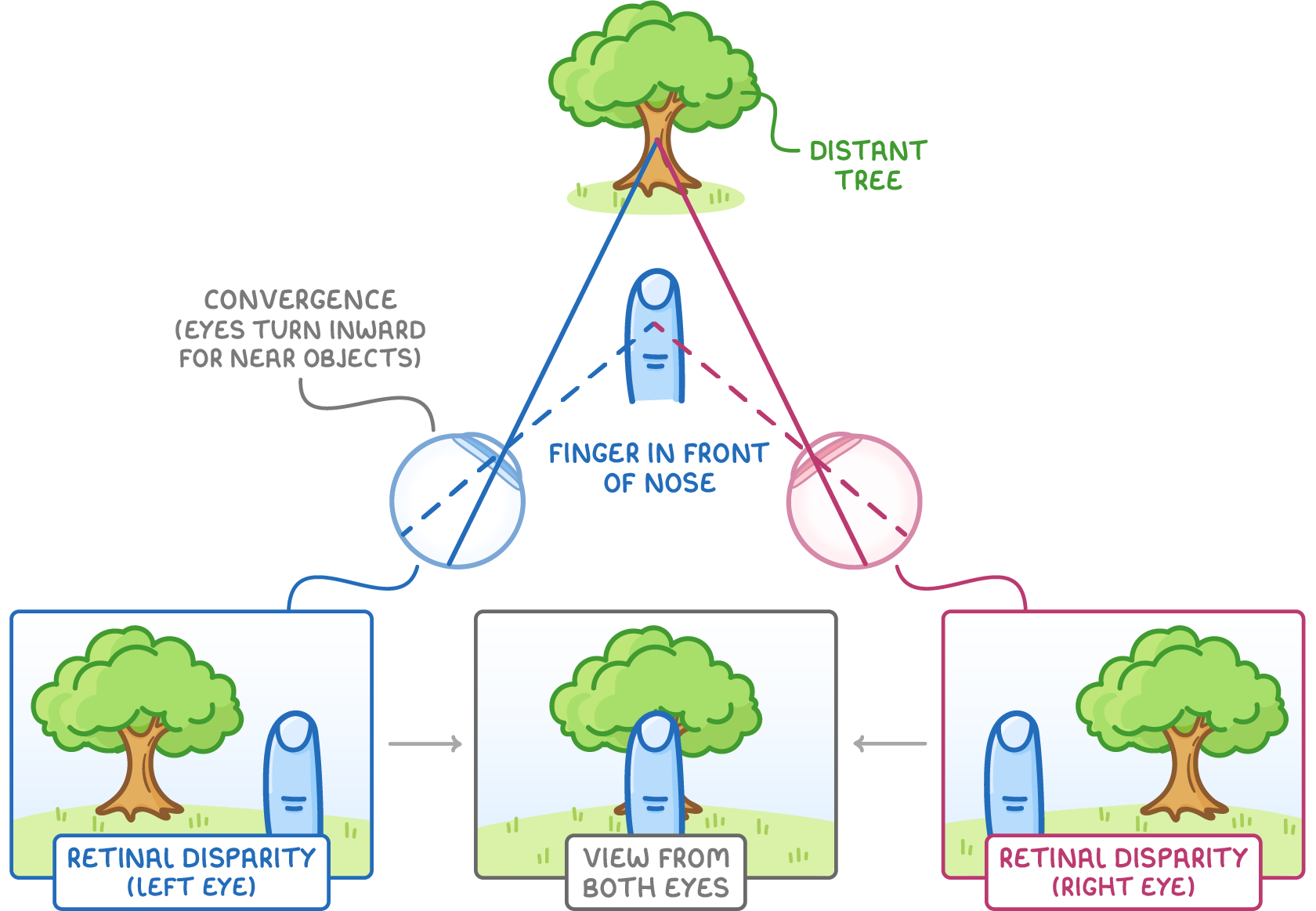
Binocular depth cues
These cues rely on both eyes working together to provide a sense of depth, crucial for navigating and interacting with a three-dimensional environment.
Examples of binocular depth cues:
- Retinal disparity - Each eye receives a slightly different image of the same scene due to their separation on the face. The brain compares these differences to gauge depth and distance. For example, holding a finger close to your nose shows a larger disparity between the images in each eye than when it's farther away.
- Convergence - When looking at a nearby object, the eyes turn inward to focus on it. The brain uses the degree of this inward turn to estimate distance. You can feel this when crossing your eyes to look at something very close.
Monocular depth cues
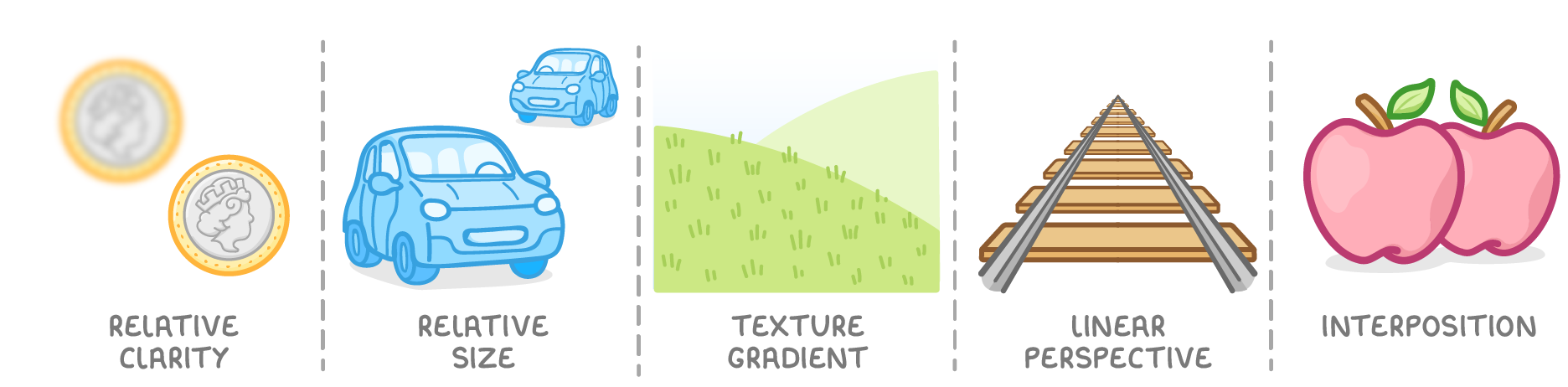
These cues allow depth perception using just one eye, often used by artists to create the illusion of depth on flat canvases.
Examples of monocular depth cues:
- Relative clarity - Objects that appear clearer and more detailed are perceived as closer, while blurry ones seem farther away.
- Relative size - If two similar objects appear different in size, the smaller one is perceived as more distant.
- Texture gradient - Textures appear finer and less detailed as distance increases. Think of a field where grass looks detailed nearby but blends together farther off.
- Linear perspective - Parallel lines seem to converge as they recede into the distance, like railroad tracks appearing to meet at the horizon.
- Interposition - When one object partially blocks another, the blocked object is perceived as farther away.
These monocular cues help us interpret depth in two-dimensional images or when one eye is dominant, enhancing our ability to understand spatial relationships.
Perception of movement
Apparent movement occurs when the brain perceives motion in static images due to rapid changes or specific arrangements. A common example is the phi phenomenon, where flashing lights in sequence (like in movie marquees) create the illusion of continuous motion.
This ability to perceive movement, even when none exists, shows how our brain actively constructs reality based on visual cues rather than just passively receiving information.
Perceptual constancies and maintaining stable perceptions
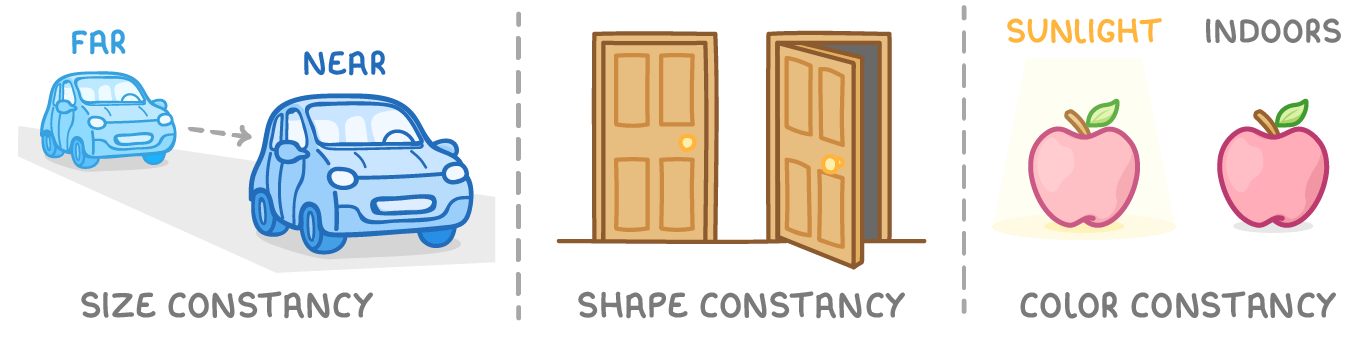
Perceptual constancies are mechanisms that allow us to recognize objects as stable and unchanging, even when the sensory input from them varies. This stability is essential for interacting consistently with the world.
Types of perceptual constancies
- Size constancy - An object is perceived as the same size regardless of its distance from the viewer. A car looks the same size whether it's near or far, even though its image on the retina shrinks with distance.
- Shape constancy - An object's shape remains consistent despite changes in viewing angle. A door appears rectangular whether viewed head-on or at an angle, though the retinal image may look trapezoidal when tilted.
- Color constancy - Colors are perceived as consistent under varying lighting conditions. A red apple looks red whether it's in bright sunlight or dim indoor light, despite changes in the light waves hitting the retina.
These constancies ensure that our perception of familiar objects remains reliable, preventing confusion as sensory input changes with movement, distance, or environmental conditions.