2.2 - Thinking, Problem-solving, Judgments & Decision-making
The role of concepts and prototypes in forming thoughts
Thinking is the mental process of manipulating information to form ideas, solve problems, and make decisions. At the core of thought are concepts, which are mental categories or ideas that help us organize and understand the world. Concepts allow us to group similar objects, events, or people together based on shared characteristics.
Concepts
Concepts are the building blocks of thought, representing categories like "dog," "furniture," or "happiness" that help us make sense of diverse experiences.
Prototypes
A prototype is the best or most typical example of a concept. For instance, when thinking of "bird," many picture a robin or sparrow rather than a penguin, as it fits the ideal image of the category. Prototypes help us quickly identify and classify new information by comparing it to our mental "best example," speeding up cognitive processing.
This foundation of concepts and prototypes shapes how we interpret and interact with the world around us.
How schemas are developed and modified
Beyond individual concepts, our minds organize information into broader frameworks called schemas. A schema is a mental structure or set of ideas that helps us interpret and predict experiences based on past knowledge.
Schema formation
Schemas are built from repeated experiences and help us make sense of complex information. For example, a "restaurant schema" might include expectations of menus, waiters, and ordering food.
Assimilation and accommodation
How schemas change through experience:
- Assimilation - This is the process of incorporating new information into an existing schema without changing it. If you visit a new restaurant with a slightly different setup, you might still fit it into your current "restaurant" schema.
- Accommodation - This occurs when new information doesn't fit an existing schema, requiring us to modify it. If you encounter a fully automated restaurant with no waiters, you might adjust your schema to include this new type of dining experience.
These processes show how our thinking adapts to new experiences, balancing familiarity with flexibility.
Problem-solving strategies: algorithms and heuristics
Problem-solving involves finding solutions to challenges or obstacles. Two primary approaches guide this process: algorithms and heuristics, each with distinct methods and outcomes.
Algorithms
An algorithm is a step-by-step procedure that guarantees a solution by trying every possible option until the correct one is found. Algorithms are systematic, often used in math or computer programming. For example, solving a puzzle by testing every piece in every spot ensures eventual success. While algorithms are thorough and accurate, they can be time-consuming, especially for complex problems with many possible solutions.
Heuristics
Heuristics are mental shortcuts or rules of thumb that simplify problem-solving and decision-making, though they don't always guarantee correctness.
Types of heuristics:
- Representativeness heuristic - Judging something based on how closely it matches a typical example or stereotype. For instance, assuming someone is a librarian because they're quiet and wear glasses, even if they're not.
- Availability heuristic - Making decisions based on the most readily available or vivid information in memory. After hearing about a plane crash, you might overestimate the danger of flying despite statistics showing it's safe.
Heuristics speed up decisions but can lead to errors or biases when prior expectations or memorable events skew judgment.
These strategies highlight the balance between precision and efficiency in solving problems.
Influences on decision-making
Decision-making is the process of choosing between alternatives, often influenced by past experiences and the context in which choices are presented.
Key factors affecting decisions:
- Mental set - This refers to a tendency to approach problems in a way that worked in the past. While helpful, it can limit flexibility; for example, using an old study method even when a new one might be more effective.
- Priming - Exposure to certain stimuli can subconsciously influence decisions. If you hear positive words before a job interview, you might feel more confident and perform better.
- Framing - The way a choice is presented affects decisions. A medical treatment described as having a "90% success rate" is often preferred over one with a "10% failure rate," even though both mean the same thing.
These influences show how external and internal factors shape the choices we make, often without conscious awareness.
Cognitive biases hindering good decisions
Cognitive biases are systematic errors in thinking that can lead to poor decision-making. Two common biases are particularly impactful in everyday choices.
Gambler's fallacy
The gambler's fallacy is the mistaken belief that past random events influence future independent outcomes. For example, after flipping a coin and getting heads five times, someone might believe tails is "due," even though each flip remains 50/50. This fallacy can lead to risky choices, like continuing to bet in a losing streak, expecting a win to balance things out.
Sunk-cost fallacy
The sunk-cost fallacy occurs when people continue investing time, money, or effort into something because of past investments, even if it's no longer beneficial. For instance, staying in a failing project because "I've already put so much into it." This bias prevents rational choices by focusing on unrecoverable costs rather than future benefits, often leading to further losses.
Recognizing these biases helps in making more logical and effective decisions.
The importance of executive functions in goal-directed behavior
Beyond basic thinking and decision-making, higher-level cognitive processes guide complex behaviors and critical thinking.
Executive functions
Executive functions are a set of mental skills that include planning, organizing, managing time, paying attention, and controlling impulses to achieve goals. These functions allow individuals to set objectives, break tasks into manageable steps, and adapt to changing circumstances. For example, studying for an exam involves planning a schedule and focusing despite distractions.
Strong executive functions are essential for academic success, problem-solving, and self-regulation, enabling critical thinking and effective decision-making. These processes are crucial for navigating life's challenges and achieving long-term goals.
The nature of creativity and barriers to innovative thinking
Creativity is a unique aspect of cognition that involves producing new and valuable ideas or solutions. It plays a vital role in problem-solving and personal expression.
Creativity
Creativity is the ability to think in novel ways, generating original ideas or approaches to challenges. Creativity fosters innovation, allowing individuals to adapt to new situations and contribute unique perspectives.
Divergent and convergent thinking
Two types of creative thinking:
- Divergent thinking - Producing many possible solutions to a problem, often associated with brainstorming and creativity. For example, thinking of multiple uses for a paperclip beyond holding papers.
- Convergent thinking - Narrowing down to a single, correct solution, often used in logical or analytical tasks.
Functional fixedness
Functional fixedness is a cognitive bias that limits a person to using an object only in its traditional way, hindering creative problem-solving.
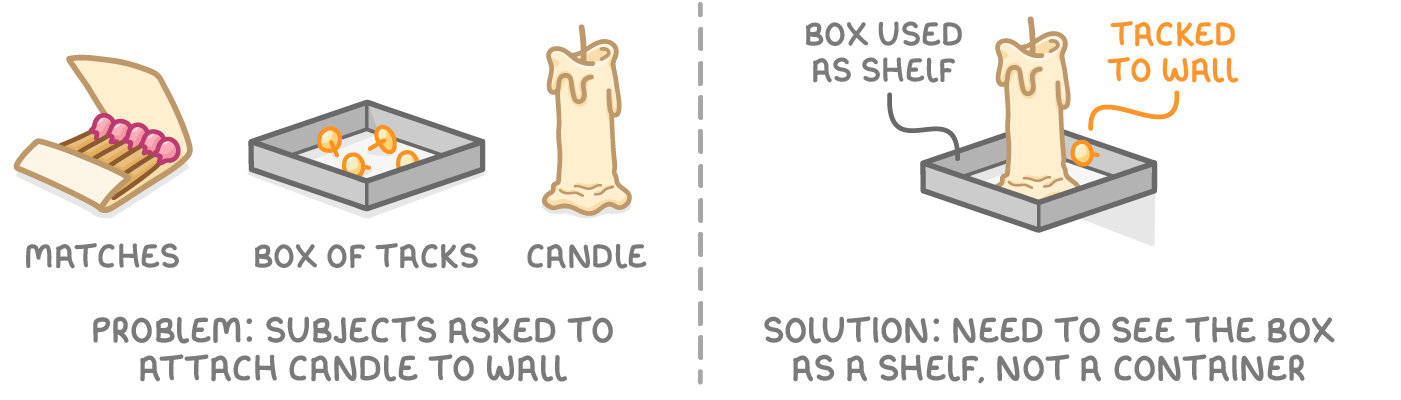
For example, imagine you are given a candle, a box of tacks, and some matches, and asked to attach the candle to a wall. Most people try solutions like pressing the tacks directly into the candle or attempting to melt it onto the wall, because they see the box purely as a container for the tacks. The solution is to empty the box, tack it to the wall, and use it as a shelf to hold the candle. Breaking free from functional fixedness involves looking at objects and situations from different angles, encouraging flexibility in thought.
Understanding creativity and its obstacles helps in cultivating innovative thinking and applying it to everyday challenges.