2.3 - Introduction to Memory
Types of memory and their processing
Memory is a complex cognitive function that allows us to encode, store, and retrieve information about past experiences, knowledge, and skills. Memories are not all processed, stored, or retrieved in the same way. The brain differentiates memories based on their nature, leading to distinct categories that serve different purposes.
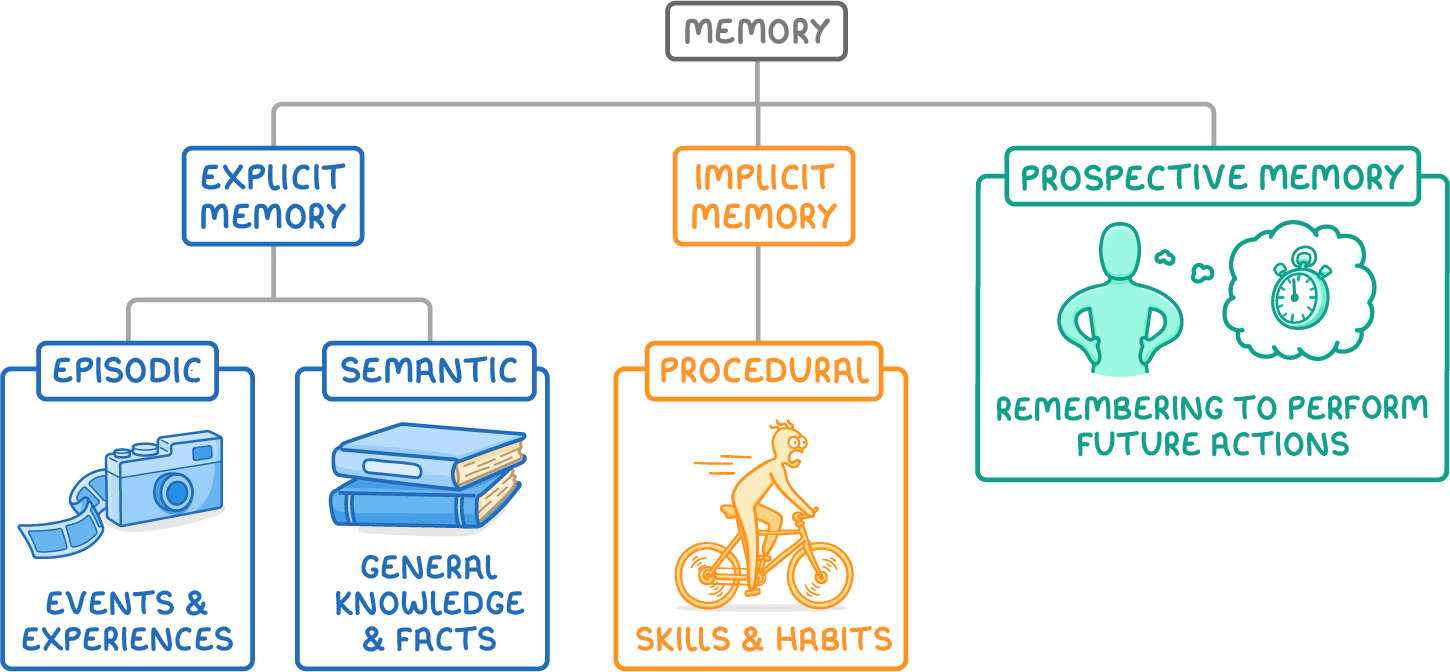
Explicit memory
Explicit memory involves information that can be consciously recalled and easily described or explained to others. It includes facts and personal experiences.
Types of explicit memory:
- Episodic memory - Personal experiences or events tied to a specific time and place, like remembering your last birthday party.
- Semantic memory - General knowledge and facts not tied to personal experience, such as knowing the capital of France is Paris.
Implicit memory
Implicit memory is harder to verbalize or explain because it often operates unconsciously. It involves skills and habits learned through repetition.
Types of implicit memory:
- Procedural memory - Knowing how to perform tasks or processes, like riding a bike or typing on a keyboard.
Prospective memory
Prospective memory focuses on remembering to perform actions in the future, such as recalling to attend a meeting or take medication at a specific time.
Each type of memory is processed differently by the brain, influencing how we recall information and apply it in various contexts.
Biological processes underlying memory formation
Memory isn't just a mental construct; it has a biological basis in the brain. One of the key mechanisms for creating and strengthening memories occurs at the neural level through a process that enhances connections between brain cells.
Long-term potentiation (LTP)
Long-term potentiation is a process where synaptic connections between neurons (nerve cells) become stronger with frequent activation.
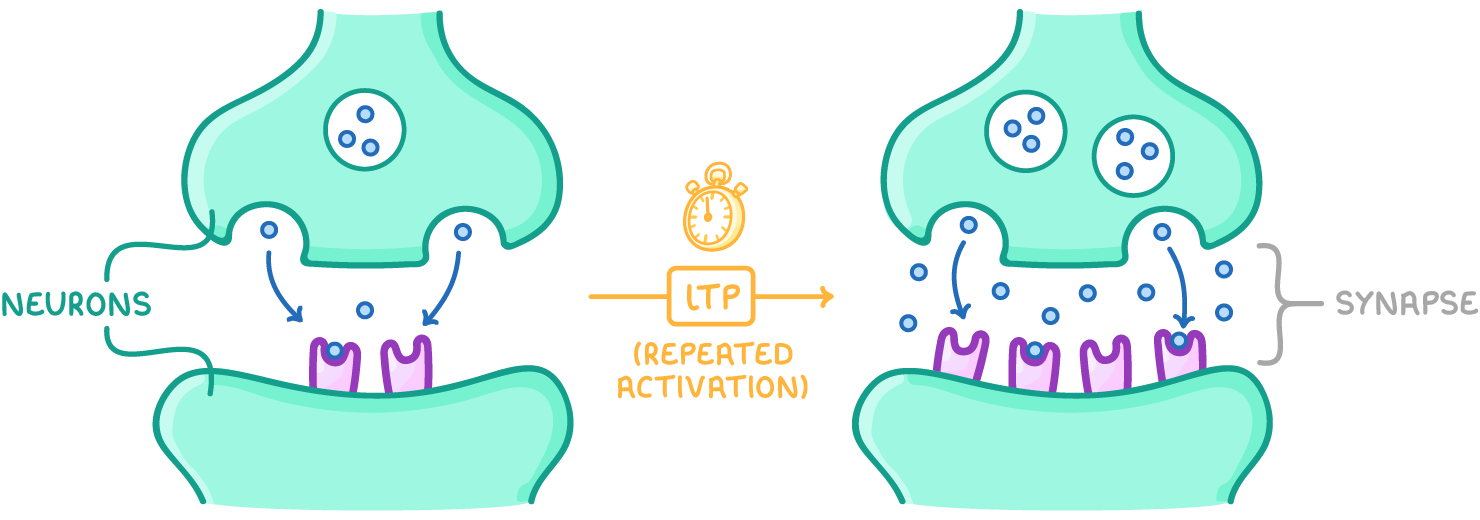
How LTP works:
- When two neurons are activated simultaneously often enough, the connection (synapse) between them becomes more efficient.
- The number of receptors on the post-synaptic neuron increases, as does the number of neurotransmitter signaling molecules that are released into the synapse that can bind to the receptors.
- This strengthens the connection between the neurons and makes it easier for signals to pass between them in the future.
- LTP is considered a fundamental mechanism for learning and memory because it helps form lasting neural pathways.
- Repeated experiences or learning can create stronger memory traces in the brain.
This biological process shows how repeated practice or exposure can solidify memories, making them easier to retrieve over time.
Models of memory: Working memory model
Memory processing involves more than just storing information; it requires active manipulation of data in real-time. The working memory model explains how we temporarily hold and process information before it potentially moves into long-term storage.
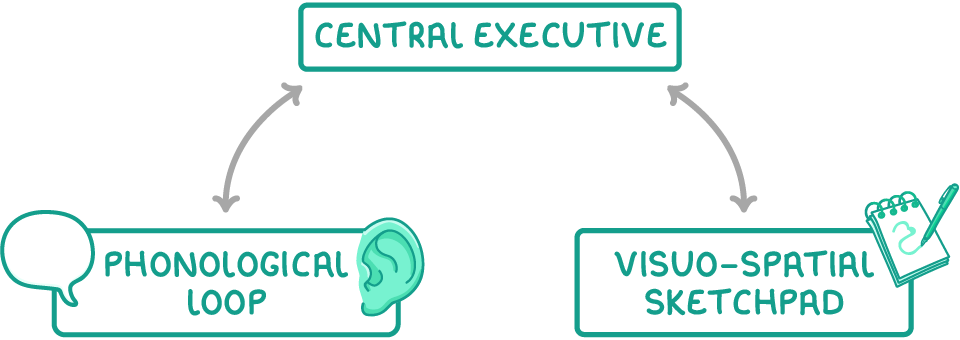
Components of the working memory model
- Central executive - This acts as the control center, directing attention and coordinating the activities of the other components. It decides what information to focus on and how to process it.
- Phonological loop - This component handles verbal and auditory information. It temporarily stores spoken or written words and is crucial for tasks like language comprehension or repeating a phone number.
- Visuospatial sketchpad - This part manages visual and spatial data, helping us visualize objects or navigate spaces. It's active when you imagine a map or mentally rotate an object.
- Dynamic interaction - These components work together under the central executive's guidance to process information. This interaction allows us to perform complex tasks, like solving a math problem while remembering the steps.
This model highlights that working memory isn't just a passive storage space but an active system for manipulating information, essential for reasoning and decision-making.
Models of memory: Multi-store model
Another way to understand memory is through the multi-store model, which breaks down memory into a series of stages that information must pass through to be retained over time. This model emphasizes how information is encoded, stored, and retrieved.

Stages of the multi-store model
- Sensory memory - The first stage where information from the environment is briefly held, just long enough to be processed. It has a very short duration (less than a second for some types).
- Iconic memory - A type of sensory memory for visual stimuli, like a fleeting image of a scene you just saw.
- Echoic memory - A type of sensory memory for auditory stimuli, such as a sound or word you heard momentarily.
- Short-term memory (STM) - If attention is paid to sensory input, it moves to STM, where it can be held for about 20-30 seconds. This stage has a limited capacity, often described as holding around 7 (plus or minus 2) items.
- Long-term memory (LTM) - With rehearsal or meaningful processing, information can transfer from STM to LTM, where it can be stored indefinitely. LTM has a virtually unlimited capacity.
Processing types in the multi-store model
- Automatic processing - Encoding information with little conscious effort, often for routine or familiar tasks, like noticing the layout of a familiar room.
- Effortful processing - Encoding information that requires conscious attention and effort, such as studying for a test or learning a new skill.
This model illustrates memory as a linear flow, where information must progress through each stage, influenced by the type of processing used.
Models of memory: Levels of processing model
The levels of processing model offers a different perspective, focusing on the depth at which information is encoded rather than distinct memory stores. It suggests that how deeply we think about information affects how well it is remembered.
Levels of encoding in memory
- Structural level (shallow processing) - Encoding based on the physical appearance of information, such as noticing the shape or font of a word. This results in weak memory traces that are easily forgotten.
- Phonemic level (intermediate processing) - Encoding based on the sound of information, like focusing on how a word sounds when read aloud. This creates a moderately strong memory trace.
- Semantic level (deep processing) - Encoding based on the meaning of information, such as connecting a word to a personal experience or understanding its context. This leads to the strongest and most durable memory traces.
This model emphasizes that deeper, more meaningful engagement with material enhances memory retention, explaining why studying with understanding is more effective than rote memorization.