2.10 - Origins of Cell Compartmentalization
What is cell compartmentalization and why does it matter?
Cell compartmentalization refers to the division of a cell into distinct regions or compartments, often separated by membranes, that perform specific functions. This organization is crucial for cellular efficiency, allowing different processes to occur simultaneously without interference. Compartmentalization enhances the specialization of cellular activities, which is a key factor in the complexity and adaptability of life forms.
Benefits of compartmentalization
- Functional separation - Different cellular processes, like energy production and protein synthesis, can occur in isolated environments, preventing conflicts or inefficiencies.
- Increased efficiency - Specialized compartments optimize conditions for specific reactions, such as maintaining unique pH levels or enzyme concentrations.
- Protection of contents - Compartments can shield sensitive materials, like DNA, from potentially damaging reactions happening elsewhere in the cell.
- Evolutionary advantage - Compartmentalization allows cells to become more complex, supporting the development of diverse and advanced life forms.
Differences in compartmentalization between prokaryotic and eukaryotic cells
Cells are broadly classified into two types based on their structural organization: prokaryotic and eukaryotic. These two cell types exhibit significant differences in how they compartmentalize their internal components, reflecting their evolutionary histories and functional capabilities.
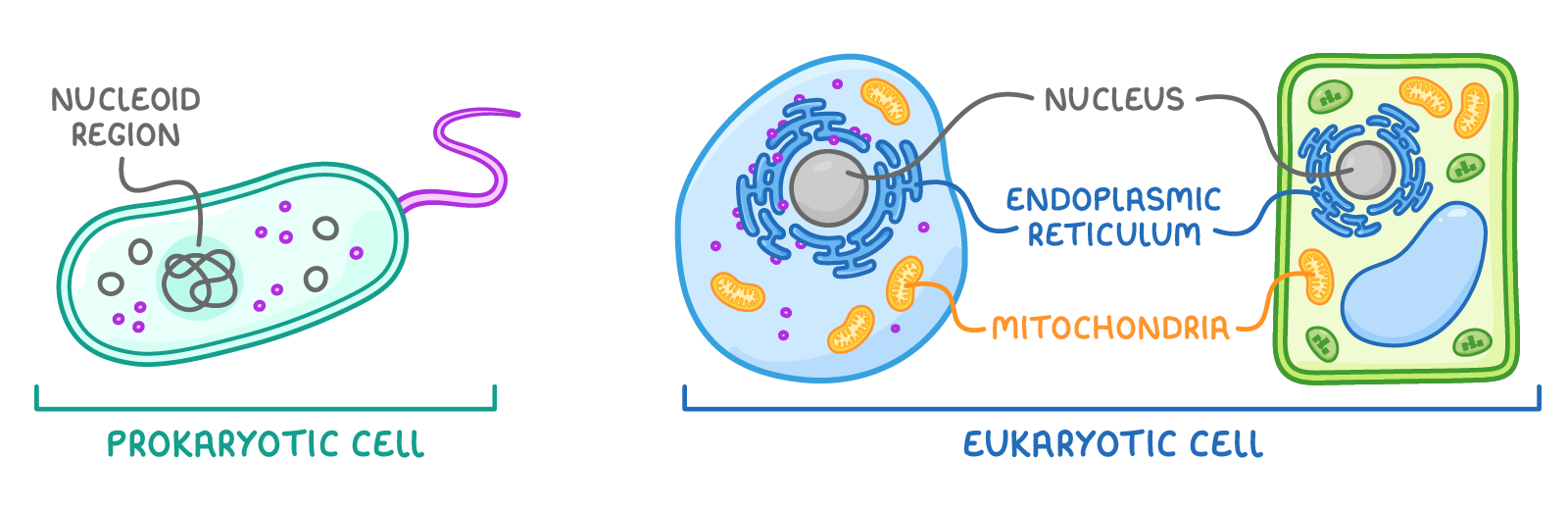
Prokaryotic cells
Prokaryotic cells are single-celled organisms that lack a defined nucleus or membrane-bound organelles. Examples include bacteria and archaea.
Characteristics of prokaryotic cells:
- Lack of internal membranes - These cells do not have internal membrane-bound structures like a nucleus; instead, their genetic material (DNA) is located in a region called the nucleoid, which is not enclosed by a membrane.
- Specialized regions - Despite the absence of organelles, prokaryotes have distinct areas within the cell where specific functions occur, such as regions for protein synthesis or photosynthesis in certain bacteria.
- Cell wall and membrane - Many prokaryotes have a protective cell wall outside their plasma membrane, providing structural support, but this is not considered internal compartmentalization.
Eukaryotic cells
Eukaryotic cells are found in plants, animals, fungi, and protists. They are typically larger and more complex than prokaryotic cells.
Characteristics of eukaryotic cells:
- Membrane-bound organelles - These cells contain internal membranes that form distinct compartments, such as the nucleus (housing DNA), mitochondria (energy production), and endoplasmic reticulum (protein and lipid synthesis).
- Functional specialization - The presence of organelles allows eukaryotic cells to separate and optimize different biochemical processes within the same cell, contributing to greater complexity and efficiency.
- Cytoskeleton - Eukaryotic cells have a cytoskeleton, a network of protein fibers that helps maintain cell shape and organize internal components, further enhancing compartmentalization.
Comparison of compartmentalization
| Feature | Prokaryotic cells | Eukaryotic cells |
|---|---|---|
| Nucleus | Absent; DNA in nucleoid region (no membrane) | Present; DNA enclosed in a membrane-bound nucleus |
| Membrane-bound organelles | Absent; functions in specialized regions | Present; includes mitochondria, chloroplasts, etc. |
| Internal membranes | Minimal; no separation of functions by membranes | Extensive; partitions cell into specialized regions |
| Complexity | Simpler structure and organization | More complex with specialized compartments |
Evolutionary origins of membrane-bound organelles through endosymbiosis
The complexity of eukaryotic cells, particularly the presence of membrane-bound organelles, is believed to have originated through a process called endosymbiosis. This evolutionary mechanism explains how certain organelles, like mitochondria and chloroplasts, came to be integral parts of eukaryotic cells.
Endosymbiosis
Endosymbiosis is a symbiotic relationship where one organism lives inside another, eventually leading to a permanent integration. In the context of cell evolution, it describes how free-living prokaryotic cells were engulfed by larger host cells and became organelles over time. This theory suggests that eukaryotic cells evolved from prokaryotic ancestors through a series of endosymbiotic events, increasing cellular complexity and functionality.
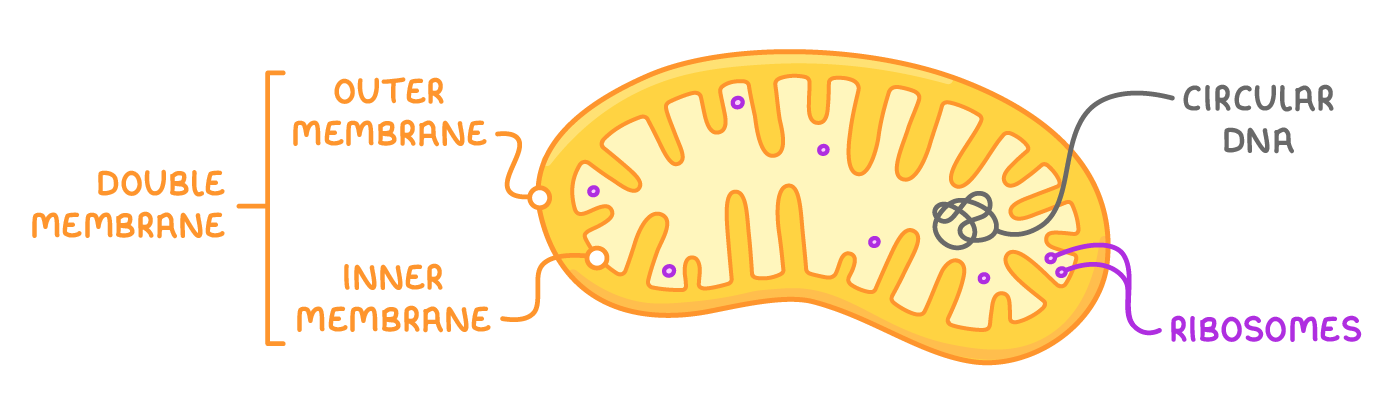
Evidence for endosymbiosis in mitochondria and chloroplasts
- Similarities to prokaryotes - Mitochondria (like the one above) and chloroplasts resemble free-living bacteria in size, structure, and genetic material. They contain their own DNA, which is circular, much like bacterial DNA, and distinct from the linear DNA found in the eukaryotic nucleus.
- Double membranes - Both organelles are surrounded by two membranes, which is consistent with the idea that an engulfed prokaryote would retain its original membrane while being enclosed by the host cell's membrane during endocytosis.
- Reproductive behavior - Mitochondria and chloroplasts replicate independently within the eukaryotic cell through a process similar to binary fission, a method used by prokaryotes, rather than through the host cell's mitotic division.
- Ribosomal similarity - The ribosomes within these organelles are more similar to those of prokaryotes than to the ribosomes in the eukaryotic cytoplasm, suggesting a shared ancestry with bacteria.
Stages of endosymbiotic evolution
- Engulfment - A larger prokaryotic or early eukaryotic host cell engulfed a smaller, free-living prokaryote, likely through a process similar to phagocytosis, where the host cell's membrane surrounds and encloses the smaller cell.
- Mutual benefit - The engulfed cell provided a benefit to the host, such as energy production (in the case of mitochondria) or photosynthesis (in the case of chloroplasts), while the host offered protection and nutrients. This mutualistic relationship favored survival for both.
- Integration - Over generations, the engulfed cell lost some of its independence, transferring much of its genetic material to the host cell's nucleus, becoming a permanent organelle within the host.
- Specialization - The organelle and host cell co-evolved, with the organelle becoming specialized for specific functions, like ATP synthesis in mitochondria or glucose production in chloroplasts, contributing to the overall complexity of eukaryotic cells.
Significance of endosymbiosis
- Increased complexity - Endosymbiosis allowed eukaryotic cells to develop specialized organelles, enabling them to perform a wider range of functions compared to prokaryotic cells.
- Energy efficiency - Mitochondria, derived from aerobic bacteria, provided a significant energy boost through efficient ATP production, supporting larger and more active cells.
- Photosynthetic capability - Chloroplasts, originating from cyanobacteria, enabled eukaryotic cells like plants and algae to harness sunlight for energy, fundamentally shaping Earth's ecosystems.
Specialized regions in prokaryotic and eukaryotic cells
While prokaryotic and eukaryotic cells differ in their use of membrane-bound compartments, both types of cells organize their internal environments into specialized regions to optimize function. These regions ensure that critical processes are conducted efficiently and without interference.
Specialized regions in prokaryotic cells
- Nucleoid region - The area where the cell's circular DNA is located, serving as the genetic control center despite lacking a surrounding membrane.
- Cytoplasm - The gel-like substance filling the cell, where metabolic reactions like glycolysis (the breakdown of glucose for energy) occur.
- Plasma membrane invaginations - In some prokaryotes, such as photosynthetic bacteria, the plasma membrane folds inward to form structures where specific processes like photosynthesis take place.
- Ribosomes - Small structures scattered throughout the cytoplasm, responsible for protein synthesis, though not enclosed by membranes.
Specialized regions in eukaryotic cells
- Nucleus - The control center of the cell, enclosed by a double membrane called the nuclear envelope, which houses the cell's linear DNA and regulates gene expression.
- Mitochondria - Often called the "powerhouses" of the cell, these organelles are the site of cellular respiration, producing ATP (adenosine triphosphate), the cell's energy currency, through processes like the Krebs cycle and oxidative phosphorylation.
- Chloroplasts - Found in plant cells and some protists, these organelles conduct photosynthesis, converting light energy into chemical energy stored as glucose.
- Endoplasmic reticulum (ER) - A network of membranes involved in protein synthesis (rough ER, studded with ribosomes) and lipid production (smooth ER), demonstrating how internal membranes create specialized environments.
- Golgi apparatus - A series of flattened membranes that modify, package, and transport proteins and lipids to specific destinations within or outside the cell.
- Lysosomes - Membrane-bound vesicles containing digestive enzymes that break down waste materials and cellular debris, protecting the rest of the cell from harmful byproducts.
By organizing their internal spaces into these specialized regions, both prokaryotic and eukaryotic cells efficiently manage the diverse processes necessary for life, highlighting the unity and diversity driven by evolutionary processes.