3.4 - Photosynthesis
The fundamental process and importance of photosynthesis
Photosynthesis is a vital biological process that allows organisms to convert light energy from the sun into chemical energy stored in carbohydrates. This process not only sustains the organisms performing it but also supports life on Earth by producing oxygen as a byproduct.
Photosynthesis
Photosynthesis is a series of chemical reactions that use carbon dioxide (CO2), water (H2O), and light energy to produce carbohydrates (like glucose) and oxygen (O2). It enables photosynthetic organisms, such as plants, algae, and some bacteria, to capture solar energy and store it in a form that can be used for growth, reproduction, and other metabolic processes.
Chemical equation for photosynthesis:
This equation shows how carbon dioxide and water are transformed into glucose (C6H12O6) and oxygen using light energy.
Evolutionary significance of photosynthesis
- Origin in prokaryotes - Photosynthesis first evolved in prokaryotic organisms, such as cyanobacteria, which are simple, single-celled organisms without a nucleus.
- Oxygenated atmosphere - Scientific evidence indicates that cyanobacterial photosynthesis was crucial in creating Earth's oxygen-rich atmosphere, transforming the planet's environment over billions of years.
- Foundation for eukaryotes - The photosynthetic pathways in prokaryotes served as the basis for the development of photosynthesis in eukaryotic organisms (organisms with complex cells), such as plants and algae, through evolutionary processes like endosymbiosis.
The structural features of chloroplasts involved in photosynthesis
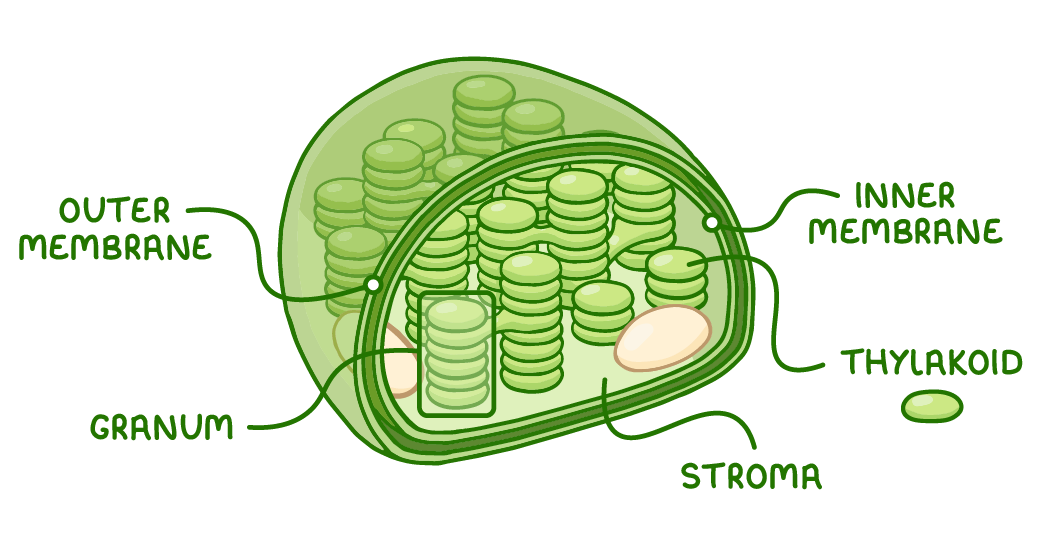
In eukaryotic organisms like plants, photosynthesis occurs within specialized organelles called chloroplasts. These structures are designed to efficiently capture light energy and convert it into chemical energy through distinct regions and components.
Chloroplasts are double-membraned organelles found in the cells of plants and algae, containing the machinery needed for photosynthesis.
Key components of the chloroplast
- Stroma - This is the fluid-filled space inside the inner membrane of the chloroplast but outside the thylakoids. It is the site where carbon fixation, or the Calvin cycle, takes place, turning carbon dioxide into carbohydrates.
- Thylakoids - These are flattened, membrane-bound sacs within the chloroplast. They contain chlorophyll, the green pigment that absorbs light energy, and are organized into stacks called grana (singular: granum).
- Grana - These stacks of thylakoids are where the light reactions of photosynthesis occur, capturing light energy to produce energy carriers.
- Photosystems - Embedded in the thylakoid membranes are two types of protein complexes called photosystem I and photosystem II, which house chlorophyll and other pigments. These systems play a critical role in absorbing light and transferring energy.
This structural organization ensures that different stages of photosynthesis are spatially separated, optimizing the efficiency of energy capture and conversion.
The light reactions and their role in capturing energy
The first stage of photosynthesis, known as the light reactions, occurs in the thylakoid membranes of the chloroplast. These reactions harness light energy to produce energy-rich molecules that power the rest of the photosynthetic process.
Overview of light reactions
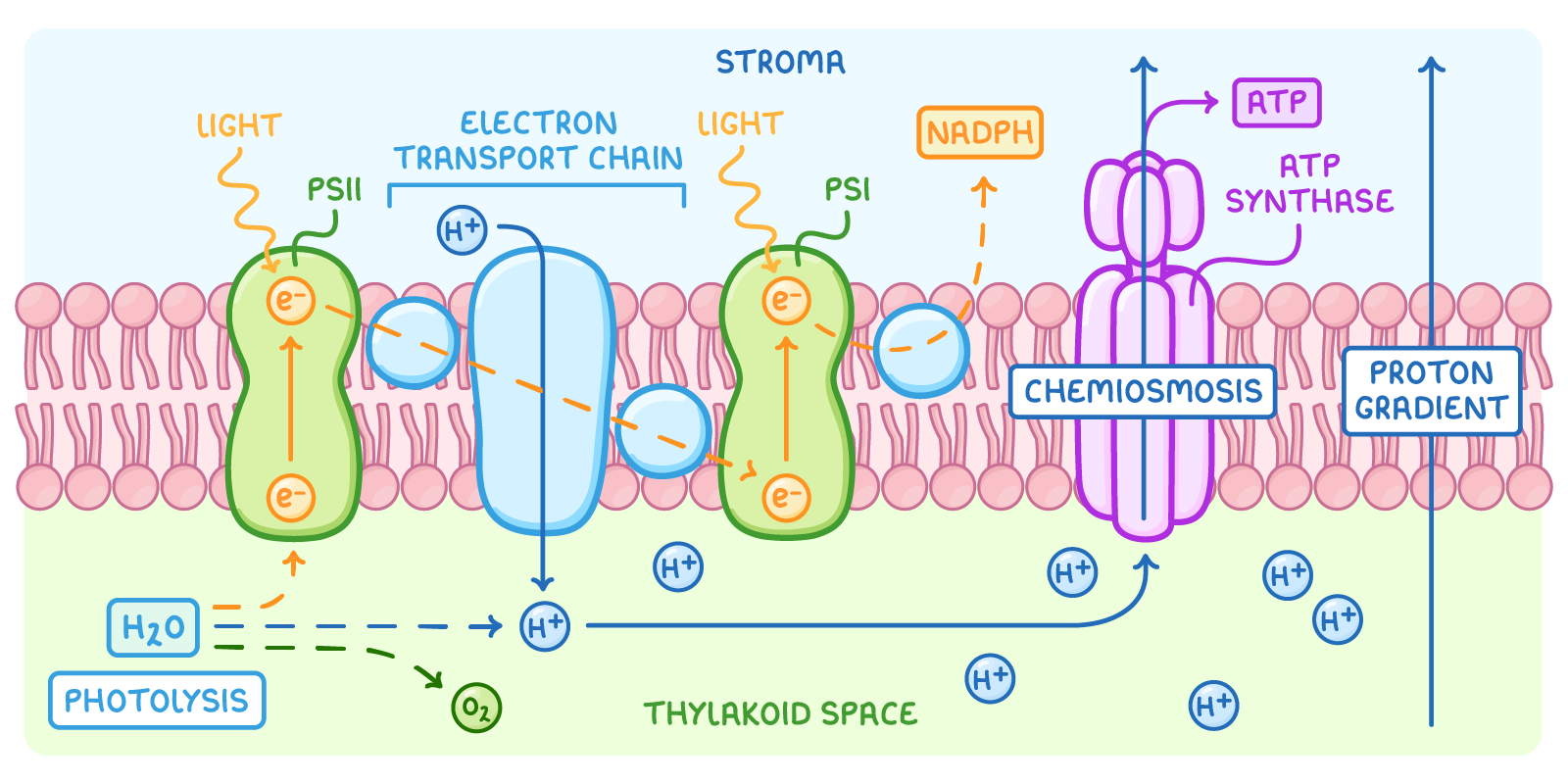
Light reactions capture energy from sunlight and use it to produce ATP (adenosine triphosphate, the primary energy currency of cells) and NADPH (nicotinamide adenine dinucleotide phosphate, a high-energy electron carrier). These reactions take place in the grana of the thylakoids, specifically within photosystems I and II. The reactions use light energy and water (H2O) as inputs, producing ATP, NADPH, and oxygen (O2) as a byproduct.
Process of energy capture in light reactions
- Light absorption - Chlorophyll molecules in photosystem II absorb light energy, exciting electrons to a higher energy state.
- Electron replacement through water splitting - The excited electrons are lost from photosystem II and must be replaced. Water molecules are split (a process called photolysis) to provide these electrons, releasing oxygen gas (O2) as a byproduct and protons (H+) into the thylakoid space.
- Electron transfer to photosystem I - The high-energy electrons move through a series of proteins in the thylakoid membrane, eventually reaching photosystem I, where they are re-energized by light absorption.
- Production of NADPH - At the end of this journey, electrons are transferred to NADP+, reducing it to NADPH, which will be used as an energy source in later stages of photosynthesis.
This sequence of events ensures that light energy is efficiently converted into chemical energy, stored temporarily in ATP and NADPH.
The electron transport chain and proton gradient formation
Central to the light reactions is the electron transport chain (ETC), a series of protein complexes in the thylakoid membrane that shuttles electrons and creates a proton gradient critical for energy production.
Role of the electron transport chain
The ETC is a sequence of proteins and other molecules that transfer electrons through a series of oxidation-reduction (redox) reactions. In chloroplasts, the ETC is embedded in the thylakoid membranes, connecting photosystem II to photosystem I.
How the electron transport chain creates a proton gradient:
- As electrons pass through the ETC, they lose energy, which is used to pump protons (H+) from the stroma into the thylakoid space, creating a concentration gradient.
- This movement results in a higher concentration of protons inside the thylakoid space compared to the stroma outside, establishing an electrochemical gradient across the thylakoid membrane.
This gradient is a form of potential energy, much like water behind a dam, waiting to be harnessed for ATP production.
ATP synthesis through photophosphorylation
The proton gradient created by the ETC is used to produce ATP through a process called photophosphorylation. This mechanism mirrors processes in other cellular energy systems but is uniquely powered by light energy in photosynthesis.
Mechanism of photophosphorylation
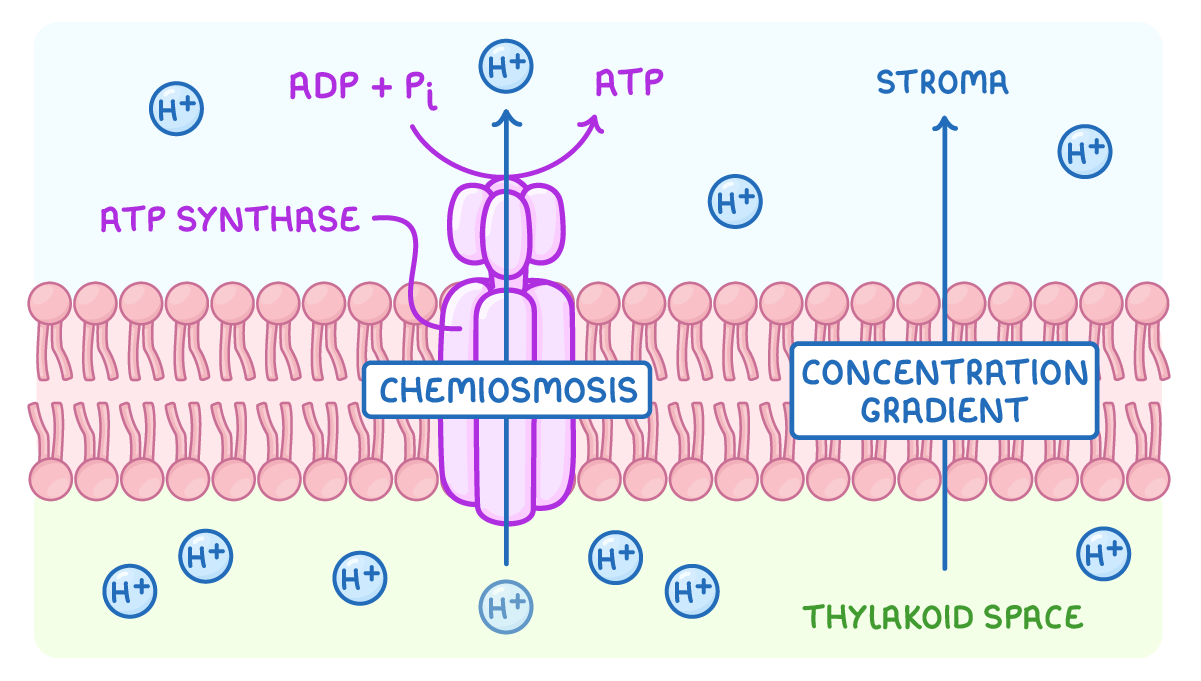
Photophosphorylation is the process of synthesizing ATP from ADP (adenosine diphosphate) and inorganic phosphate using energy derived from light. ATP synthase is an enzyme embedded in the thylakoid membrane that acts as a channel and molecular motor, allowing protons to flow back into the stroma.
The chemiosmosis process:
- The flow of protons (H+) down their concentration gradient through ATP synthase is called chemiosmosis.
- This movement drives the rotation of ATP synthase, which catalyzes the addition of a phosphate group to ADP, forming ATP.
- The potential energy stored in the proton gradient is converted into chemical energy in the bonds of ATP, ready to power other cellular processes.
This elegant process links the energy captured from light to a usable form, ensuring cells have the energy needed for subsequent reactions.
The Calvin cycle and carbohydrate production
The second stage of photosynthesis, known as the Calvin cycle, uses the ATP and NADPH produced in the light reactions to convert carbon dioxide into carbohydrates. This process occurs in the stroma of the chloroplast.
Overview of the Calvin cycle
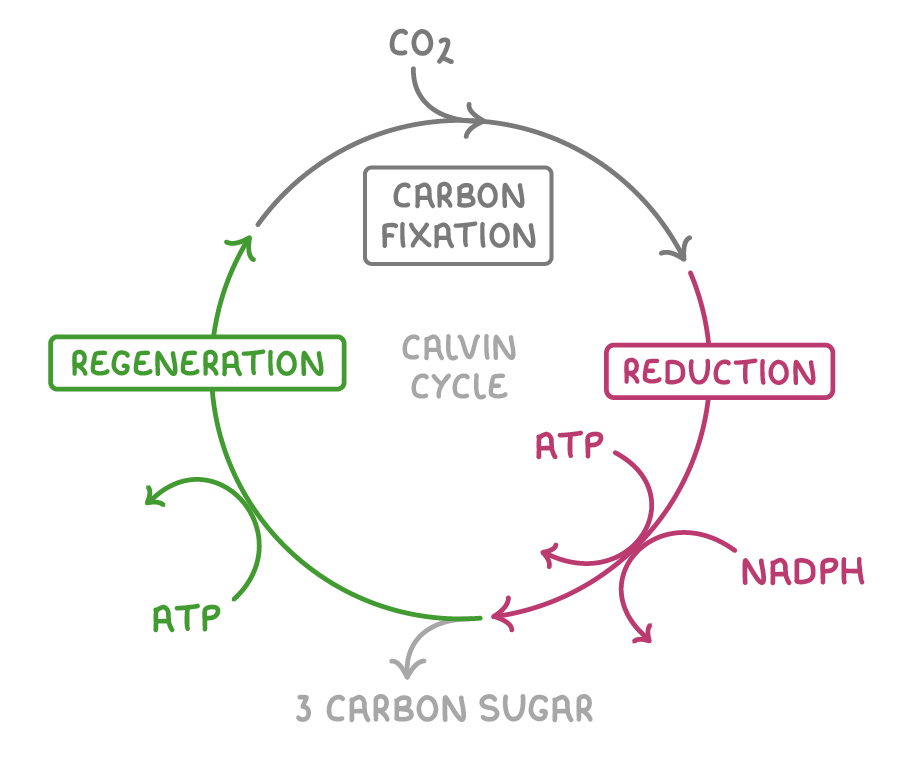
The Calvin cycle, also known as carbon fixation, builds organic molecules, primarily glucose, from carbon dioxide, providing a source of energy and building blocks for the organism. Unlike the light reactions, the Calvin cycle takes place in the stroma of the chloroplast, outside the thylakoids. It relies on ATP for energy and NADPH for reducing power, both supplied by the light reactions.
Key stages of the Calvin cycle
- Carbon fixation - Carbon dioxide (CO2) molecules are incorporated into a larger molecule, beginning the process of building carbohydrates.
- Reduction - ATP and NADPH are used to add energy and electrons to the carbon molecules, transforming them into higher-energy forms.
- Regeneration - The cycle regenerates its starting molecule, allowing it to continue fixing more carbon dioxide with the help of ATP.
Outcome of the Calvin cycle
- Carbohydrate production - The cycle ultimately produces a three-carbon sugar that can be used to form glucose and other carbohydrates.
- Storage and use - These carbohydrates serve as energy storage for the organism and as structural components for growth, such as in cell walls.
The Calvin cycle completes the process of photosynthesis by transforming light-derived energy into stable, organic molecules that fuel life processes.