4.1 - Cell Communication
The importance of cell communication in living systems
Cell communication is a fundamental process in living organisms, allowing cells to coordinate their activities, respond to environmental changes, and maintain the overall functioning of the organism. This interaction ensures that information is stored, retrieved, transmitted, and acted upon, which is essential for life processes. Whether it's a single-celled organism sensing its surroundings or a complex multicellular organism regulating growth, communication between cells is key to survival and adaptation.
Why cell communication matters
- Coordination of functions - Cells work together to perform tasks such as growth, immune responses, and tissue repair by sharing information.
- Response to stimuli - Communication allows cells to detect and react to changes in their internal and external environments.
- Maintenance of homeostasis - Cells signal each other to regulate processes like hormone levels and nutrient distribution, ensuring stability within the organism.
The mechanisms of cell communication through direct contact
Cells can communicate directly with one another through physical contact, a method often used when cells are in close proximity. This type of communication involves interactions between cell surfaces and is crucial in processes like immune responses and tissue development.
How direct contact communication works
Cell-to-cell contact occurs when cells interact via specialized structures or molecules on their surfaces, allowing direct transfer of signals without the need for chemical mediators. This method ensures a rapid and specific response, as the signal is delivered only to the cells that are in direct contact, minimizing unintended effects on nearby cells.
Example - Immune response:
- In the immune system, antigen-presenting cells (APCs) display foreign particles (antigens) on their surfaces.
- Helper T-cells and killer T-cells physically interact with APCs to recognize these antigens, triggering an immune response.
- Helper T-cells coordinate the response by activating other immune cells, while killer T-cells directly attack infected cells.
Short-distance cell communication using local regulators
Cells can also communicate over short distances by releasing chemical signals known as local regulators. These signals target nearby cells, influencing their behavior without affecting the entire organism.
Characteristics of short-distance signaling
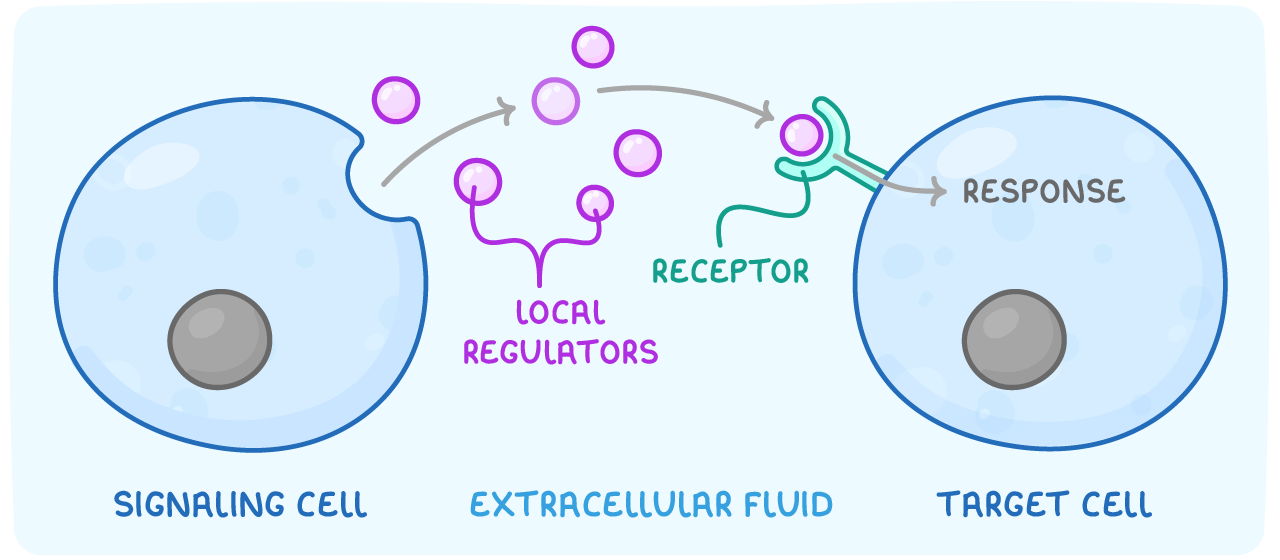
Local regulators are signaling molecules released by a cell that affect only neighboring cells in the immediate vicinity. These molecules diffuse through the extracellular fluid and bind to receptors on nearby target cells, triggering a response. This type of signaling is fast due to the short distance but is limited to a small area around the signal-emitting cell.
Examples of short-distance signaling
- Neurotransmitters - In the nervous system, neurons release neurotransmitters into the synapse (a small gap between neurons) to communicate with adjacent neurons or muscle cells, facilitating rapid responses like muscle contraction.
- Plant immune response - When a plant cell detects a pathogen, it releases signaling molecules to alert nearby cells, triggering defensive responses such as strengthening cell walls or producing toxic compounds.
- Quorum sensing in bacteria - Bacteria use local chemical signals to detect the density of their population. When a threshold is reached, they coordinate group behaviors like forming biofilms or producing toxins.
- Morphogens in embryonic development - During embryo formation, cells release morphogens (signaling molecules) that create concentration gradients, instructing nearby cells on how to differentiate into specific tissues or structures.
Long-distance cell communication via chemical signals
For communication across greater distances within an organism, cells rely on chemical signals that travel through the bloodstream or other fluid systems. This method is essential for coordinating activities between different parts of a multicellular organism.
Characteristics of long-distance signaling
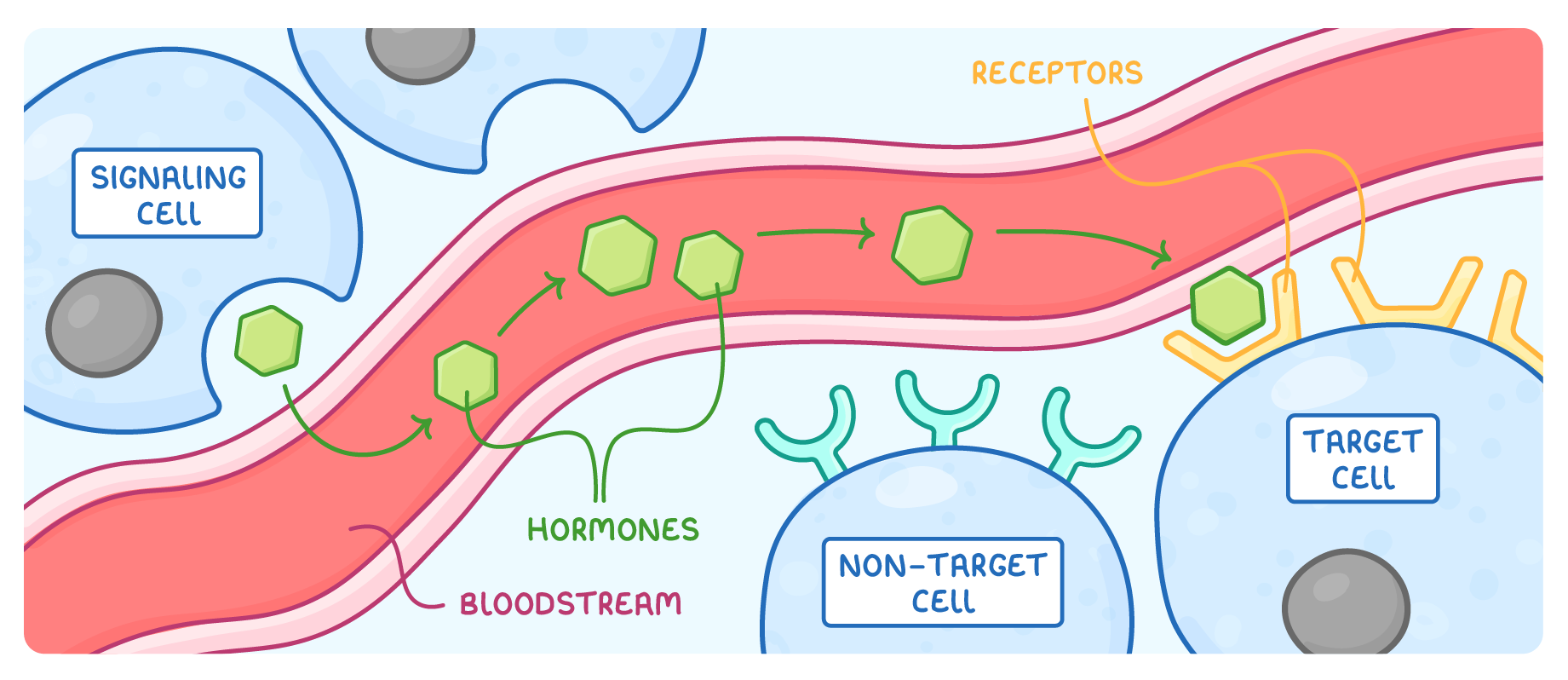
Endocrine signaling involves cells releasing hormones into the bloodstream, which then travel to distant target cells with specific receptors. Hormones bind to receptors on or inside target cells, initiating a cascade of cellular responses even though the signal-emitting cell and target cell are far apart. This signaling is slower than direct contact or local signaling due to the time required for hormones to travel, but it can affect cells throughout the entire organism.
Examples of long-distance signaling
- Insulin - Produced by pancreatic cells, insulin travels through the blood to regulate glucose uptake in distant cells like muscle and fat cells, maintaining blood sugar levels.
- Human growth hormone (HGH) - Secreted by the pituitary gland, HGH stimulates growth and cell reproduction in various tissues across the body.
- Thyroid hormones - These hormones, released by the thyroid gland, control metabolism in nearly all body cells, influencing energy use and growth.
- Testosterone - Produced in the testes, testosterone affects male reproductive tissues and secondary sexual characteristics, signaling cells far from its point of origin.
- Estrogen - Secreted by the ovaries, estrogen regulates female reproductive processes and influences tissues like bone and fat across the body.
Examples of cell communication in various biological contexts
Cell communication is not limited to one type of organism or system; it occurs in diverse contexts, each adapted to specific needs. The following examples highlight the versatility and importance of these signaling mechanisms.
Immune system coordination
- Direct contact - As mentioned earlier, immune cells like helper T-cells and killer T-cells interact directly with antigen-presenting cells to mount a targeted attack against pathogens.
- Chemical signals - Immune cells also release cytokines (a type of local regulator) to communicate with nearby cells, amplifying the immune response by recruiting additional cells to the infection site.
Nervous system signaling
- Short-distance - Neurotransmitters facilitate quick communication between neurons or between neurons and muscle cells, ensuring rapid reflexes and responses.
- Long-distance integration - The nervous system often works in tandem with the endocrine system, where hormones provide slower, sustained regulation of bodily functions influenced by neural signals.
Developmental biology
- Morphogen gradients - In embryos, short-distance signaling via morphogens determines cell fate, guiding the formation of tissues and organs through precise spatial patterns.
- Hormonal control - Long-distance signals like growth hormones ensure that developmental processes are synchronized across the growing organism.
Through these varied mechanisms - direct contact, short-distance local regulators, and long-distance chemical signals - cells achieve the remarkable coordination necessary for life, from single-celled bacteria to complex multicellular organisms.