4.2 - Introduction to Signal Transduction
What is signal transduction and why is it important?
Signal transduction is the process by which a cell converts an extracellular signal into a specific intracellular response. This mechanism allows living systems to store, retrieve, transmit, and respond to information essential for life processes. It plays a critical role in coordinating cellular activities and enabling cells to react appropriately to their environment, whether that's growing, secreting molecules, or expressing specific genes.
Key purposes of signal transduction
- Communication - Enables cells to receive and interpret signals from their surroundings or other cells.
- Coordination - Ensures that cellular activities are synchronized, such as during development or immune responses.
- Response to stimuli - Allows cells to adapt to changes, like responding to hormones or environmental cues.
This process is fundamental to maintaining homeostasis and facilitating complex functions in multicellular organisms, linking external signals with precise internal actions.
Components of a signal transduction pathway
A signal transduction pathway consists of several key components that work together to transmit a signal from the outside of a cell to the inside, ultimately triggering a specific response. Understanding these components is crucial to grasping how cells communicate and function.
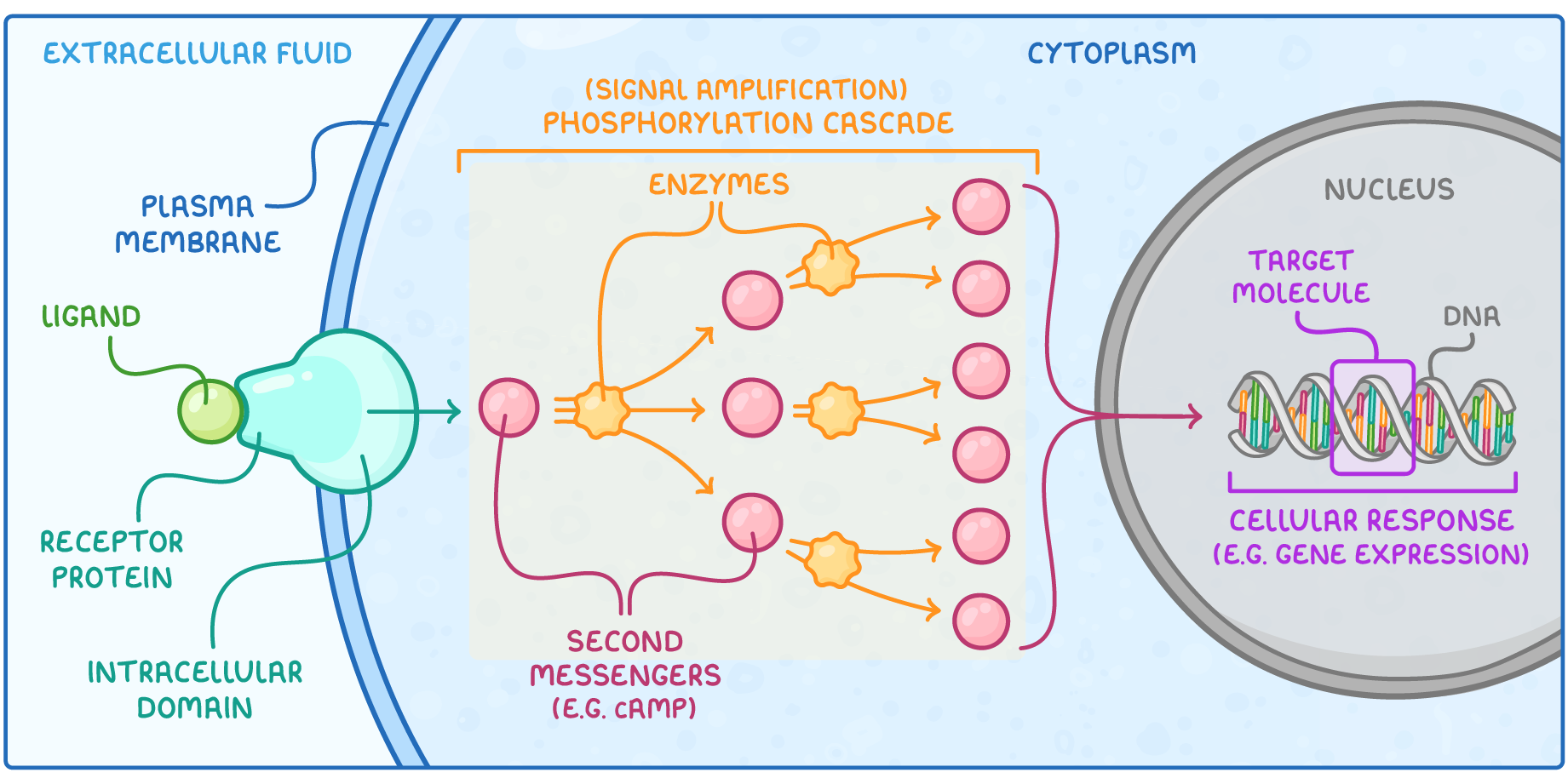
Primary components of signal transduction pathways
- Ligand - A chemical messenger, such as a peptide (a short chain of amino acids) or a small molecule, that carries the signal to the cell. Ligands can travel short or long distances, like hormones moving through the bloodstream.
- Receptor protein - A specialized protein that recognizes and binds to a specific ligand. Receptors can be located on the cell surface, in the cytoplasm, or within the nucleus, depending on the type of signal.
- Intracellular domain - The part of the receptor inside the cell that changes shape upon ligand binding, initiating the transduction process.
- Second messengers - Molecules like cyclic AMP (cAMP) that relay and often amplify the signal inside the cell.
- Enzymes - Proteins that facilitate chemical reactions, often modifying other proteins through processes like phosphorylation (adding a phosphate group) to propagate the signal.
- Target molecules - The final components, such as proteins or genes, that produce the cellular response, whether it's cell growth, secretion, or gene expression.
These components form a chain of events, ensuring that a signal received at the cell's surface translates into a meaningful action within the cell.
Ligand-receptor interactions: Starting the signal
The signal transduction pathway begins with the recognition of a ligand by a receptor protein on or in a target cell. This interaction is highly specific, much like a lock and key, ensuring that only the correct signal triggers a response.
How ligand-receptor binding initiates the signal
- Ligand recognition - The ligand binds to the ligand-binding domain, a specific region of the receptor protein designed to recognize a particular messenger.
- Receptor activation - Upon binding, the receptor undergoes a conformational change (a change in shape), particularly in its intracellular domain, which starts the signal transduction process.
- Location variations - Receptors can be:
- On the cell surface, common for water-soluble ligands that cannot cross the cell membrane.
- In the cytoplasm or nucleus, typical for lipid-soluble ligands like steroid hormones that can pass through the membrane.
Examples of receptor types
- G protein-coupled receptors (GPCRs) - A common type of receptor protein in eukaryotes (organisms with complex cells, like humans). These receptors work with G proteins to transmit signals and are involved in many processes, such as vision and smell.
- Ligand-gated channels - Receptors that, upon ligand binding, open or close to allow ions to flow into or out of the cell, directly altering the cell's internal environment.
This initial binding step is critical, as it determines whether and how a cell will respond to a given signal.
Signal relay and amplification through cascades
Once the receptor is activated, the signal must be relayed inside the cell to reach its target. This often involves a series of steps known as a signaling cascade, which not only transmits the signal but also amplifies it, ensuring a robust cellular response.
Steps in a signaling cascade
- Signal initiation - The activated receptor's intracellular domain triggers the first step, often by activating an enzyme or releasing a second messenger.
- Signal relay - Enzymes and second messengers, such as cyclic AMP (cAMP), pass the signal along a chain of molecules. This relay process can involve multiple steps, each activating the next component.
- Protein modifications - Many pathways include phosphorylation cascades, where enzymes add phosphate groups to proteins, altering their activity and passing the signal forward.
- Signal amplification - At each step, the signal can be amplified, meaning a single ligand-receptor interaction can activate many molecules downstream. This ensures even a weak initial signal can produce a significant response.
Why amplification matters
- Increased sensitivity - Amplification allows cells to detect and respond to very low concentrations of ligands.
- Efficient response - A small signal can trigger a large-scale reaction, such as the release of numerous molecules or widespread gene activation.
This cascade mechanism ensures that signals are not lost and that cells can respond appropriately even to subtle environmental changes.
Cellular responses triggered by signal transduction
The ultimate goal of signal transduction is to produce a specific cellular response. Depending on the signal and the cell type, these responses can vary widely, affecting everything from immediate actions to long-term changes in cell behavior.
Types of cellular responses
- Cell growth - Signals can stimulate cells to divide and grow, crucial during development or tissue repair.
- Secretion of molecules - Cells may release substances like hormones or neurotransmitters in response to a signal, as seen in endocrine or nervous system functions.
- Gene expression - Signals can activate or repress specific genes, leading to the production of new proteins that alter cell function over time.
Real-world example: Hormonal signaling
Hormones, such as insulin, are ligands that travel long distances through the bloodstream to reach target cells. When insulin binds to receptors on muscle or liver cells, it triggers a cascade that leads to increased glucose uptake - a critical response for regulating blood sugar levels.
This diversity in responses highlights the versatility of signal transduction pathways in maintaining cellular and organismal function, ensuring that cells adapt to internal and external cues effectively.