1.3 - Introduction to Macromolecules
The role of macromolecules in biological systems
Macromolecules are large, complex molecules essential for life, playing critical roles in the structure and function of biological systems. These molecules, including carbohydrates, lipids, proteins, and nucleic acids, are the building blocks of cells and are involved in nearly every process within organisms. Their interactions showcase the complexity of biological systems, as they are formed and broken down through specific chemical reactions that maintain the balance of life.
Key functions of macromolecules
- Structural support - Macromolecules like proteins and carbohydrates provide structural integrity to cells and tissues.
- Energy storage - Lipids and carbohydrates store energy for later use by organisms.
- Information transfer - Nucleic acids, such as DNA (deoxyribonucleic acid), carry genetic information crucial for growth and reproduction.
- Catalysis and regulation - Proteins, acting as enzymes, speed up chemical reactions and regulate metabolic processes.
Understanding how these large molecules are built and broken down is fundamental to grasping how biological systems interact and sustain life.
The process of hydrolysis in breaking down macromolecules
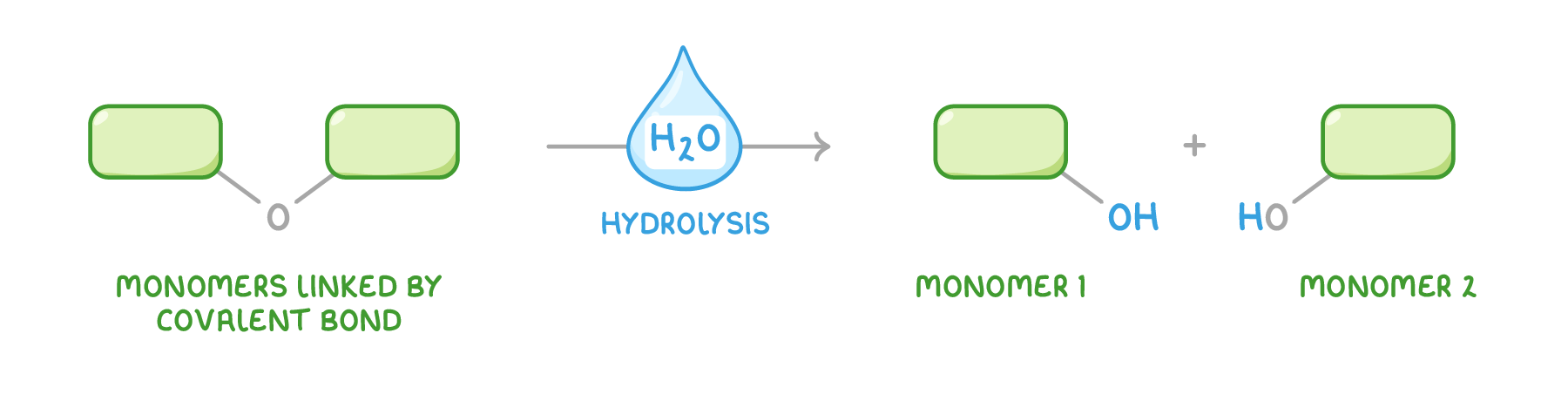
Hydrolysis is a chemical reaction that breaks down large macromolecules into smaller units, or monomers, by cleaving the covalent bonds between them. This process is vital for digestion and recycling within cells, allowing organisms to extract energy and building blocks from complex molecules.
Mechanism of hydrolysis
- Initiation with water - A water molecule is introduced to the covalent bond linking two monomers in a polymer (a large molecule made of repeating monomer units).
- Bond cleavage - The water molecule splits, and its components are added to the monomers.
- The hydrogen (H) from the water attaches to one monomer.
- The hydroxyl group (OH) from the water attaches to the other monomer.
- Resulting separation - This addition breaks the covalent bond, separating the polymer into smaller molecules or individual monomers.
Importance of hydrolysis
- Energy release - Breaking down macromolecules like starches into simple sugars provides energy for cellular activities.
- Recycling components - Hydrolysis allows cells to reuse monomers to build new molecules as needed.
- Digestive processes - In organisms, hydrolysis is key to breaking down food molecules into absorbable units, such as proteins into amino acids.
This reaction ensures that biological systems can continuously break down and repurpose macromolecules to meet changing demands.
The process of dehydration synthesis in building macromolecules
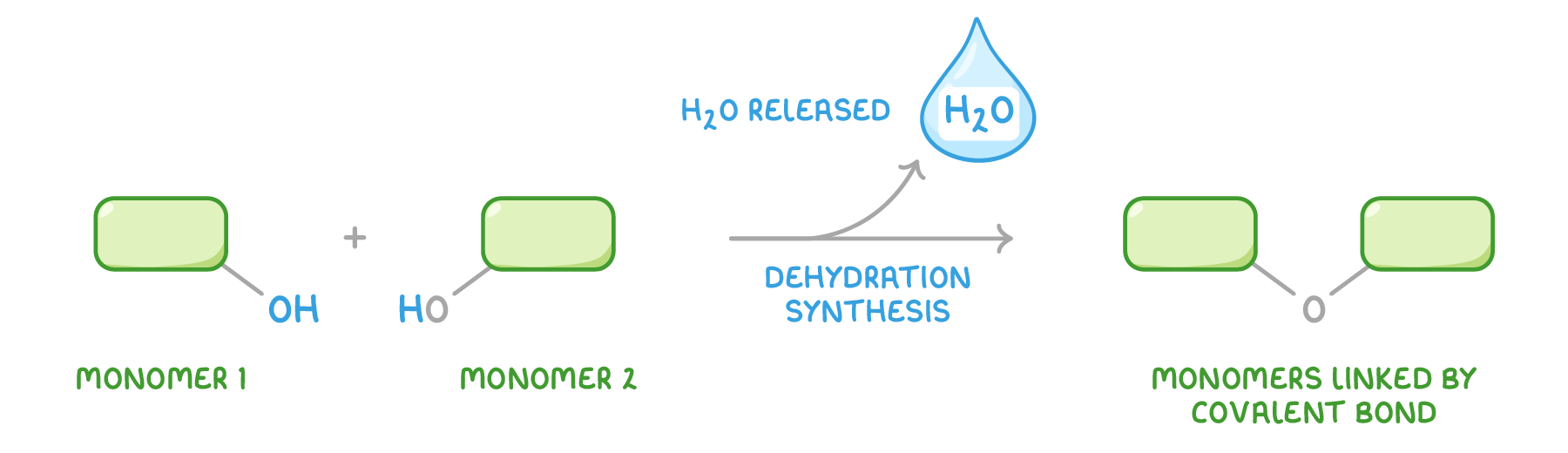
Dehydration synthesis is the chemical reaction responsible for building large macromolecules by joining smaller molecules, or monomers, together through covalent bonds. This process is essential for creating the complex structures that support life, such as proteins and polysaccharides.
Mechanism of dehydration synthesis
- Monomer alignment - Two monomers are positioned close to each other, ready to form a bond.
- Removal of water components - A hydrogen (H) is removed from one monomer, and a hydroxyl group (OH) is removed from the other.
- Formation of covalent bond - The removal of these components results in the loss of a water molecule (H2O), allowing the two monomers to bond covalently at the site of removal.
- Creation of larger molecule - This bond formation links the monomers into a larger structure, such as a dimer (two monomers) or eventually a polymer.
Significance of dehydration synthesis
- Building essential molecules - This reaction forms critical macromolecules like proteins (from amino acids) and carbohydrates (from simple sugars).
- Energy storage - It enables the creation of energy-storing molecules like starch in plants and glycogen in animals.
- Structural formation - Dehydration synthesis helps build structural components, such as cell walls in plants, made of cellulose.
This process is a cornerstone of biological growth, allowing cells to construct the intricate molecules needed for function and survival.
The concept of polymerization in forming complex structures
Polymerization is the process of linking many monomers together through repeated dehydration synthesis reactions to form a polymer. Polymers are the large, complex macromolecules that make up much of the structural and functional components of living organisms. This process amplifies the capabilities of simple molecules by creating extensive chains or networks.
How polymerization works
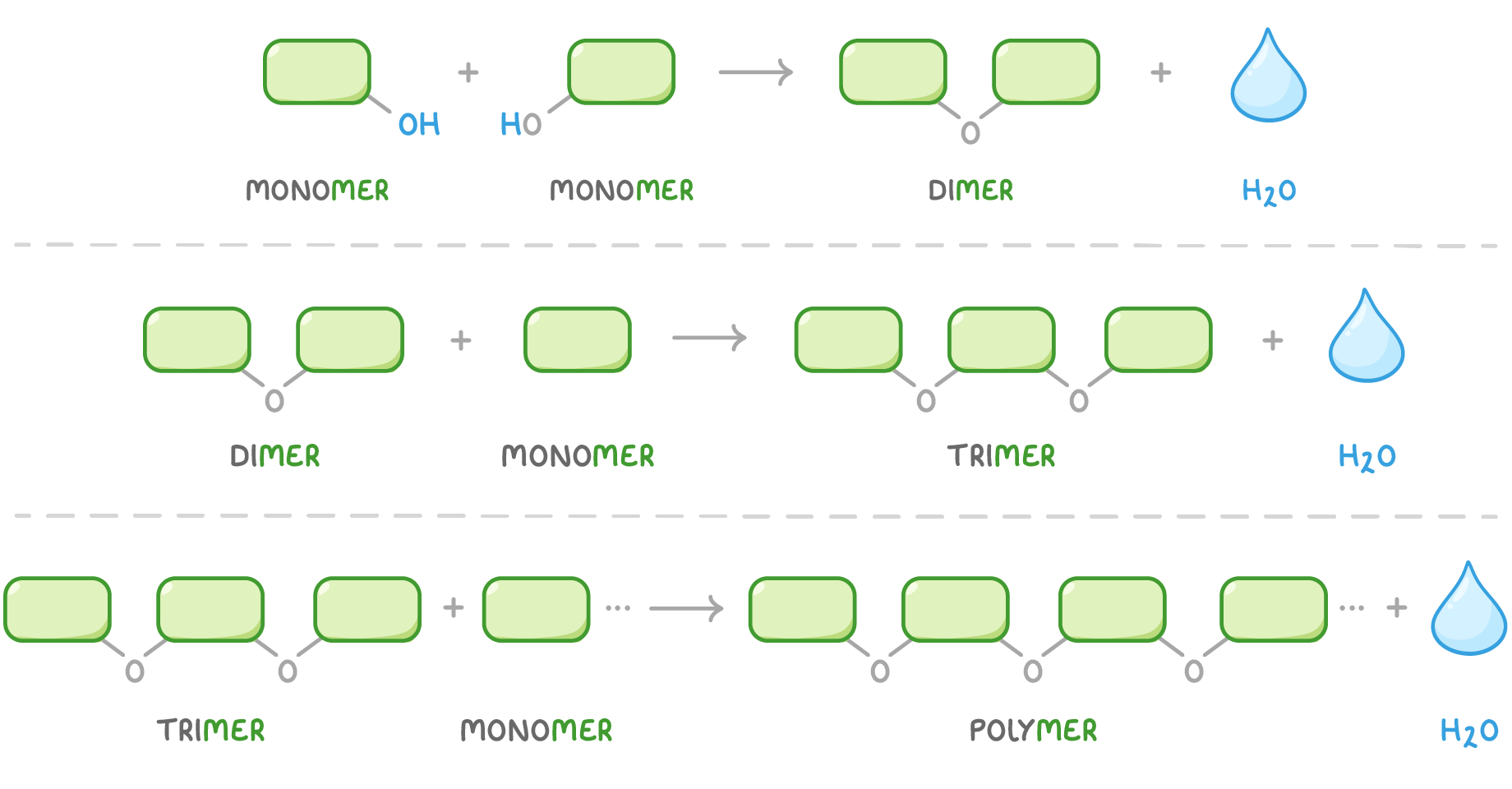
When two monomers join together, it forms a dimer. When three join, it forms a trimer. This dehydration synthesis process can be repeated multiple times, connecting numerous monomers to form a polymer - a long chain or branched structure made up of many repeating monomer units.
Depending on the monomers involved, polymerization can produce a variety of macromolecules with different properties. The resulting polymer often has properties and functions that are far more complex than those of the individual monomers.
Types of polymers formed:
- Polysaccharides - Chains of sugar monomers, like starch for energy storage or cellulose for structural support in plants.
- Polypeptides - Chains of amino acids forming proteins, which serve as enzymes, structural components, and signaling molecules.
- Polynucleotides - Chains of nucleotides forming DNA and RNA (ribonucleic acid), which store and transmit genetic information.
Role in biological systems
- Scalability - Polymerization allows organisms to create macromolecules of varying sizes tailored to specific needs, from small peptides to massive DNA strands.
- Diversity of function - The arrangement and type of monomers in a polymer determine its role, enabling a wide range of biological functions from one basic process.
- System interactions - Polymers interact within biological systems, such as proteins binding to DNA to regulate gene expression, showcasing the interconnectedness of life at a molecular level.
Polymerization through dehydration synthesis is a fundamental mechanism that enables the complexity and adaptability of biological systems, ensuring that organisms can grow, repair, and respond to their environments effectively.