7.12 - Origins of Life on Earth
Scientific evidence for the origin of life on Earth
The origin of life on Earth is a fascinating topic that scientists have studied through various lines of evidence. This evidence helps construct models that explain how life might have emerged from non-living matter billions of years ago. Understanding these models provides insight into the complex interactions of biological systems, which is a core concept in biology.
Why scientific evidence matters
- Foundation of models - Scientific evidence forms the basis for hypotheses and models about how life began, allowing us to piece together Earth's early history.
- Interdisciplinary approach - Evidence comes from fields like geology, chemistry, and biology, showing how different systems interacted to create conditions for life.
- Testing and refinement - These models are continually tested and refined as new discoveries emerge, demonstrating the dynamic nature of scientific inquiry.
Key geological evidence and timelines for life's emergence
Geological evidence plays a critical role in dating the origin of life and understanding the early Earth's environment. By studying rocks, fossils, and other geological features, scientists have established a timeline that narrows down when life likely first appeared.
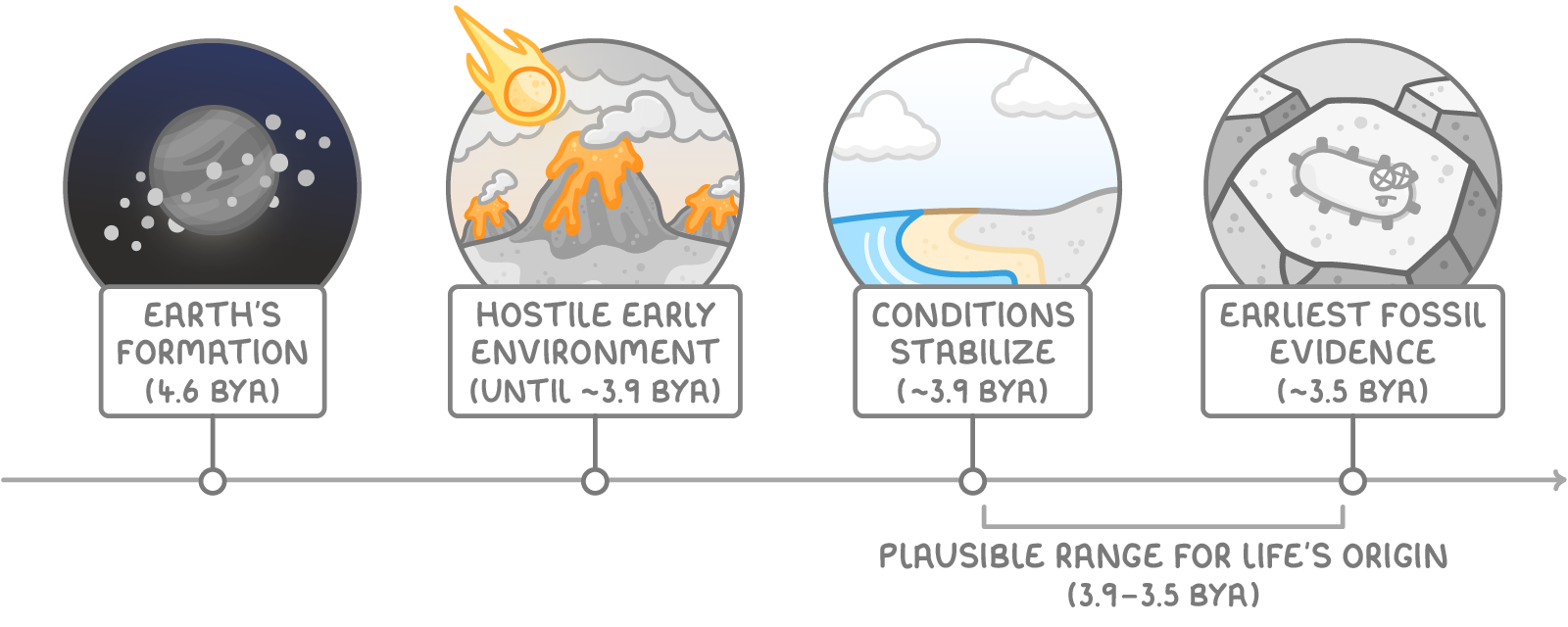
Timeline of Earth's formation and early life
- Earth's formation - Earth formed approximately 4.6 billion years ago (bya), likely through the accretion of dust and gas in the early solar system.
- Hostile early environment - For the first several hundred million years, Earth's surface was too hostile for life due to intense volcanic activity, meteorite impacts, and extreme temperatures. Conditions became more suitable around 3.9 bya.
- Earliest fossil evidence - The oldest known fossils, which are traces of microbial life, date back to about 3.5 bya. These fossils are found in ancient rock formations and provide direct evidence of early life forms.
- Plausible range for life's origin - Combining geological data and fossil records, scientists propose that life likely originated between 3.9 and 3.5 bya, a window when Earth's environment stabilized enough to support simple organisms.
Significance of geological evidence
- Context for life's start - Geological evidence helps us understand the environmental conditions under which life emerged, such as the presence of liquid water and milder temperatures.
- Chronological framework - It provides a timeline that anchors other scientific models, showing how long it took for life to appear after Earth's formation.
- Validation of models - Fossils and rock layers corroborate hypotheses about early life, linking physical evidence to theoretical ideas.
The RNA world hypothesis and its assumptions
One of the leading models for the origin of life is the RNA world hypothesis. This hypothesis suggests that RNA (ribonucleic acid), a molecule similar to DNA, was the first genetic material on Earth, predating both DNA and proteins. RNA's unique properties could have allowed it to play a central role in the emergence of life.
What is the RNA world hypothesis?
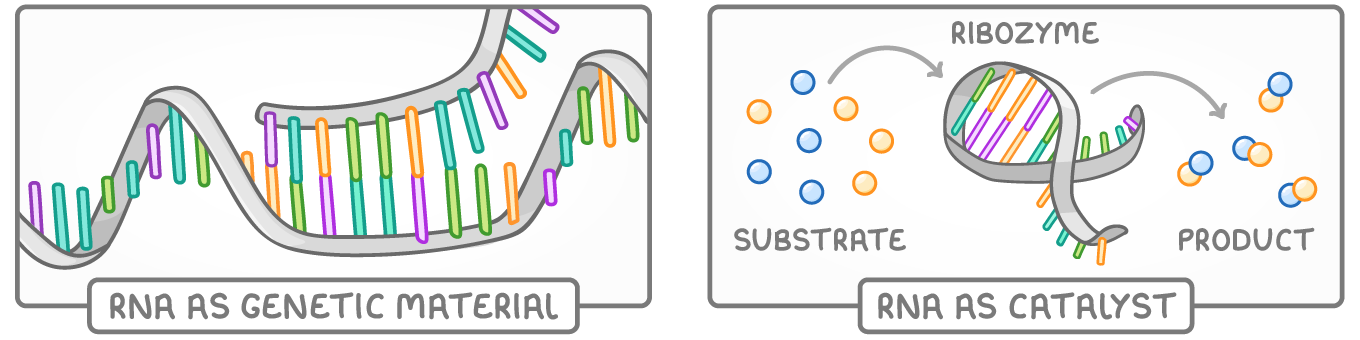
The RNA world hypothesis proposes that early life relied on RNA as both a carrier of genetic information and a catalyst for chemical reactions. Unlike DNA, which stores genetic information in modern cells, or proteins, which often act as catalysts, RNA can do both. This dual functionality makes it a plausible candidate for the first self-replicating molecule.
Key assumptions of the RNA world hypothesis:
- RNA replication for genetic continuity - At some point in early Earth's history, RNA molecules were able to replicate themselves, ensuring the transmission of genetic information from one generation of molecules to the next.
- Base-pairing for replication - Replication of RNA depended on base-pairing, a process where specific nucleotide bases in RNA (adenine, uracil, guanine, and cytosine) pair with complementary bases to form a new strand. This mechanism is similar to how DNA replicates today.
- Absence of protein catalysts - In this early stage, genetically encoded proteins were not yet involved as catalysts. Instead, RNA itself acted as a catalyst, speeding up chemical reactions necessary for replication and other functions. These catalytic RNA molecules are called ribozymes.
Why RNA as the first genetic material?
- Versatility - RNA's ability to store genetic information and catalyze reactions suggests it could have functioned independently before more complex systems evolved.
- Evidence from modern biology - Ribozymes still exist in modern organisms, supporting the idea that RNA once played a central role in early life.
- Simplicity - RNA-based life would have been simpler than DNA-protein systems, fitting the primitive conditions of early Earth.
Significance of origins of life models in biological systems interactions
Understanding how life originated on Earth is not just about tracing history; it also highlights the complex interactions within and between biological systems. These early processes set the stage for the diversity and complexity of life we see today.
Connections to systems interactions
- Chemical to biological transition - The shift from simple molecules like RNA to complex biological systems demonstrates how chemical interactions can lead to life, a fundamental systems interaction.
- Environmental influence - Geological and environmental conditions interacted with early molecules to create life, showing how non-living systems shaped biological ones.
- Foundation for evolution - The origin of self-replicating molecules like RNA paved the way for genetic variation and natural selection, key drivers of biological diversity and interaction over billions of years.
By studying these early events, we gain insight into how biological systems emerged and continue to interact within the broader context of Earth's history.