8.1 - Responses to the Environment
How organisms respond to environmental changes through behavior and physiology
Organisms constantly interact with their surroundings, adapting to internal and external changes to maintain stability and survive. These adaptations occur through behavioral and physiological responses, which help organisms cope with varying conditions in their environment.
Behavioral and physiological mechanisms
- Behavioral responses - These are actions organisms take in response to environmental stimuli. For example, moving toward or away from a stimulus helps ensure safety or resource acquisition.
- Physiological responses - These are internal changes in an organism's body processes to maintain homeostasis (a stable internal environment despite external changes). For instance, adjusting internal temperature or hormone levels in response to external temperature shifts.
Examples of environmental responses
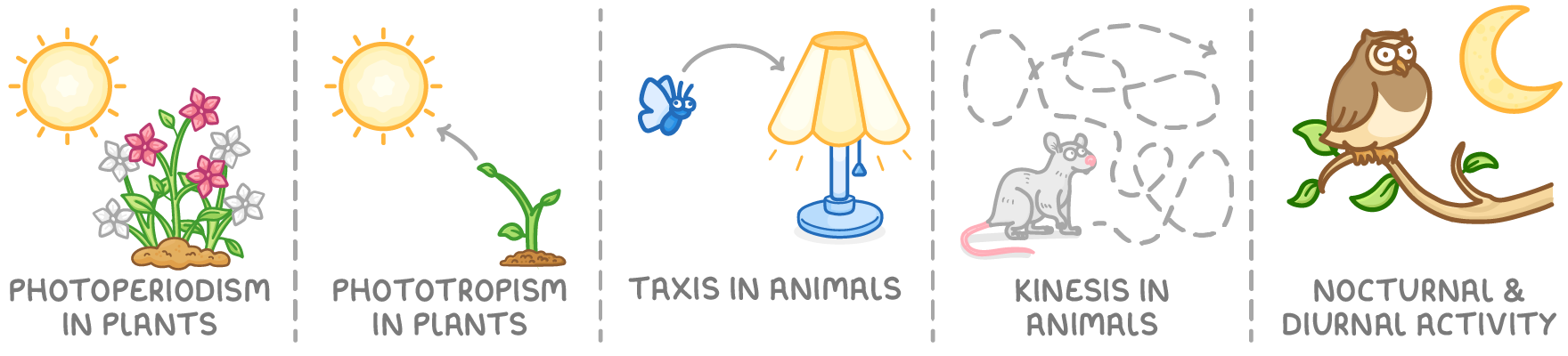
- Photoperiodism in plants - The response to changes in day length, which influences flowering and other seasonal activities.
- Phototropism in plants - Growth toward light sources to maximize photosynthesis, the process by which plants convert light energy into chemical energy.
- Taxis in animals - Directed movement toward or away from a stimulus, such as insects moving toward light.
- Kinesis in animals - Random movement in response to a stimulus intensity, like increased activity in high humidity to find a drier area.
- Nocturnal and diurnal activity - Patterns of activity based on time of day, such as owls being active at night (nocturnal) and humans during the day (diurnal), to optimize survival and resource use.
These responses ensure that organisms can thrive under changing environmental conditions by aligning their internal states or actions with external cues.
The role of communication in altering behavior and enhancing fitness
Organisms often exchange information with each other to respond to internal needs or external signals. This communication can lead to changes in behavior that improve survival and reproductive success, a concept known as fitness (the ability to survive and reproduce in a given environment).
Communication triggers and behavioral changes
- Internal changes - Shifts within an organism, like hunger or stress, can prompt signals to others for assistance or coordinated action.
- External cues - Environmental factors, such as the presence of predators or changes in resource availability, can trigger communication that alters group or individual behavior.
Examples of communication-driven responses
- Fight-or-flight response - A physiological and behavioral reaction to danger, where animals either confront a threat or flee to safety, often triggered by signals from others in a group.
- Predator warnings - Alerts issued by animals, such as alarm calls in birds, to warn others of nearby danger, prompting evasive actions.
- Plant responses to herbivory - Plants release chemical signals when under attack by herbivores (organisms that eat plants), which can attract predators of those herbivores or trigger defensive mechanisms in nearby plants.
This exchange of information is critical for quick adaptation to challenges, enhancing an organism's ability to survive and reproduce.
Behavioral responses and their impact on individual and population success
Behavioral responses are not just reactions to immediate stimuli; they also play a significant role in the long-term success of individuals and their populations. Communication through various signals often drives these behaviors, influencing fitness at both levels.
Mechanisms of communication in organisms
- Visual signals - Displays like bright coloration or body postures that convey messages, such as warning off competitors or attracting mates.
- Audible signals - Sounds, such as bird songs, used to communicate location, establish territory, or attract partners.
- Tactile signals - Physical contact, often seen in social insects like ants, to share information about food sources or danger.
- Electrical signals - Used by certain fish to communicate or navigate in murky environments.
- Chemical signals - Scents or pheromones (chemical substances released to trigger responses in others of the same species) that can indicate readiness to mate or mark territory.
Specific behaviors enhancing fitness
- Territorial marking in mammals - Using scent or physical markers to define and defend areas, reducing competition and ensuring resource access.
- Coloration in flowering plants and animals - Bright colors attract pollinators in plants or signal toxicity in animals, aiding reproduction or survival.
- Bird songs - Used to attract mates or defend territories, directly impacting reproductive success.
- Pack behaviors in animals - Cooperative hunting or defense strategies in groups, increasing individual safety and food acquisition.
- Predator warnings - Alarm signals that protect group members, boosting population survival rates.
These behaviors, driven by communication, often result in differential reproductive success, where individuals with effective strategies produce more offspring, contributing to the success of their population.
The connection between behavior, natural selection, and evolution
Behavioral responses and communication are not isolated actions; they are deeply tied to the processes of natural selection and evolution. Certain behaviors are favored because they improve survival and reproduction, shaping the traits of future generations.
Behaviors favored by natural selection
- Innate behaviors - Instinctive actions, such as a spider spinning a web without learning, that are genetically determined and increase survival chances.
- Learned behaviors - Skills or actions acquired through experience, like birds learning specific songs, that enhance adaptability to environmental changes.
Examples of fitness-enhancing behaviors
- Parent and offspring interactions - Protective behaviors or teaching skills that ensure young survive to reproductive age.
- Courtship and mating behaviors - Displays or rituals that increase the likelihood of successful mating, passing on advantageous traits.
- Foraging by bees and other animals - Efficient search patterns for food, like the waggle dance in bees indicating food source locations, which supports individual and group survival.
Impact on evolution
Behaviors that improve fitness are more likely to be passed on through natural selection, the process where advantageous traits become more common in a population over generations. This leads to evolutionary changes, as populations adapt to their environments through favored behavioral traits.
Cooperative behaviors and population survival
Cooperative behaviors, where individuals work together for mutual benefit, often increase the fitness of both the individual and the population. These behaviors are vital for survival in challenging environments and contribute significantly to evolutionary success.
Examples of cooperative behaviors
- Pack behavior in animals - Wolves hunting together to take down larger prey, improving food access for all members.
- Herd, flock, and schooling behavior in animals - Groups like zebras or fish moving together to confuse predators, enhancing safety for individuals.
- Predator warnings - Alerts that benefit the entire group by reducing predation risk.
- Colony and swarming behavior in insects - Ants or bees working collectively to build nests or gather resources, supporting population growth.
- Kin selection - Favoring the survival of close relatives, even at personal cost, because it helps pass on shared genes, as seen in some social insects where workers sacrifice reproduction to support the queen.
These cooperative strategies demonstrate how individual actions can benefit the larger population, ensuring long-term survival and adaptation through collective efforts.