8.5 - Community Ecology
Community structure: species composition and diversity
A biological community is a group of different species living in the same area and interacting with each other. The structure of a community is defined by two key components: species composition and species diversity. These elements help scientists understand the makeup and health of ecosystems.
Species composition
Species composition refers to the specific types of species present in a community, essentially a list of "who's there." Knowing which species are in a community provides insight into the roles they play, such as which are predators, prey, or decomposers. Composition can vary widely between communities, even in similar environments, due to historical events, migration, or local adaptations.
Species diversity
Species diversity measures both the number of different species in a community (richness) and how evenly individuals are distributed among those species (evenness). High diversity often indicates a stable and resilient ecosystem, capable of withstanding environmental changes. Diversity is quantified using indices like Simpson's Diversity Index, which accounts for both richness and evenness to provide a numerical value of diversity.
Calculating species diversity with Simpson's Diversity Index
To objectively measure species diversity, ecologists use mathematical tools like Simpson's Diversity Index. This index calculates the probability that two randomly selected individuals from a community belong to different species, giving a clear picture of diversity.
Formula for Simpson's Diversity Index
Where:
- n = Total number of organisms of a particular species
- N = Total number of organisms of all species
This formula results in a value between 0 and 1, where a higher value indicates greater diversity. A value close to 1 means high diversity (many species, evenly distributed), while a value close to 0 suggests low diversity (few species or dominance by one species).
Worked example - Calculating Simpson's Diversity Index
In a small forest community, a survey records the following: 50 oak trees, 30 maple trees, and 20 pine trees. Calculate the Simpson's Diversity Index for this community.
Step 1: Identify the values
- Total number of oak trees (n1) = 50
- Total number of maple trees (n2) = 30
- Total number of pine trees (n3) = 20
- Total number of organisms of all species (N) = 50 + 30 + 20 = 100
Step 2: Calculate the proportion for each species and square it
- For oak trees: , so
- For maple trees: , so
- For pine trees: , so
Step 3: Sum the squared proportions
Step 4: Apply the formula for Simpson's Diversity Index
Step 5: Interpretation
The Simpson's Diversity Index for this forest community is 0.62, indicating a moderate level of diversity with a fair distribution of individuals among the three species.
Interactions within and among populations in community structure
Communities are not static; they are dynamic systems shaped by the interactions between populations of different species. These interactions influence how species coexist, compete, or depend on each other, ultimately determining the community's structure over time.
How interactions shape communities
- Dynamic changes - Populations within a community interact in ways that cause shifts in abundance, distribution, and even species presence over time.
- Driving forces - These interactions can promote growth, limit populations, or cause declines, depending on whether the effects are positive or negative.
- Modeling interactions - Ecologists use models to predict community changes based on relationships like predator/prey dynamics or cooperative behaviors.
Types of population interactions and their effects
Interactions between populations can be classified by their effects on the species involved, whether harmful, beneficial, or neutral. These relationships drive population dynamics, influencing how species numbers rise or fall within a community.
Key types of interactions
- Competition - Occurs when two or more species vie for the same limited resources, such as food or space. This often results in reduced growth or survival for at least one species.
- Predation - One species (predator) hunts and consumes another (prey), impacting prey population size while providing energy to the predator. This can lead to cycles of population increase and decrease.
- Symbiosis - A close, long-term interaction between two species, which can take several forms:
- Mutualism - Both species benefit, such as pollinators gaining nectar while helping plants reproduce.
- Commensalism - One species benefits while the other is unaffected, like barnacles attaching to whales for transport without harming them.
- Parasitism - One species benefits at the expense of the other, such as ticks feeding on a host's blood, often weakening the host.
- Cooperation - Species work together for mutual benefit, often seen within the same species (like ants in a colony) but sometimes across species.
- Trophic cascades - Indirect effects through food chains, where a change in one population (like a predator) alters populations at other levels (like prey or plants).
- Niche partitioning - Species reduce competition by using resources differently, such as feeding at different times or in different areas, allowing coexistence.
These interactions collectively determine the balance of species within a community, shaping its structure and stability.
Energy and matter access through community interactions
Interactions among populations are often driven by the need to access energy and matter, the fundamental resources for survival and reproduction. These interactions dictate how resources flow through a community and influence population dynamics.
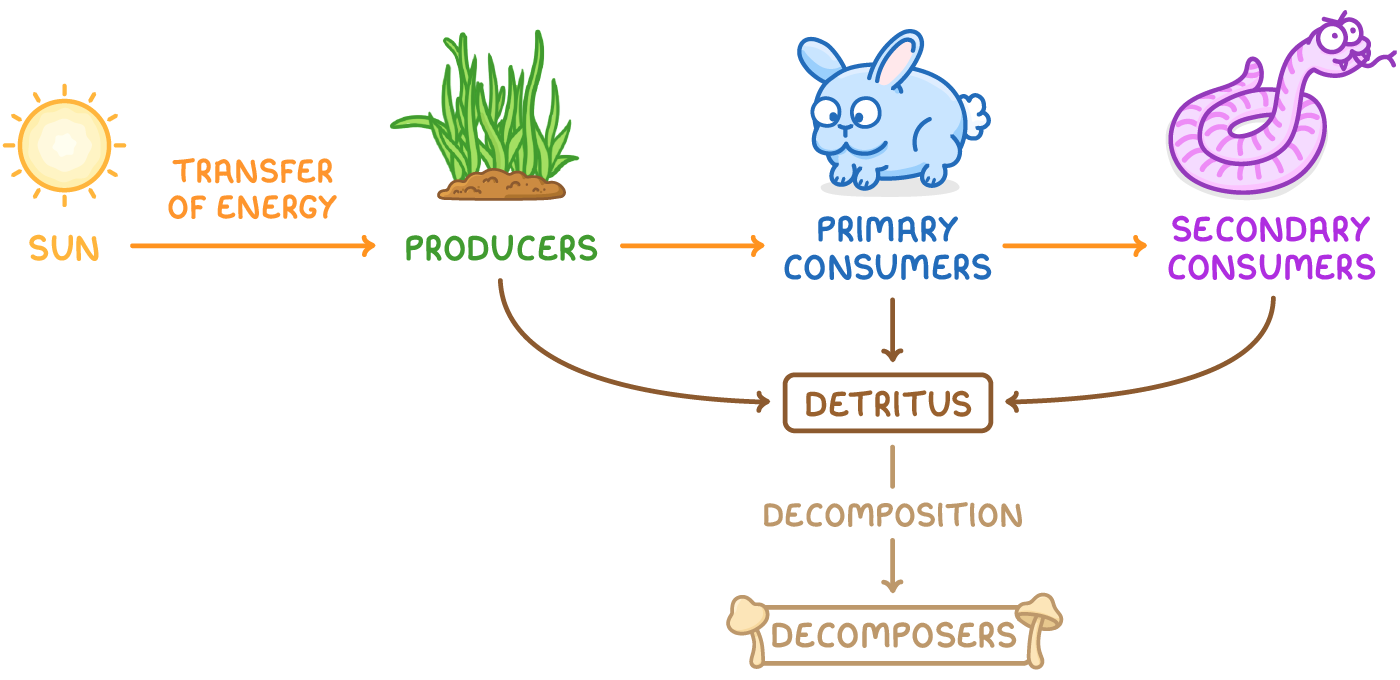
Role of interactions in resource access
- Energy flow - Predation and symbiotic relationships determine how energy moves from one species to another, often through food webs. For example, predators gain energy by consuming prey, while mutualistic partners may share energy resources.
- Matter cycling - Interactions also control the movement of essential materials like water, carbon, and nutrients. Decomposers, for instance, interact with other populations by breaking down dead matter, returning nutrients to the soil for plant use.
- Resource limitation - Competition arises when energy or matter is scarce, forcing species to adapt through niche partitioning or other strategies to survive.
Understanding these interactions helps explain why certain species dominate in a community while others struggle, reflecting the constant battle for resources that shapes ecological balance.