6.3 - Transcription & RNA Processing
The central dogma of molecular biology and the flow of genetic information
The central dogma of molecular biology explains how genetic information flows within a cell to create the building blocks of life. This fundamental principle describes the transfer of information from DNA to RNA to protein, a process essential for cellular function and organismal development.

Key steps in the flow of genetic information
- DNA to RNA (Transcription) - Genetic information stored in DNA is copied into a messenger molecule called RNA through a process known as transcription. This step allows the cell to use the genetic code without altering the original DNA.
- RNA to Protein (Translation) - The information in RNA is then used to assemble proteins, the functional molecules of the cell, through a process called translation. Proteins determine cell structure, function, and regulation.
- Central dogma principle - This unidirectional flow from DNA to RNA to protein ensures that genetic instructions are accurately transmitted and executed to maintain life processes.
This sequence of events is often summarized as "DNA makes RNA makes protein," and it forms the foundation for understanding gene expression.
The role and types of RNA in protein synthesis
RNA, or ribonucleic acid, is a crucial molecule in the process of gene expression. Unlike DNA, which stores genetic information, RNA plays active roles in transferring and translating that information into proteins. There are three main types of RNA, each with a specific function in protein synthesis.
Types of RNA and their functions
- Messenger RNA (mRNA) - Carries genetic information from the DNA in the nucleus to the ribosomes in the cytoplasm, where proteins are made. It serves as a temporary copy of a specific gene's instructions.
- Transfer RNA (tRNA) - Binds to specific amino acids (the building blocks of proteins) and brings them to the ribosome during translation. Each tRNA has an anticodon, a sequence of three bases that pairs with a complementary codon on the mRNA, ensuring the correct amino acid is added to the growing protein chain.
- Ribosomal RNA (rRNA) - Forms the structural and functional core of ribosomes, the cellular machinery responsible for protein synthesis. rRNA helps catalyze the formation of peptide bonds between amino acids.
Each type of RNA is essential for translating the genetic code into functional proteins, working together in a highly coordinated manner during gene expression.
The process of transcription in gene expression
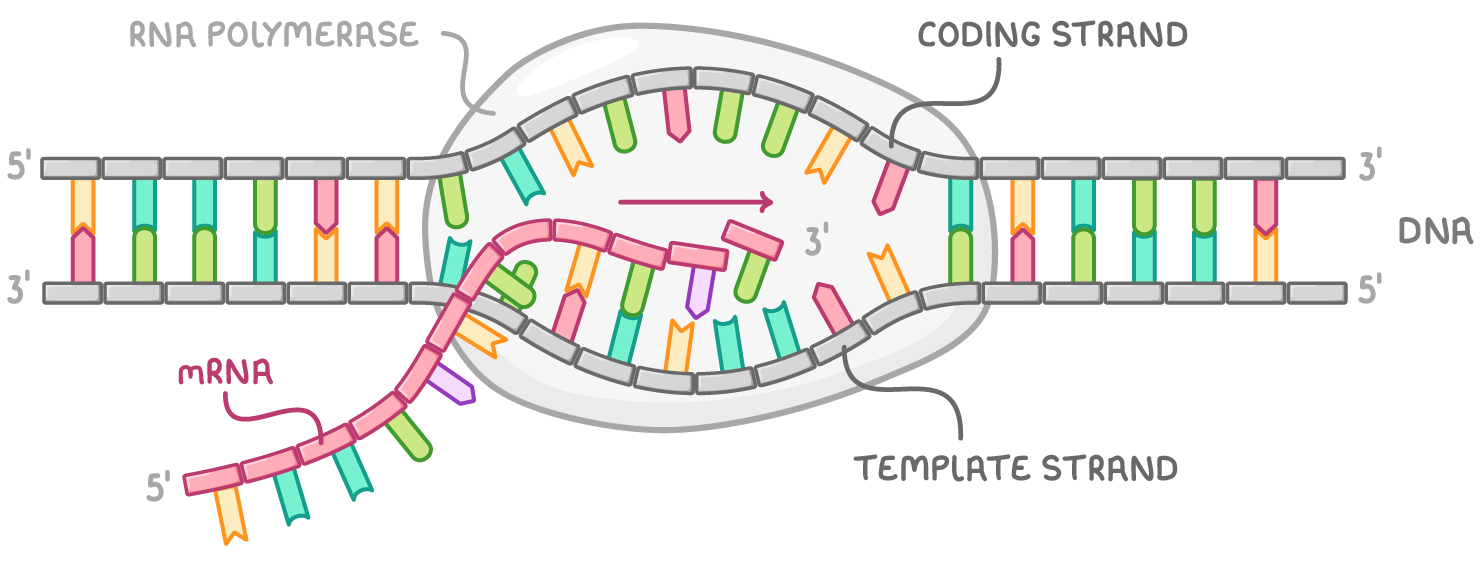
Transcription is the first step in gene expression, where a segment of DNA is copied into RNA. This process allows the genetic information stored in DNA to be transferred to a molecule that can leave the nucleus and direct protein synthesis in the cytoplasm.
How transcription works
- Role of RNA polymerase - The enzyme RNA polymerase is responsible for synthesizing RNA. It binds to a specific region of DNA called the promoter, which signals the start of a gene, and begins the transcription process.
- Template strand usage - RNA polymerase uses one strand of the DNA double helix, known as the template strand, to guide the synthesis of the new RNA molecule. The other strand, called the coding strand, is not used directly but has a sequence similar to the resulting RNA.
- Direction of synthesis - RNA polymerase reads the DNA template strand in the 3' to 5' direction and synthesizes the new RNA molecule in the 5' to 3' direction. This ensures accurate base pairing and proper sequence formation.
- Base pairing rules - During transcription, RNA polymerase matches RNA nucleotides to the DNA template: adenine (A) in DNA pairs with uracil (U) in RNA, cytosine (C) pairs with guanine (G), and vice versa. This creates an RNA strand complementary to the DNA template.
Transcription results in the formation of a single-stranded RNA molecule that carries the genetic code from the nucleus to the site of protein synthesis, setting the stage for translation.
RNA processing and modifications in eukaryotic cells
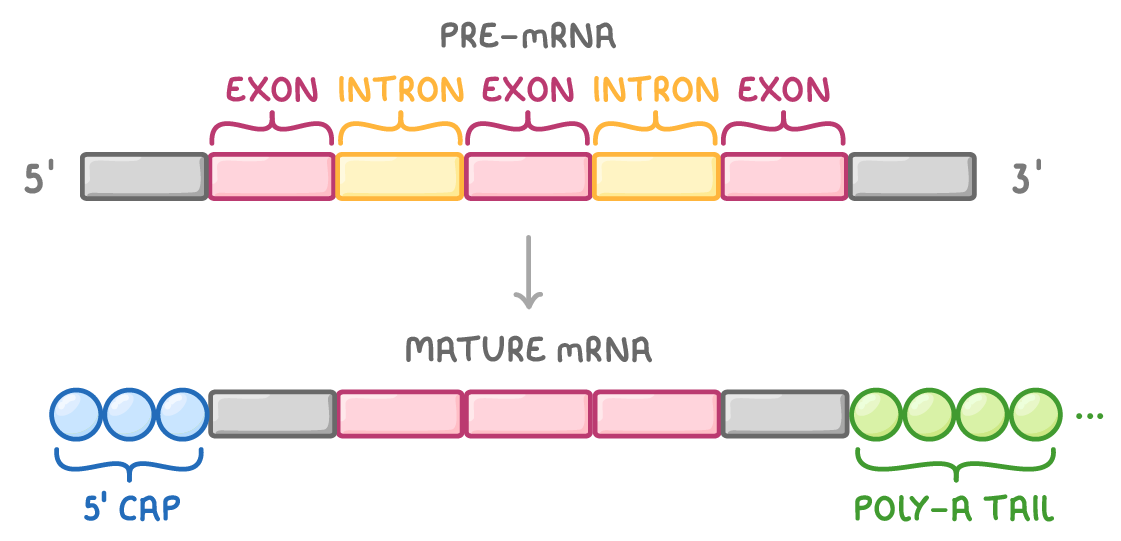
In eukaryotic cells, the initial RNA transcript produced during transcription, known as pre-mRNA, is not immediately ready for translation. It undergoes a series of modifications to become mature mRNA, which can then be used to synthesize proteins.
Key modifications of pre-mRNA
- Addition of a 5' cap - A modified guanine nucleotide is added to the 5' end of the pre-mRNA. This cap helps the mRNA bind to the ribosome during translation and protects it from degradation by enzymes.
- Addition of a poly-A tail - A sequence of adenine nucleotides, called a poly-A tail, is added to the 3' end of the pre-mRNA. This tail increases the stability of the mRNA, protecting it from degradation and aiding in its export from the nucleus to the cytoplasm.
- Splicing of introns and exons - Pre-mRNA contains both coding regions called exons and non-coding regions called introns. During splicing, introns are removed, and exons are joined together to form the final mature mRNA. This process is mediated by a complex of proteins and RNA molecules known as the spliceosome.
These modifications ensure that the mRNA is functional, stable, and ready to carry accurate genetic information for protein synthesis.
The significance of alternative splicing in generating protein diversity
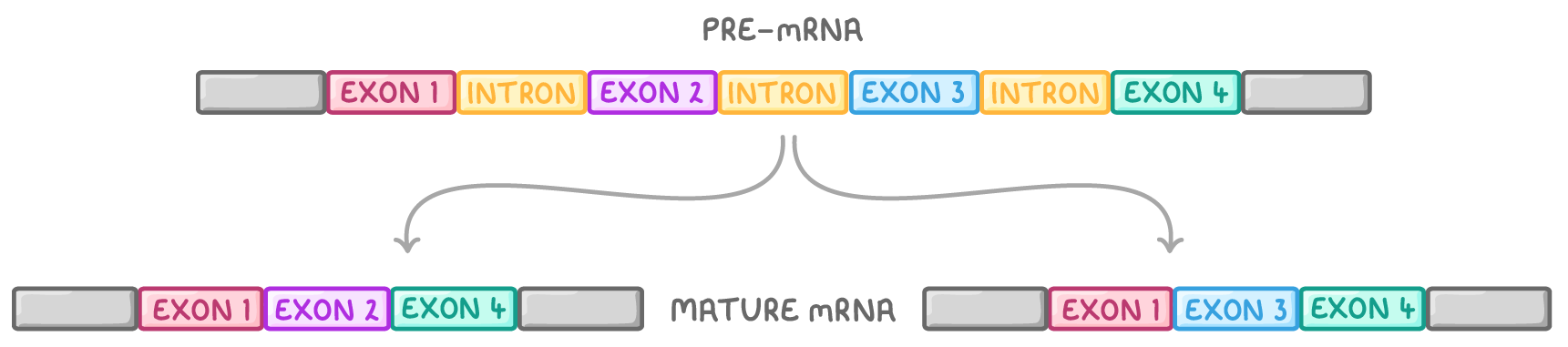
Alternative splicing is a process during RNA modification in eukaryotic cells where different combinations of exons are included or excluded from the mature mRNA. This mechanism allows a single gene to produce multiple versions of mRNA, and consequently, different proteins.
How alternative splicing works
- Exon selection variability - During splicing, the spliceosome can choose different combinations of exons to include in the mature mRNA. Some exons may be skipped, or alternative exons may be used, leading to different mRNA transcripts from the same pre-mRNA.
- Impact on protein diversity - Each unique mRNA transcript resulting from alternative splicing can code for a distinct protein variant with potentially different functions or properties. This means one gene can produce multiple proteins, vastly expanding the functional repertoire of the genome.
- Biological importance - Alternative splicing is crucial for processes like tissue differentiation and development, where specific protein variants are needed in different cell types or at different stages of growth. For example, it allows for the production of specialized proteins in muscle cells versus nerve cells from the same genetic code.
Alternative splicing is a powerful mechanism that enhances the complexity and adaptability of eukaryotic organisms, enabling them to respond to diverse environmental and developmental needs with a limited set of genes.
The process of transcription in gene expression
Transcription is the first step in gene expression, where a segment of DNA is copied into RNA. This process allows the genetic information stored in DNA to be transferred to a molecule that can leave the nucleus and direct protein synthesis in the cytoplasm.
How transcription works
- Role of RNA polymerase - The enzyme RNA polymerase is responsible for synthesizing RNA. It binds to a specific region of DNA called the promoter, which signals the start of a gene, and begins the transcription process.
- Template strand usage - RNA polymerase uses one strand of the DNA double helix, known as the template strand, to guide the synthesis of the new RNA molecule. The other strand, called the coding strand, is not used directly but has a sequence similar to the resulting RNA.
- Direction of synthesis - RNA polymerase reads the DNA template strand in the 3' to 5' direction and synthesizes the new RNA molecule in the 5' to 3' direction. This ensures accurate base pairing and proper sequence formation.
- Base pairing rules - During transcription, RNA polymerase matches RNA nucleotides to the DNA template: adenine (A) in DNA pairs with uracil (U) in RNA, cytosine (C) pairs with guanine (G), and vice versa. This creates an RNA strand complementary to the DNA template.
Transcription results in the formation of a single-stranded RNA molecule that carries the genetic code from the nucleus to the site of protein synthesis, setting the stage for translation.