7.1 - Introduction to Natural Selection
What is natural selection and its role in evolution?
Natural selection is a fundamental mechanism of evolution, the process that drives the diversity and unity of life on Earth. Evolution refers to the gradual change in the characteristics of a species over generations, and natural selection plays a key role by determining which traits become more common in a population. This process explains how species adapt to their environments and why life on Earth exhibits such a wide variety of forms and functions.
Key features of natural selection
- Mechanism of change - Natural selection acts as a filter, favoring certain traits over others, leading to changes in the genetic makeup of a population.
- Foundation of diversity - It contributes to the vast array of species by promoting adaptations suited to specific environments.
- Connection to evolution - As a major driver, natural selection helps explain both the unity (shared ancestry) and diversity (unique adaptations) among living organisms.
Causes of natural selection according to Darwin's theory
Charles Darwin's theory of natural selection, developed in the 19th century, provides a framework for understanding how evolution occurs. This theory is based on the idea that individuals within a population vary in their traits, and those with advantageous traits are more likely to survive and reproduce.
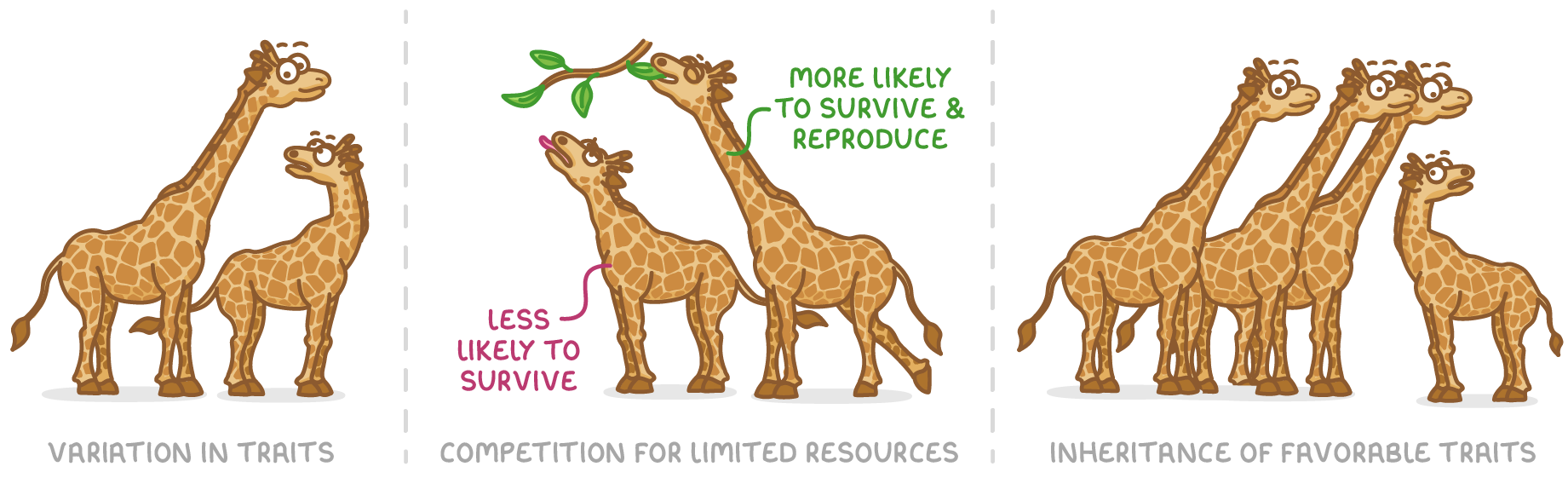
Core principles driving natural selection
- Variation in traits - Within any population, individuals show differences in their physical and behavioral characteristics, known as phenotypes. A phenotype is the set of observable traits resulting from an organism's genetic makeup and environmental influences.
- Competition for limited resources - Resources such as food, water, and shelter are often scarce, leading to competition among individuals. Not all can survive under these constraints.
- Differential survival and reproduction - Individuals with phenotypes that provide an advantage in their environment are more likely to survive and produce offspring. For example, a faster predator or a plant better adapted to drought has a higher chance of passing on its traits.
- Inheritance of favorable traits - These advantageous traits are often heritable, meaning they are passed from parents to offspring through genes. Over generations, these traits become more common in the population.
As a result of these principles, natural selection shapes populations by increasing the frequency of beneficial traits while less favorable ones may diminish.
How natural selection affects populations over time
Natural selection does not just impact individual organisms; it transforms entire populations by altering the frequency of certain traits across generations. This process can lead to adaptations that improve a population's ability to thrive in its specific environment.
Effects on population characteristics
- Shift in trait frequency - Traits that enhance survival and reproduction become more prevalent. For instance, in a population of insects, those with camouflage that hides them from predators may increase in number over time.
- Adaptation to environment - Over many generations, natural selection can result in populations becoming better suited to their surroundings, such as birds developing beak shapes ideal for their food sources.
- Potential for speciation - In some cases, natural selection can drive populations in different environments to diverge so significantly that they become distinct species, a process known as speciation.
This dynamic process ensures that populations are not static but are continually evolving in response to challenges and opportunities in their habitats.
The role of environmental factors in shaping evolution
The environment plays a critical role in natural selection by determining which traits are advantageous. Both living and non-living components of an ecosystem can influence the direction and speed of evolutionary change.
Types of environmental influences
- Biotic factors - These are the living components of an environment, such as predators, prey, competitors, and parasites. For example, the presence of a new predator can select for faster or more camouflaged individuals in a prey population.
- Abiotic factors - These are the non-living components, including temperature, rainfall, soil type, and light availability. A sudden change, like a drought, might favor plants with deeper roots or animals that conserve water.
- Fluctuations over time - Environments are rarely constant; they can change seasonally or over longer periods. These fluctuations mean that different traits may be favored at different times, altering the rate and direction of evolution.
Because environments are variable, natural selection can lead to diverse outcomes, with different genetic variations being selected in each generation depending on current conditions.
Measuring evolutionary fitness through reproductive success
In the context of natural selection, fitness does not refer to physical strength but to an organism's ability to contribute to the next generation. Evolutionary fitness is a measure of how well an individual's traits enable it to survive and reproduce in its environment.
Understanding evolutionary fitness
- Reproductive success as the key metric - Fitness is quantified by the number of viable offspring an individual produces that survive to reproduce themselves. An organism with high fitness passes on more of its genes to future generations.
- Relative nature of fitness - Fitness is always measured in comparison to others in the same population. A trait that boosts reproductive success in one environment may not be beneficial in another.
- Link to natural selection - Natural selection acts on differences in fitness. Individuals with higher fitness are more likely to have their traits become more common in the population over time.
By focusing on reproductive success, we can understand why certain traits persist and spread, shaping the evolutionary trajectory of species.