5.1 - Meiosis
The purpose of meiosis in sexually reproducing organisms
Meiosis is a specialized form of cell division that occurs in sexually reproducing organisms. Unlike mitosis, which produces identical cells for growth and repair, meiosis results in the formation of haploid gametes - sperm and egg cells in animals, or pollen and ovules in plants. These gametes are crucial for sexual reproduction, as they combine during fertilization to form a diploid zygote, ensuring the transmission of genetic information from one generation to the next.
Key concepts in meiosis
- Diploid vs. haploid - Diploid (2n) cells contain two sets of chromosomes, one from each parent, while haploid (n) cells contain only one set. Meiosis reduces the chromosome number from diploid to haploid.
- Gametes - These are specialized reproductive cells that carry half the genetic material of the parent organism, ensuring that fertilization restores the full diploid number.
- Genetic diversity - Meiosis introduces variation through processes like crossing over and independent assortment, which shuffle genetic material, creating unique combinations in offspring.
- Transmission of chromosomes - By producing haploid gametes, meiosis ensures that each generation inherits a complete set of chromosomes, maintaining species continuity.
This process is essential for sexual reproduction, as it prevents the doubling of chromosome numbers with each generation and promotes genetic diversity.
The stages of meiosis I: Reducing chromosome number
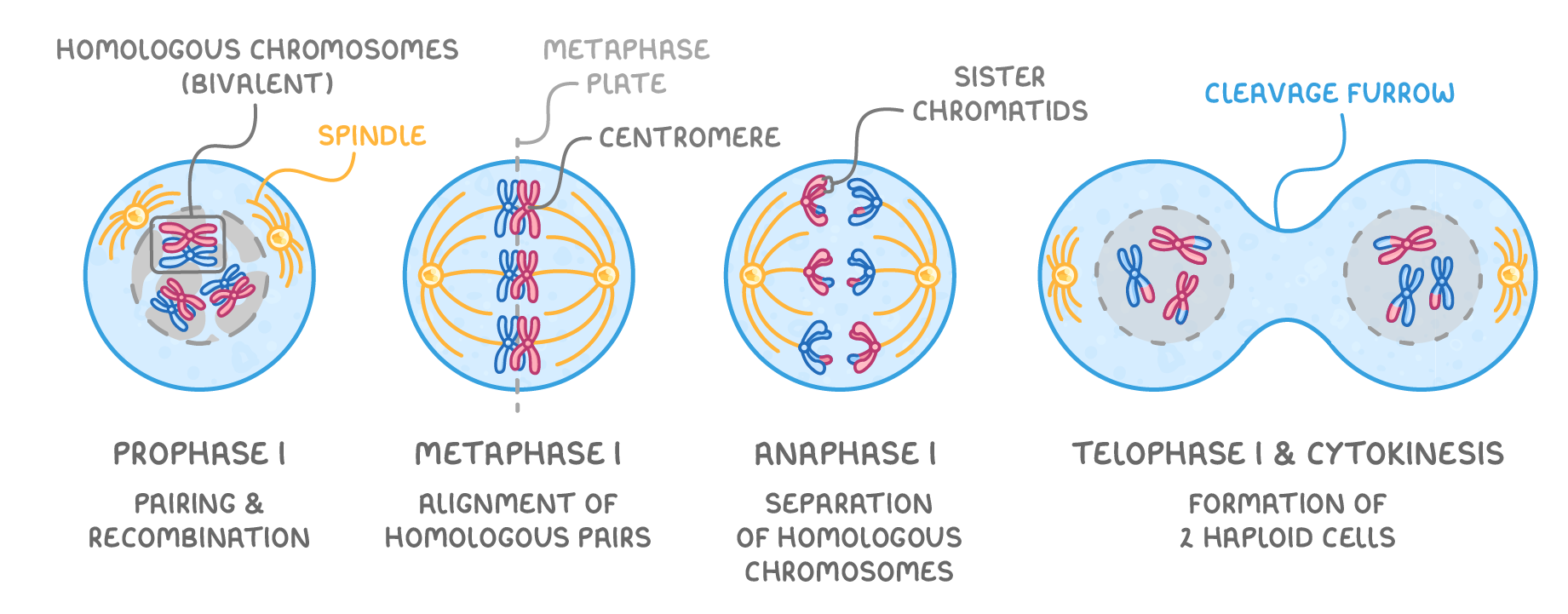
Meiosis occurs in two sequential divisions: meiosis I and meiosis II. Meiosis I is often called the reductional division because it reduces the chromosome number from diploid to haploid by separating homologous chromosomes. Let's break down the stages of meiosis I to understand this process.
Prophase I: Pairing and recombination
- Chromosome condensation - Chromosomes shorten and thicken, becoming visible under a microscope.
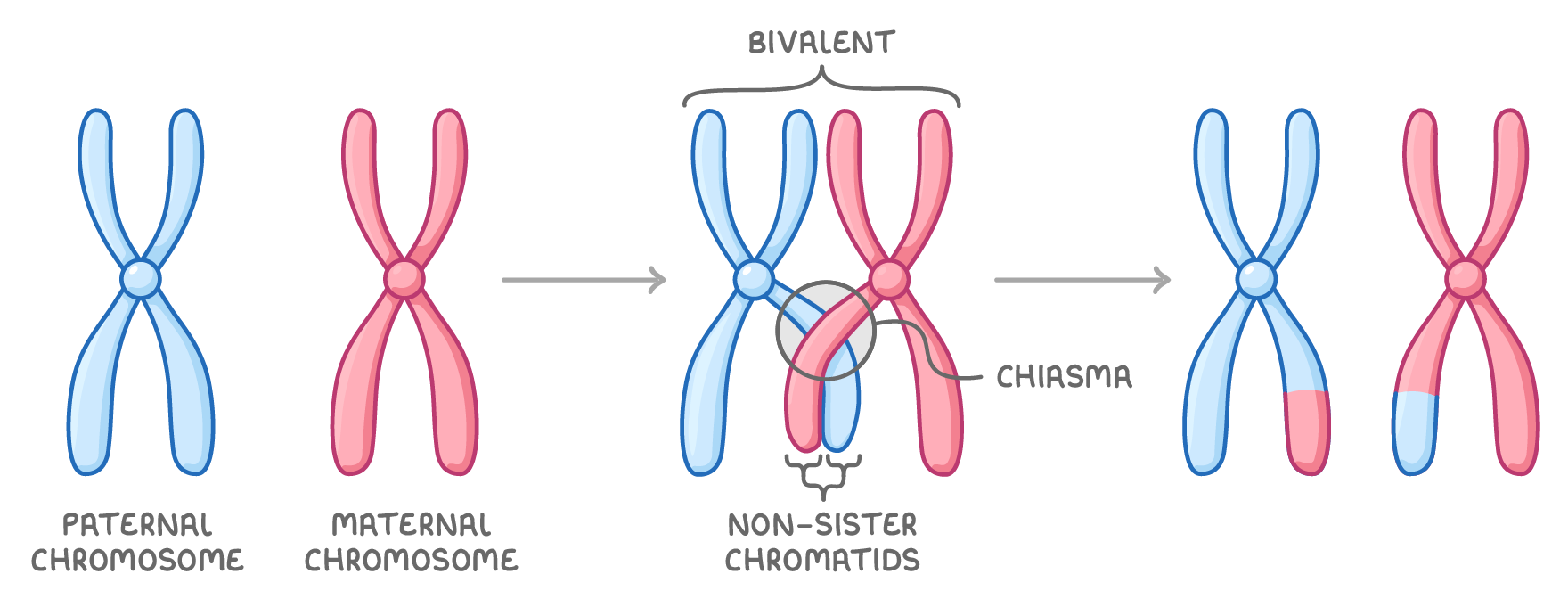
- Synapsis - Homologous chromosomes (one from each parent) pair up, forming a structure called a bivalent or tetrad, which consists of four chromatids.
- Crossing over and chiasmata - During crossing over, segments of DNA are exchanged between non-sister chromatids of homologous chromosomes. Chiasmata are the points where chromosomes remain attached after crossing over, visible as X-shaped structures, increasing genetic diversity.
- Spindle formation - The meiotic spindle, a network of microtubules, begins to form, and centrosomes move to opposite poles of the cell.
- Nuclear envelope breakdown - The nuclear envelope disintegrates, allowing chromosomes to interact with the spindle fibers.
Metaphase I: Alignment of homologous pairs
- Equatorial alignment - Homologous chromosome pairs line up along the metaphase plate, the central plane of the cell.
- Spindle attachment - Meiotic spindle fibers attach to the centromeres of each chromosome in the pair, preparing to pull them apart.
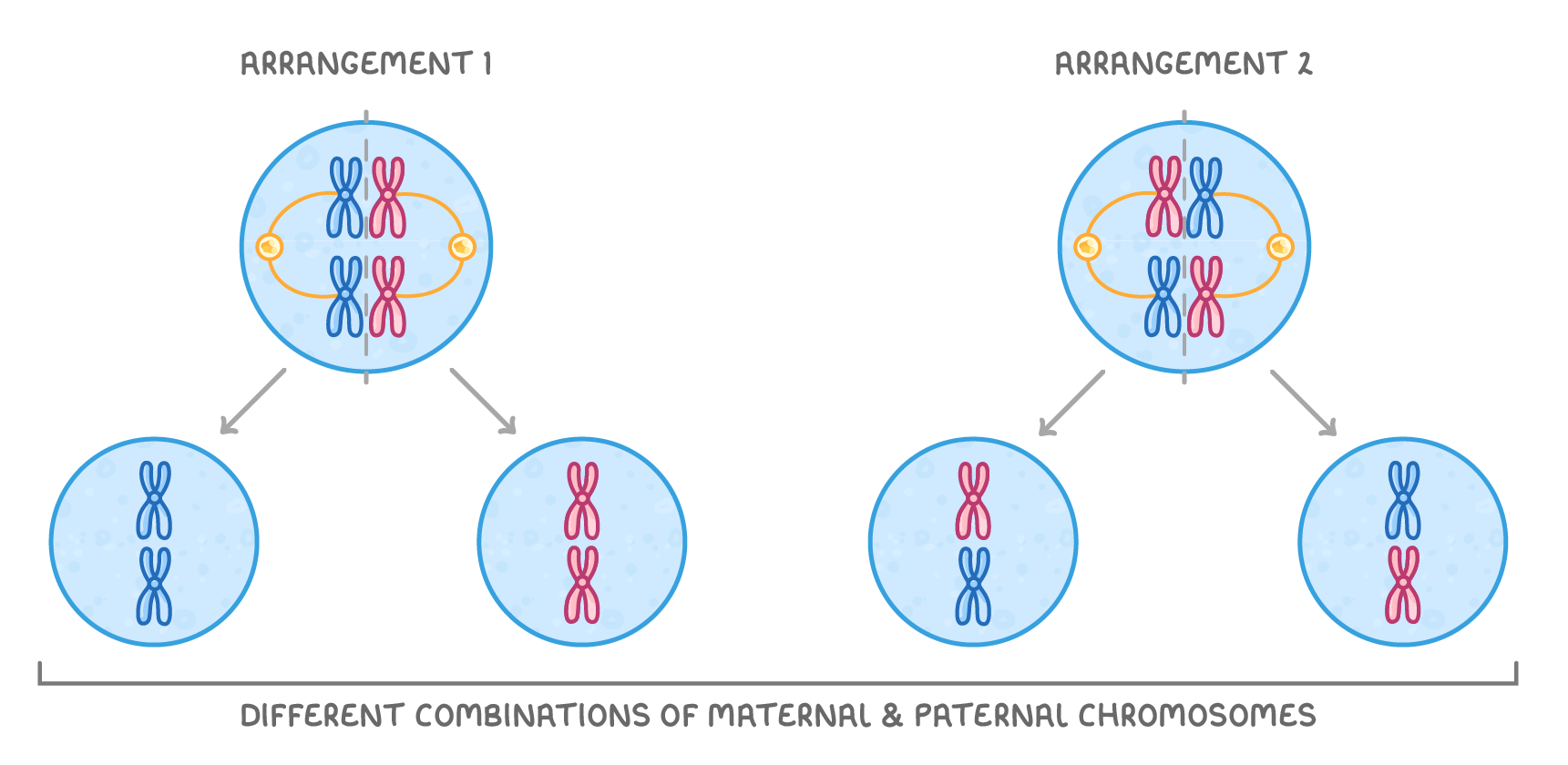
- Independent assortment - The random orientation of homologous pairs at the metaphase plate ensures that each daughter cell receives a unique combination of maternal and paternal chromosomes, contributing to genetic variation.
Anaphase I: Separation of homologous chromosomes
- Homologous separation - The spindle fibers contract, pulling homologous chromosomes apart toward opposite poles of the cell.
- Sister chromatids remain attached - Unlike in mitosis, sister chromatids (the two identical copies of a chromosome) stay connected at the centromere during this phase.
- Reduction in chromosome number - This separation reduces the chromosome number from diploid to haploid in the resulting cells, as each pole receives one chromosome from each homologous pair.
Telophase I and cytokinesis: Formation of two haploid cells
- Spindle breakdown - The meiotic spindle disassembles as the chromosomes reach the poles.
- Nuclear envelope reformation - A new nuclear envelope forms around each set of chromosomes at the poles.
- Cytokinesis - The cytoplasm divides, forming two haploid daughter cells. In animal cells, a cleavage furrow constricts the cell, while in plant cells, a cell plate forms to separate the cells.
- Outcome - Each daughter cell is haploid, containing one chromosome from each homologous pair, though each chromosome still consists of two sister chromatids.
At the end of meiosis I, the chromosome number is halved, setting the stage for the second division.
The stages of meiosis II: Separating sister chromatids
Meiosis II is often called the equational division because it resembles mitosis, separating sister chromatids without further reducing the chromosome number. This division ensures that each gamete receives a single copy of each chromosome.
Prophase II: Preparation for second division
- Spindle reformation - A new meiotic spindle forms in each haploid cell.
- Chromosome attachment - Sister chromatids, still connected at the centromere, attach to the spindle fibers via their kinetochores (protein structures on the centromere).
- Nuclear envelope breakdown - If a nuclear envelope formed during telophase I, it breaks down again to allow spindle interaction with chromosomes.
Metaphase II: Alignment of sister chromatids
- Chromosome alignment - Individual chromosomes (each with two sister chromatids) line up along the metaphase plate in each cell.
- Spindle connection - Kinetochores of each chromatid connect to microtubules extending from opposite poles, preparing for separation.
- Random orientation - The alignment of chromosomes continues to contribute to genetic diversity through independent assortment.
Anaphase II: Separation of sister chromatids
- Centromere division - Proteins holding sister chromatids together at the centromere break down.
- Chromatid separation - Sister chromatids are pulled apart to opposite poles by the spindle fibers, now considered individual chromosomes.
- Movement to poles - This ensures each pole receives one copy of each chromosome, maintaining the haploid number.
Telophase II and cytokinesis: Formation of four haploid cells
- Spindle disassembly - The meiotic spindle breaks down as chromosomes reach the poles.
- Nuclear envelope reformation - A new nuclear envelope forms around each set of chromosomes.
- Chromosome decondensation - Chromosomes begin to uncoil, returning to a less compact form.
- Cytokinesis - The cytoplasm divides, forming four distinct haploid daughter cells. In animal cells, a cleavage furrow forms, while in plant cells, a cell plate develops.
- Outcome - Each of the four daughter cells contains a unique haploid set of chromosomes, ready to function as gametes.
Meiosis II completes the process, producing gametes with half the genetic material of the parent cell, ensuring proper chromosome distribution during reproduction.
How meiosis ensures genetic diversity and chromosome transmission
Meiosis is not just about reducing chromosome numbers; it plays a critical role in genetic diversity and the accurate transmission of genetic material across generations.
Mechanisms of increasing genetic diversity in meiosis
- Crossing over - During prophase I, non-sister chromatids of homologous chromosomes exchange genetic material. Chiasmata are the points where chromosomes remain attached after this exchange, creating new combinations of alleles (different forms of a gene) on each chromosome.
- Independent assortment - The random alignment of homologous pairs during metaphase I and chromosomes during metaphase II results in numerous possible combinations of maternal and paternal chromosomes in gametes.
- Random fertilization - When gametes fuse during reproduction, the combination of genetic material from two parents further increases diversity in offspring.
Role in chromosome transmission
- Haploid gamete formation - By producing haploid cells, meiosis ensures that fertilization restores the diploid number, preventing chromosome number from doubling each generation.
- Genetic continuity - Each gamete carries a complete, though unique, set of chromosomes, ensuring that offspring inherit a balanced genetic blueprint from both parents.
- Species stability - This process maintains the chromosome number characteristic of a species over generations, supporting reproductive success.
Through these mechanisms, meiosis contributes to both the variation that drives evolution and the continuity of genetic information.
Similarities and differences between mitosis and meiosis
While mitosis and meiosis are both processes of cell division, they serve different purposes and result in distinct outcomes. Understanding their similarities and differences helps clarify their specific roles in an organism's life cycle.
Similarities between mitosis and meiosis
- Spindle apparatus - Both processes use a spindle apparatus made of microtubules to move and separate chromosomes during division.
- Stages of division - Both include similar phases (prophase, metaphase, anaphase, telophase) with comparable events like chromosome alignment and separation.
- Cytokinesis - In both processes, cytokinesis divides the cytoplasm to form daughter cells, using a cleavage furrow in animal cells or a cell plate in plant cells.
Differences between mitosis and meiosis
| Feature | Mitosis | Meiosis |
|---|---|---|
| Purpose | Produces cells for growth, repair, and asexual reproduction | Produces gametes for sexual reproduction |
| Number of divisions | One division | Two divisions (meiosis I and II) |
| Number of daughter cells | Two daughter cells | Four daughter cells |
| Genetic content | Daughter cells are diploid and genetically identical to the parent cell | Daughter cells are haploid and genetically diverse |
| Chromosome behavior | Sister chromatids separate in anaphase | Homologous chromosomes separate in anaphase I; sister chromatids separate in anaphase II |
| Genetic diversity | No mechanisms for diversity; cells are clones | Crossing over and independent assortment create genetic variation |
| Occurrence | Occurs in somatic (body) cells | Occurs in reproductive cells |
These differences highlight how meiosis is uniquely adapted for sexual reproduction, producing genetically diverse gametes, while mitosis maintains genetic consistency for growth and repair.