5.2 - Meiosis & Genetic Diversity
What is meiosis and its role in sexual reproduction
Meiosis is a specialized type of cell division that occurs in sexually reproducing organisms. Unlike mitosis, which produces identical cells for growth and repair, meiosis results in the formation of gametes (sperm and egg cells in animals, pollen and ovules in plants) with half the number of chromosomes of the parent cell. This reduction is critical for maintaining a consistent chromosome number across generations when two gametes fuse during fertilization.
Key purposes of meiosis
- Reduction division - Meiosis reduces the chromosome number from diploid (2n, two sets of chromosomes) to haploid (1n, one set of chromosomes), ensuring that offspring receive the correct genetic complement after fertilization.
- Genetic diversity - Through various mechanisms, meiosis introduces variation among gametes, which is essential for evolution and adaptation in populations.
- Gamete formation - It produces cells specialized for reproduction, enabling the combination of genetic material from two parents.
This process is foundational to sexual reproduction in eukaryotes (organisms with cells containing a nucleus), setting the stage for unique genetic combinations in offspring.
Stages of meiosis and chromosome separation
Meiosis consists of two sequential divisions: meiosis I and meiosis II. Each division includes phases similar to mitosis but with distinct outcomes that ensure the production of haploid gametes. The correct separation of chromosomes during these divisions is crucial for genetic stability.
Meiosis I: Separation of homologous chromosomes
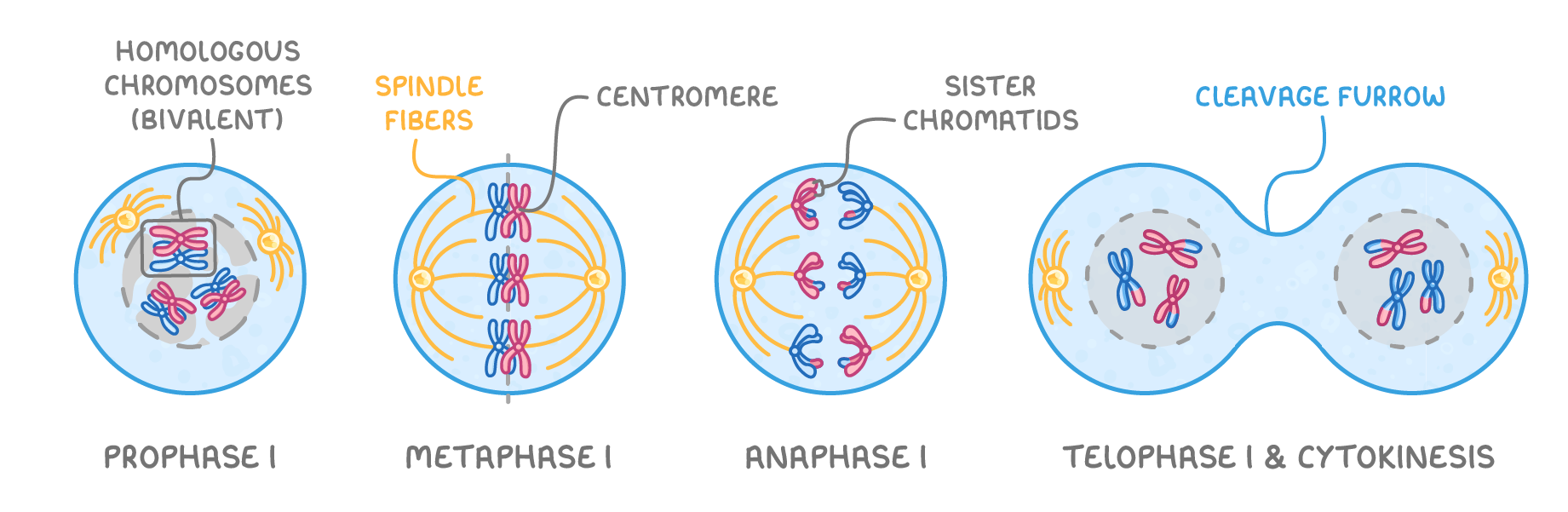
Meiosis I is often called reductional division because it reduces the chromosome number by half. It involves the separation of homologous chromosomes (pairs of chromosomes, one from each parent, that carry similar genetic information).
Stages of meiosis I:
- Prophase I - Chromosomes condense, and homologous chromosomes pair up in a process called synapsis. During this pairing, genetic material may be exchanged through crossing over (explained in detail later). The nuclear envelope breaks down, and spindle fibers form.
- Metaphase I - Homologous chromosome pairs line up at the cell's equator, attached to spindle fibers at their centromeres. The orientation of each pair is random, contributing to genetic variation.
- Anaphase I - Homologous chromosomes are pulled apart to opposite poles of the cell. Each chromosome still consists of two sister chromatids (identical copies of DNA).
- Telophase I and Cytokinesis - The cell divides into two daughter cells, each with a haploid set of chromosomes (though each chromosome still has two chromatids). Nuclear envelopes may reform temporarily.
At the end of meiosis I, each daughter cell contains a mix of maternal and paternal chromosomes, but the chromosome number is halved.
Meiosis II: Separation of sister chromatids
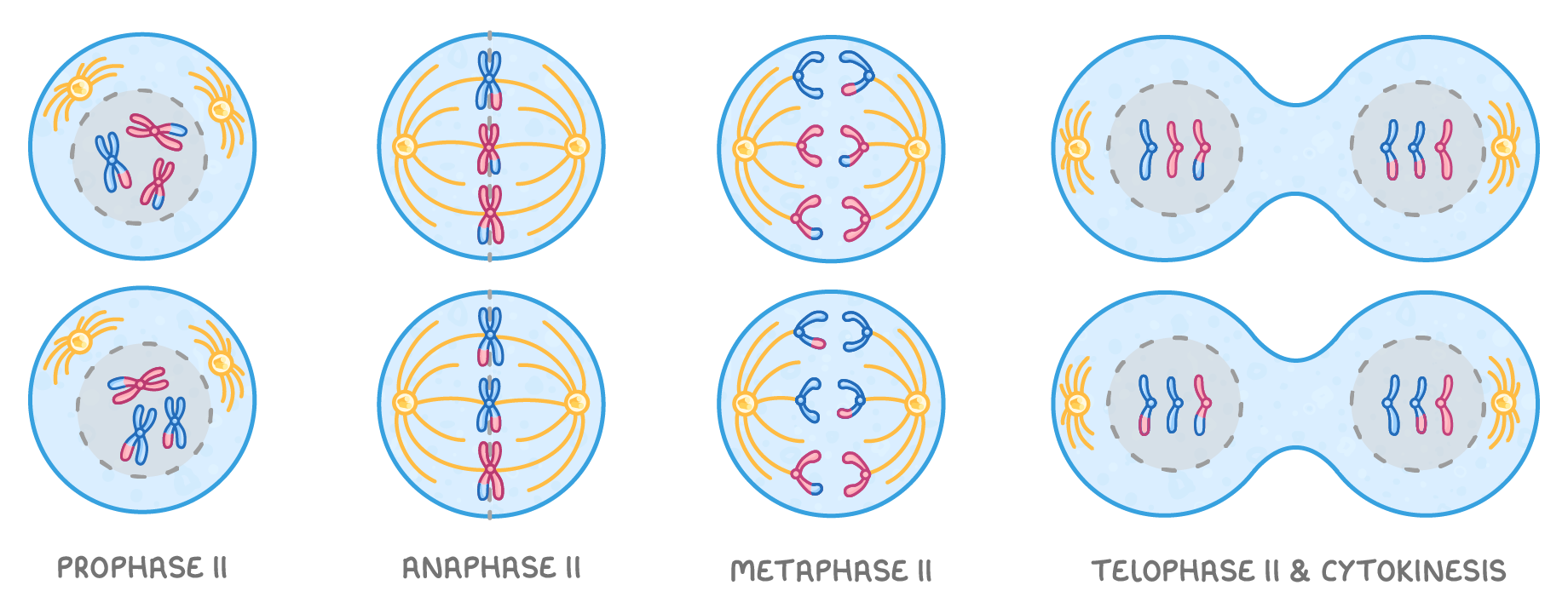
Meiosis II is similar to mitosis and is called equational division because it does not further reduce the chromosome number. Instead, it separates sister chromatids.
Stages of meiosis II:
- Prophase II - If nuclear envelopes reformed, they break down again. Chromosomes condense, and spindle fibers form in each daughter cell.
- Metaphase II - Chromosomes line up at the equator of each cell, with spindle fibers attached to the centromeres of each chromosome.
- Anaphase II - Sister chromatids are pulled apart to opposite poles, now considered individual chromosomes.
- Telophase II and Cytokinesis - Nuclear envelopes reform around the separated chromosomes, and each cell divides, resulting in four haploid gametes.
The outcome of meiosis II is four non-identical haploid cells, each with a unique combination of genetic material, ready for potential fertilization.
Crossing over and its role in genetic diversity
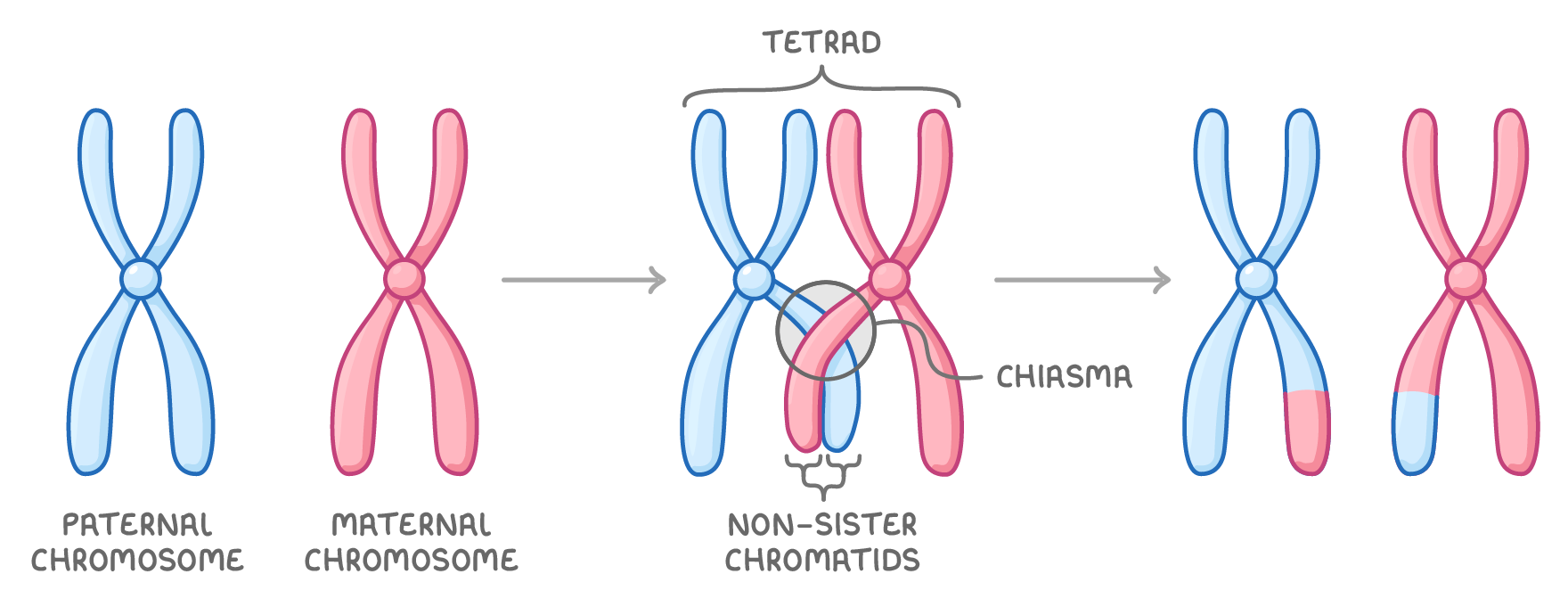
During prophase I of meiosis, a key event called crossing over (also known as recombination) occurs, significantly increasing genetic diversity among gametes. This process involves the exchange of genetic material between non-sister chromatids (chromatids from different homologous chromosomes).
How crossing over works
- Pairing of homologous chromosomes - During synapsis in prophase I, homologous chromosomes align closely, forming a structure called a tetrad (a group of four chromatids).
- Exchange of DNA segments - Specific points, called chiasmata, form where segments of DNA are swapped between non-sister chromatids. This exchange mixes maternal and paternal genetic material.
- Resulting variation - After crossing over, each chromosome contains a unique combination of alleles (different versions of a gene), distinct from the original parental chromosomes.
Importance of crossing over
- Unique genetic combinations - Crossing over creates new combinations of alleles in gametes, ensuring that offspring inherit a mix of traits from both parents.
- Evolutionary advantage - This genetic shuffling increases variation within a population, providing raw material for natural selection and adaptation to changing environments.
Crossing over is a fundamental mechanism by which meiosis contributes to the genetic diversity essential for species survival.
Random assortment of chromosomes and genetic variation
Another critical mechanism for genetic diversity in meiosis is the random assortment of chromosomes during metaphase I. This process ensures that each gamete receives a unique mix of maternal and paternal chromosomes.
How random assortment contributes to diversity
- Independent alignment - During metaphase I, homologous chromosome pairs line up at the cell's equator independently of other pairs. The orientation of each pair (whether the maternal or paternal chromosome faces a particular pole) is entirely random.
- Exponential combinations - For humans, with 23 pairs of chromosomes, there are over 8 million (223) possible combinations of maternal and paternal chromosomes in each gamete, purely from random assortment.
- Unique gametes - This randomness means that no two gametes are likely to have the same combination of chromosomes, further enhancing genetic variation.
When combined with crossing over, random assortment ensures an almost infinite variety of genetic possibilities in the resulting offspring after fertilization.
Fertilization and its impact on genetic diversity
The final step in sexual reproduction that boosts genetic diversity is fertilization, the fusion of two haploid gametes (one from each parent) to form a diploid zygote (the first cell of a new organism). This process introduces even more variation.
Contribution of fertilization to variation
- Combination of genetic material - Fertilization brings together genetic material from two different individuals, combining unique sets of alleles from each parent.
- Random pairing of gametes - Which sperm fertilizes which egg is a random event, adding another layer of genetic shuffling to the already diverse pool of gametes produced by meiosis.
- Resulting uniqueness - The zygote formed has a genetic makeup that is distinct from both parents and any siblings (except in the case of identical twins), contributing to the diversity within a population.
Fertilization, following the genetic mixing in meiosis, ensures that sexual reproduction produces offspring with novel genetic combinations, driving biodiversity.
Errors in meiosis: Nondisjunction and its consequences
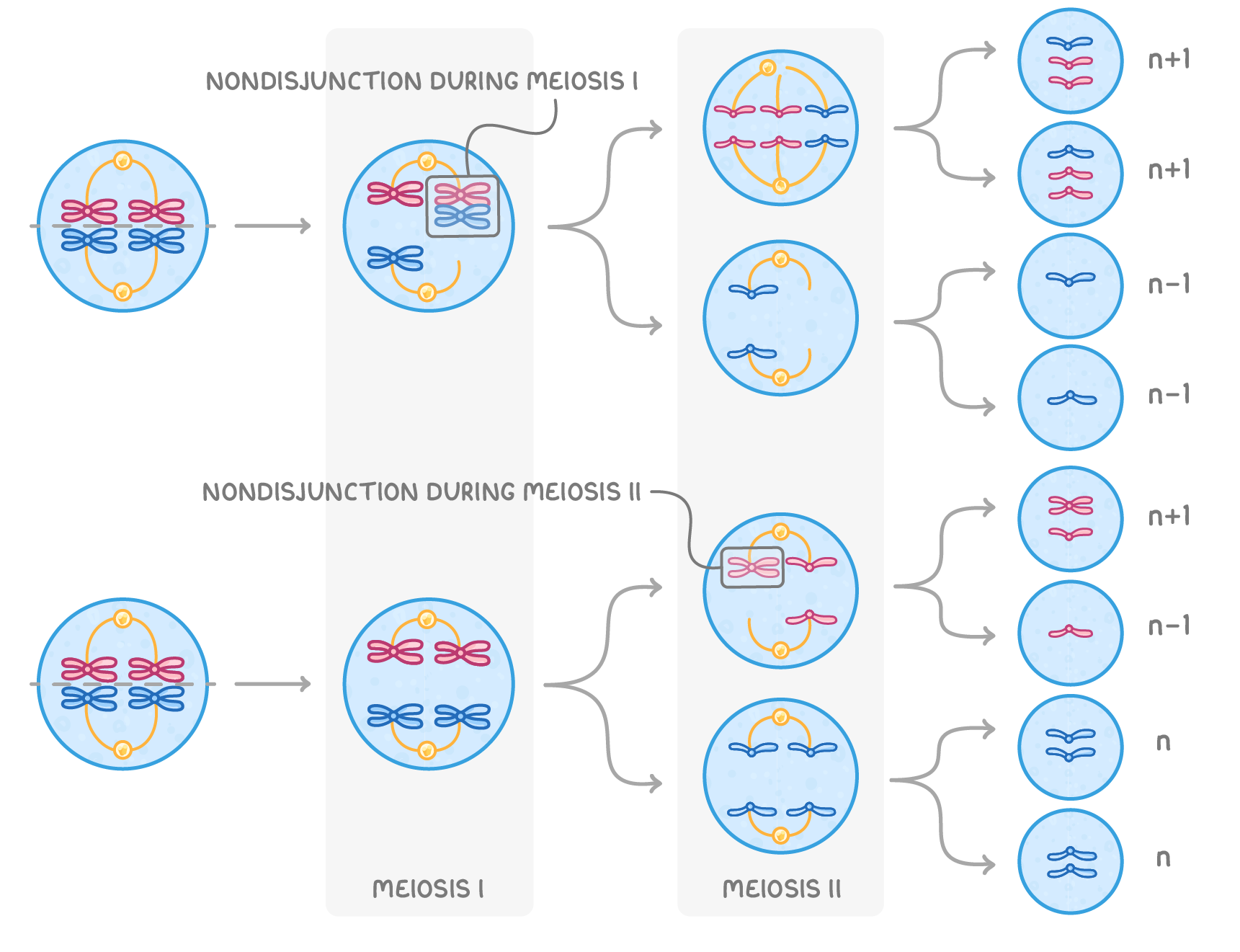
While meiosis typically ensures that gametes are haploid, errors can occur during chromosome separation, leading to abnormal chromosome numbers. One such error is nondisjunction, the failure of chromosomes to separate properly during meiosis I or II.
What happens during nondisjunction
- Failure in meiosis I - If homologous chromosomes do not separate during anaphase I, one daughter cell may receive both chromosomes of a pair, while the other receives none.
- Failure in meiosis II - If sister chromatids do not separate during anaphase II, one gamete may end up with an extra chromatid, while another lacks it.
- Resulting gametes - Gametes produced from nondisjunction are not haploid; they may have an extra chromosome (n+1) or be missing one (n-1).
Consequences of nondisjunction
- Abnormal zygotes - If a gamete with an abnormal chromosome number participates in fertilization, the resulting zygote will have an incorrect number of chromosomes, a condition called aneuploidy.
- Examples of disorders - In humans, nondisjunction can lead to conditions such as Down syndrome (trisomy 21, where there are three copies of chromosome 21 instead of two), Turner syndrome (monosomy X, where a female has only one X chromosome), or Klinefelter syndrome (XXY, where a male has an extra X chromosome).
- Impact on viability - Many cases of aneuploidy result in non-viable embryos, leading to miscarriage, but some conditions allow survival with varying degrees of health challenges.
Understanding nondisjunction highlights the importance of precise chromosome separation in meiosis for maintaining genetic stability and health in sexually reproducing organisms.