7.6 - Evidence of Evolution
The concept of evolution and its supporting scientific evidence
Evolution is the process by which populations of organisms change over generations, leading to the diversity of life on Earth while also revealing underlying unity among species. This process is driven by mechanisms such as natural selection, genetic drift, and mutation, resulting in adaptations that enhance survival and reproduction. The evidence for evolution comes from a wide range of scientific disciplines, each contributing unique insights into how life has changed over millions of years.
Key disciplines supporting evolution
- Geographical data - Studies of species distribution across different regions show patterns of divergence and adaptation to specific environments.
- Geological data - Examination of Earth's layers and rock formations provides a timeline of life through the fossil record.
- Physical data - Measurements and observations of physical traits in organisms help trace evolutionary changes.
- Biochemical data - Analysis of molecules like proteins and DNA reveals similarities and differences that indicate evolutionary relationships.
- Mathematical data - Models and calculations, such as those used in population genetics, predict and explain evolutionary patterns.
This multidisciplinary approach strengthens the understanding of evolution by combining independent lines of evidence that consistently point to the same conclusions about life's history.
Types of data that provide evidence for evolution
A variety of data types are used to support the theory of evolution, each offering a different perspective on how organisms have changed over time. These data types are collected through observation, experimentation, and analysis across multiple scientific fields, building a comprehensive picture of evolutionary history.
Major categories of evolutionary evidence
- Morphological data - Observations of physical structures in living and extinct organisms show similarities and differences that suggest common ancestry.
- Biochemical data - Comparisons of molecular structures, such as proteins and DNA, highlight shared ancestry through conserved sequences.
- Geological data - Information from Earth's rock layers and fossil deposits provides a chronological record of life's changes over millions of years.
- Genetic data - Analysis of DNA and gene sequences reveals evolutionary relationships by identifying shared genetic material among species.
By integrating these data types, scientists can describe trends, identify specific patterns, and explain relationships that support the idea of evolution as a unifying principle in biology.
How geological data and fossils demonstrate changes over time
Geological data, particularly the fossil record, provides a direct window into the history of life on Earth. Fossils are the preserved remains or traces of ancient organisms, and their placement in rock layers helps scientists reconstruct the timeline of evolutionary changes. This evidence shows how organisms have adapted, diversified, and sometimes gone extinct over vast periods.
Dating fossils to establish a timeline
Fossils are dated using several scientific methods to determine their age and place them in the correct historical context. These methods ensure accuracy in constructing the evolutionary timeline.
Methods for dating fossils:
- Age of surrounding rocks - Fossils are often found in sedimentary rock layers, and the age of these layers is determined through relative dating (stratigraphy) or absolute dating methods, placing fossils in a chronological sequence.
- Rate of decay of isotopes - Radioactive isotopes, such as carbon-14, decay at a known rate (half-life). By measuring the remaining amount of these isotopes in a fossil or nearby material, scientists can calculate its age.
- Geographical data - The location of fossils across different continents or regions provides clues about ancient environments and species distribution, aiding in dating and understanding evolutionary patterns.
What fossils reveal about evolution
- Transitional forms - Fossils often show intermediate traits between ancient and modern species, illustrating gradual changes over time, such as the transition from fish to tetrapods.
- Extinction events - The fossil record documents mass extinctions, where many species disappeared, followed by the emergence of new forms of life, demonstrating evolutionary responses to environmental changes.
- Chronological progression - Older rock layers contain simpler organisms, while younger layers show increasingly complex life forms, supporting the idea of evolutionary development over time.
This geological evidence provides a tangible record of how life has changed, offering concrete proof of evolution through the ages.
The role of morphological homologies in showing common ancestry
Morphological homologies are similarities in the physical structures of different organisms that suggest they share a common ancestor. These similarities often serve different functions in modern species but are derived from the same ancestral structure, providing strong evidence for evolutionary relationships.
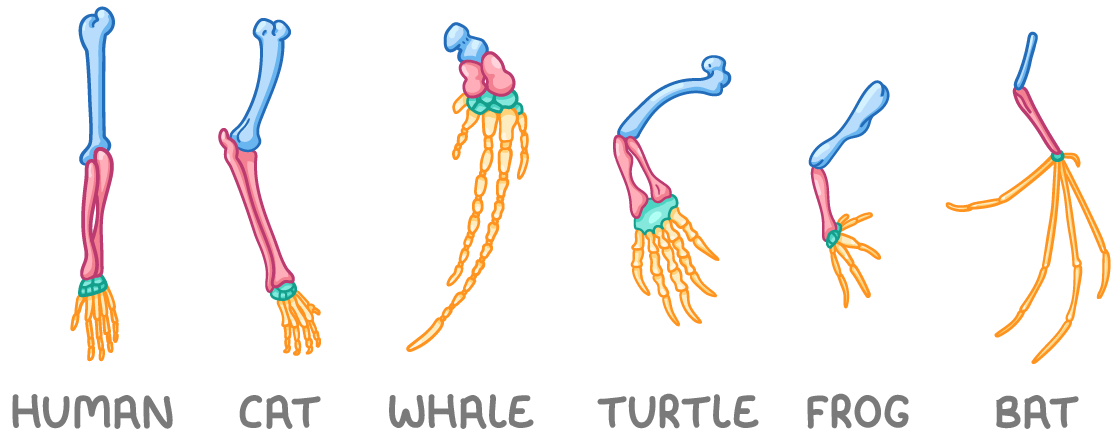
Understanding morphological homologies
- Homologous structures - These are body parts in different species that have a similar structure and embryonic origin but may serve different purposes. For example, the forelimbs of humans, bats, and whales all have the same basic bone structure despite being used for grasping, flying, and swimming, respectively.
- Vestigial structures - These are remnants of structures that were functional in ancestors but are reduced or nonfunctional in modern species. Examples include the human appendix or the tiny leg bones in some snakes, indicating a shared ancestry with organisms that once used these structures.
- Embryological similarities - During early development, embryos of related species often show striking similarities, such as gill slits in vertebrate embryos, which later develop into different structures, pointing to a common evolutionary origin.
How homologies support evolution
Morphological homologies demonstrate that diverse species likely evolved from a shared ancestor, with natural selection modifying these structures over time to suit different environments or lifestyles. This pattern of divergence from a common starting point is a key piece of evidence for evolution, as it shows how life has branched out while retaining traces of its shared history.
Biochemical and genetic evidence for evolution and common ancestry
Biochemical and genetic data provide some of the most compelling evidence for evolution by revealing similarities at the molecular level. By comparing DNA nucleotide sequences and protein amino acid sequences across species, scientists can uncover evolutionary relationships that are not always apparent from physical traits alone.
DNA and protein sequence comparisons
- DNA nucleotide sequences - DNA is the hereditary material in all living organisms, and its sequence of nucleotides (A, T, C, G) can be compared between species. The more similar the sequences, the more closely related the species are likely to be, indicating a more recent common ancestor. For instance, humans and chimpanzees share about 98% of their DNA, suggesting a close evolutionary relationship.
- Protein amino acid sequences - Proteins are made of chains of amino acids, and their sequences are determined by DNA. Comparing these sequences across species shows similarities that reflect shared ancestry. For example, the protein cytochrome c, involved in cellular respiration, has highly conserved sequences across diverse organisms, from yeast to humans, pointing to a common origin of life.
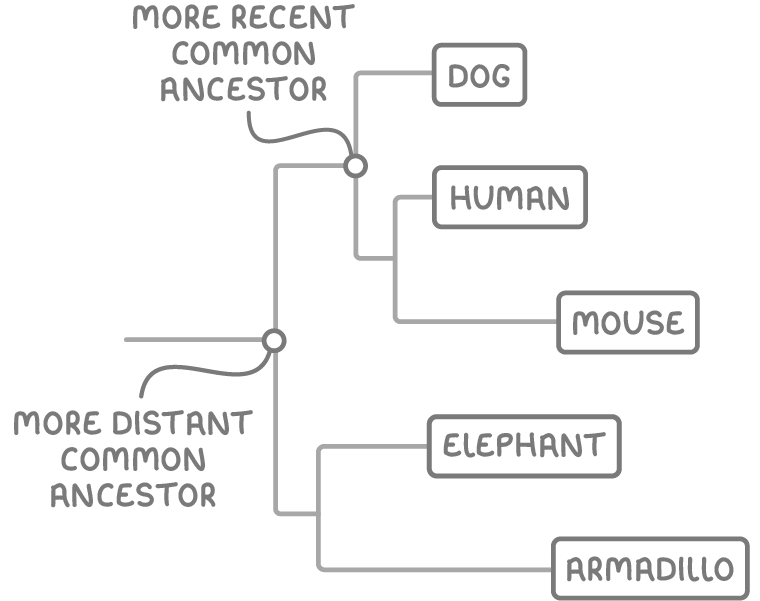
What molecular evidence reveals
- Degree of relatedness - The extent of similarity in DNA or protein sequences indicates how closely related two species are, helping to construct evolutionary trees or phylogenies.
- Conserved genes and molecules - Certain genes and proteins are essential for life and have changed very little over millions of years, showing the unity of life through shared molecular machinery.
- Molecular clocks - The rate of mutations in DNA sequences can be used to estimate the time since two species diverged from a common ancestor, providing a timeline for evolutionary events.
This molecular evidence complements morphological and geological data, offering a deeper understanding of how all living organisms are connected through the process of evolution.