3.3 - Cellular Energy
The fundamental role of energy in living organisms
Energy is the driving force behind all life processes, enabling organisms to grow, reproduce, and maintain their internal balance. Without a constant input of energy, living systems cannot function or survive. This energy fuels everything from the smallest cellular activities to the most complex organismal behaviors.
Why energy is essential for life
- Sustains vital processes - Energy is required for growth, movement, reproduction, and repair in all living organisms.
- Drives molecular interactions - It powers the synthesis of molecules like proteins and DNA, which are crucial for cell function and structure.
- Maintains homeostasis - Energy helps organisms keep a stable internal environment despite external changes, such as regulating body temperature or balancing internal pH.
Every living system, from single-celled bacteria to complex multicellular organisms like humans, depends on energy to carry out these life-sustaining activities.
How energy maintains order and powers cellular processes
Living organisms are highly ordered systems, meaning their structures and functions are precisely organized at the molecular and cellular levels. Energy plays a critical role in maintaining this order while adhering to the fundamental laws of thermodynamics, which govern energy transformations in all systems.
Energy and the laws of thermodynamics
- First law of thermodynamics - Energy cannot be created or destroyed, only transformed. In living systems, energy from food or sunlight is converted into usable forms for cellular work.
- Second law of thermodynamics - Energy transformations increase disorder (entropy) in the universe. Organisms use energy input to counteract this tendency toward disorder within their own systems.
- Energy balance - For life to persist, energy input must exceed energy loss. This surplus energy maintains order and drives cellular processes like muscle contraction or nerve signaling.
- Consequences of energy loss - If energy loss exceeds input, the organism's order breaks down, leading to cellular dysfunction and, ultimately, death.
Coupling of energy-releasing and energy-requiring processes
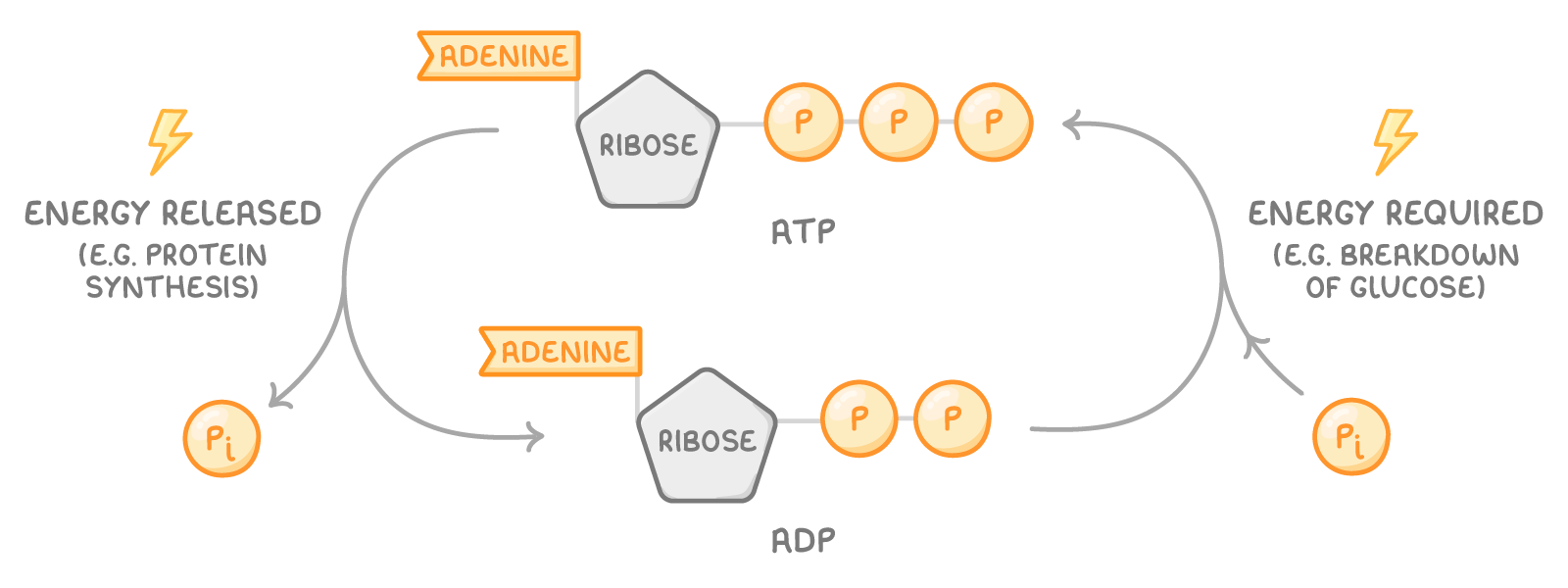
Cellular processes often involve a balance between reactions that release energy and those that consume it. This coupling ensures that energy is used efficiently within the cell.
Energy release:
- ATP (adenosine triphosphate) can be broken down into ADP (adenosine diphosphate) and inorganic phosphate (Pi).
- This breakdown of ATP releases energy, which can be used to power cellular processes that require it, such as protein synthesis.
- In this way, energy-releasing reactions are directly coupled to energy-consuming processes, ensuring the cell can carry out vital functions.
Energy consumption:
- Some reactions, such as the breakdown of glucose, release energy that the cell can capture.
- This captured energy is required to rejoin ADP and Pi, regenerating ATP.
- The regenerated ATP is then available to be broken down again, continuing the cycle.
- This links energy-consuming reactions directly to energy-releasing ones, so that no energy is wasted and the cell maintains a continuous, efficient supply of ATP.
This balance ensures that cells maintain their functions without violating the laws of thermodynamics.
The sequential nature of energy-related pathways in biological systems
Energy transformations in living organisms occur through carefully ordered sequences known as metabolic pathways. These pathways are series of chemical reactions where the product of one reaction becomes the reactant for the next, allowing for controlled and efficient energy transfer.

Characteristics of metabolic pathways
- Step-by-step progression - Each reaction in a pathway is catalyzed by specific enzymes, ensuring energy is released or used in manageable amounts rather than all at once.
- Controlled energy transfer - Sequential steps prevent energy loss as heat and maximize the usable energy captured for cellular work.
- Examples of pathways - Key pathways like glycolysis (the breakdown of glucose to produce energy) and the citric acid cycle (a stage of cellular respiration) illustrate how energy is transferred through a series of linked reactions.
Why sequential pathways matter
- Efficiency - By breaking down processes into smaller steps, cells avoid overwhelming energy releases that could damage cellular components.
- Regulation - Sequential pathways allow cells to control energy flow, turning reactions on or off based on the organism's needs.
- Integration - These pathways connect different cellular processes, ensuring that energy production and consumption are balanced across the system.
This ordered approach to energy management is a fundamental feature of life, enabling organisms to sustain complex functions over time.
The concept of common ancestry supported by conserved metabolic pathways
One of the most compelling pieces of evidence for the idea of common ancestry across all life forms is the presence of shared metabolic pathways. These core processes for energy release are remarkably similar across the three domains of life: Archaea, Bacteria, and Eukarya.
What are conserved metabolic pathways?
- Conserved pathways are sequences of chemical reactions that are nearly identical in structure and function across diverse organisms, indicating they were present in a common ancestor.
- For example, glycolysis, the process of breaking down glucose to produce ATP, and oxidative phosphorylation, a key step in cellular respiration that generates energy, are found in virtually all living organisms.
How conserved pathways support common ancestry
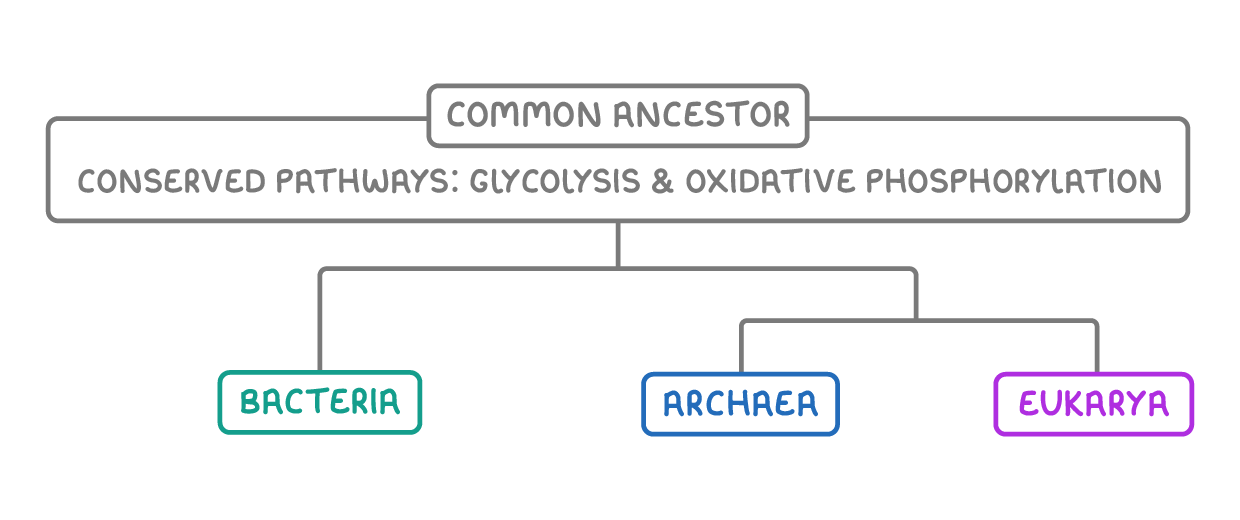
The presence of the same metabolic processes across all domains of life (Bacteria, Archaea, and Eukarya) suggests that these pathways evolved early in the history of life and were passed down through generations.
Evidence of evolution:
- Since all organisms require energy to survive, the conservation of these pathways reflects a shared solution to a universal problem, likely originating from a common ancestor.
- Minor variations in these pathways among species provide insights into evolutionary divergence, while their core similarities highlight a unified origin of life.
- This conservation of metabolic pathways serves as powerful evidence that all life on Earth is interconnected, tracing back to a single point of origin billions of years ago.
- By studying these shared processes, scientists can better understand the evolutionary relationships that link all living organisms.