2.7 - Tonicity & Osmoregulation
Understanding tonicity and its effect on cells
Tonicity refers to the ability of a solution to cause a cell to gain or lose water, based on the concentration of solutes (dissolved particles) outside the cell compared to inside. This concept is crucial for understanding how cells maintain their internal environment when surrounded by different external conditions.
Key terms related to tonicity
- Tonicity - The measure of the osmotic pressure gradient between two solutions, which determines the direction and extent of water movement across a semi-permeable membrane.
- Solute - Any substance dissolved in a solvent, such as salts or sugars in water.
- Solvent - The liquid in which solutes are dissolved, typically water in biological systems.
- Semi-permeable membrane - A barrier, like the cell membrane, that allows certain molecules (like water) to pass through while blocking others (like larger solutes).
Tonicity affects cells by influencing the movement of water, which can lead to swelling, shrinking, or maintaining the cell's normal shape, depending on the surrounding environment.
Types of tonic environments and their effects
External environments surrounding cells can be classified into three categories based on their solute concentration relative to the cell's internal environment. These categories determine how water moves across the cell membrane through a process called osmosis.
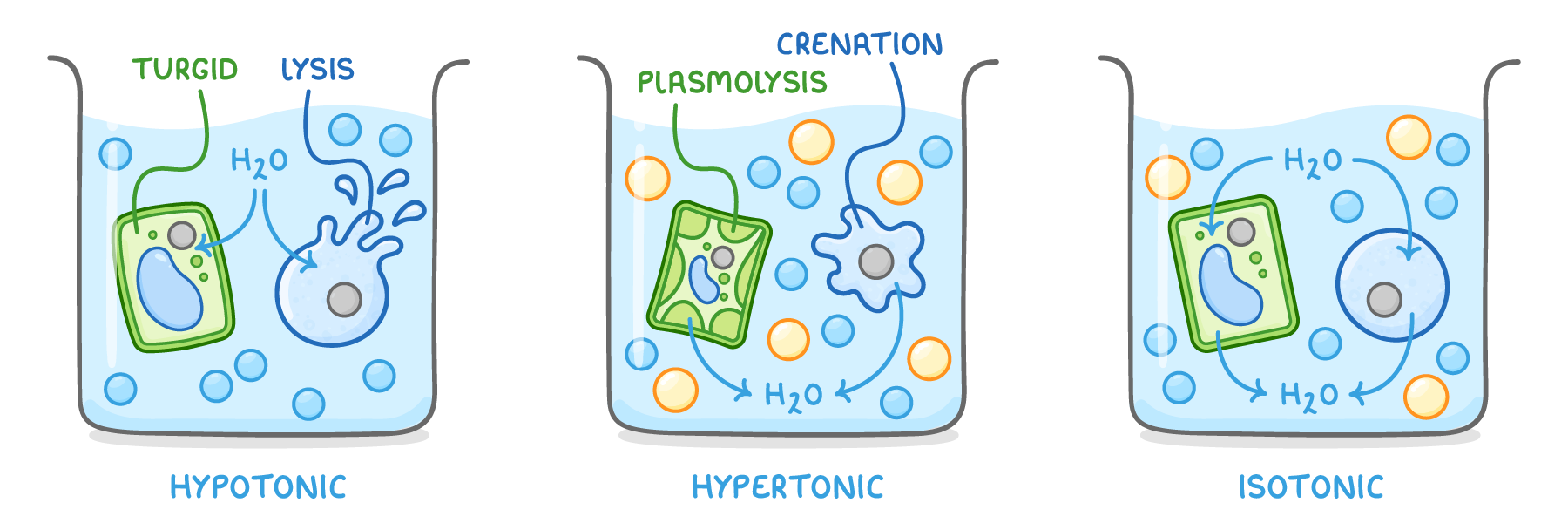
Hypotonic environment
- A hypotonic solution has a lower solute concentration compared to the inside of the cell, meaning it has a higher water concentration.
- Water moves into the cell because there is more water outside.
- This can cause animal cells to swell and potentially burst (lyse).
- In plant cells, the cell wall prevents bursting, but the cell becomes turgid (firm), which is often beneficial for structural support.
- A freshwater environment is hypotonic to the cells of a fish, leading to constant water influx.
Hypertonic environment
- A hypertonic solution has a higher solute concentration compared to the inside of the cell, meaning it has a lower water concentration.
- Water moves out of the cell to the area of lower water concentration.
- This causes animal cells to shrink (crenate), while plant cells lose internal pressure, leading to a condition called plasmolysis where the cell membrane pulls away from the cell wall.
- Seawater is hypertonic to human cells, which is why drinking it causes dehydration as water leaves the body's cells.
Isotonic environment
- An isotonic solution has the same solute concentration as the inside of the cell, resulting in no net movement of water.
- There is no change in cell volume because water enters and leaves the cell at equal rates.
- This balance is ideal for most animal cells to maintain their shape and function.
- Intravenous (IV) fluids used in hospitals are often isotonic to human blood cells to prevent damage during administration.
Osmosis and water movement in cells
Osmosis is the passive movement of water across a semi-permeable membrane from an area of high water concentration to an area of low water concentration. This process is driven by differences in solute concentration and plays a vital role in maintaining cellular water balance.
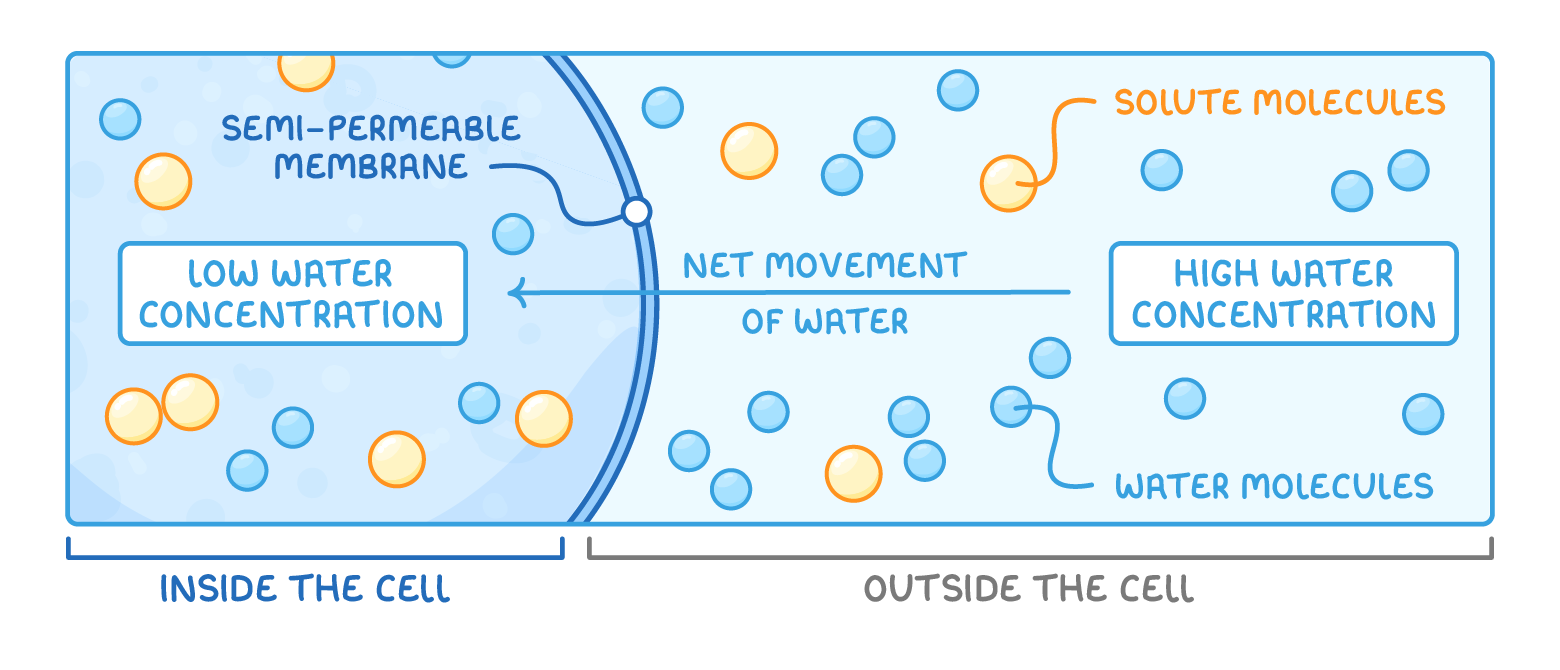
Key principles of osmosis
- Direction of movement - Water moves from a hypotonic region (high water concentration, low solute concentration) to a hypertonic region (low water concentration, high solute concentration).
- No energy required - Osmosis is a passive process, meaning it does not require cellular energy since water moves along its concentration gradient.
- Impact on homeostasis - By regulating water movement, osmosis helps cells maintain an internal environment suitable for biochemical reactions and structural integrity.
This movement of water is critical for cells to avoid extreme swelling or shrinking, which can disrupt normal functions.
Water potential and its role in water movement
Water potential (Ψ) is a measure of the potential energy of water in a system, determining the direction of water movement. It quantifies how freely water can move in a particular environment, with water always moving from areas of higher water potential to areas of lower water potential.
Formula for water potential
Where:
- Ψ = Total water potential (measured in bars)
- Ψp = Pressure potential (the physical pressure on water, often positive in plant cells due to turgor pressure)
- Ψs = Solute potential (the effect of solute concentration on water potential, always negative as solutes reduce water's ability to move)
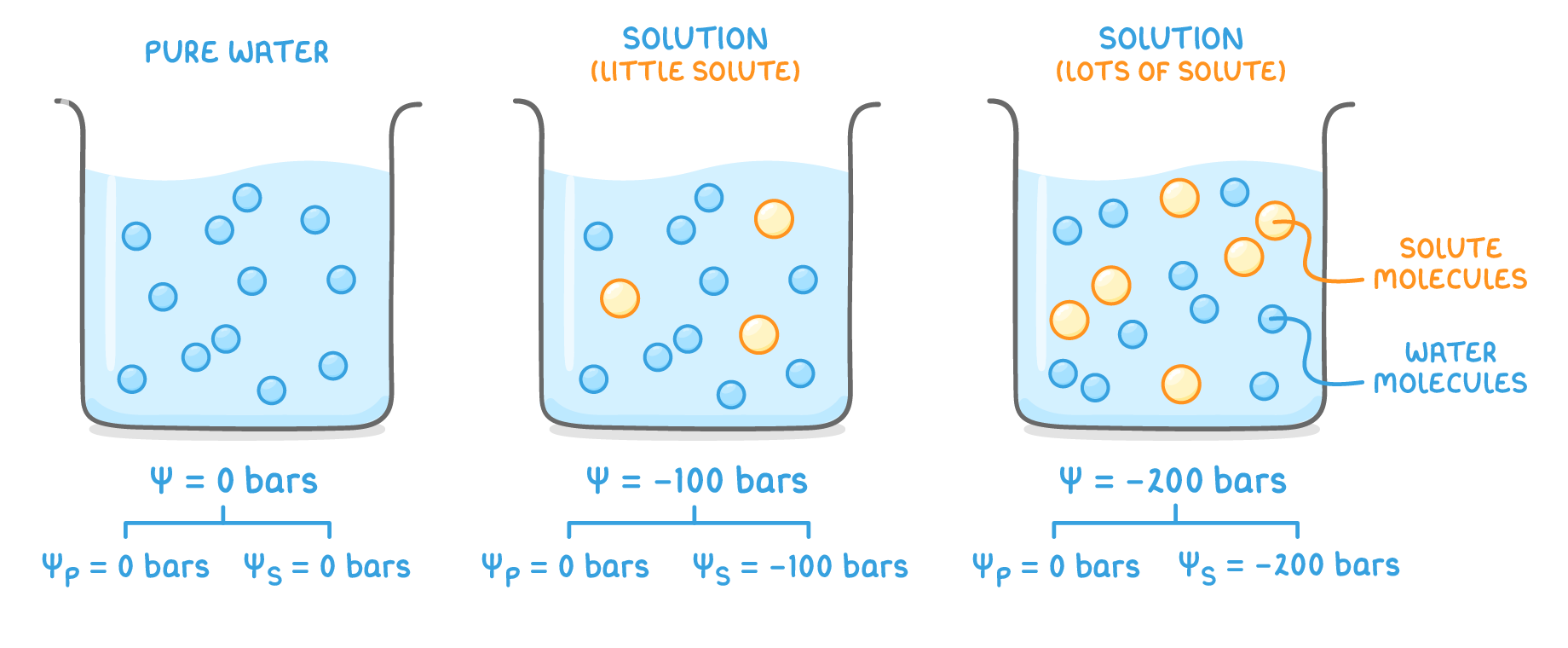
Components of water potential
- Pressure potential (Ψp) - In plant cells, this is often due to turgor pressure, which pushes water against the cell wall, increasing water potential. In animal cells, it is usually negligible, and it's the same in the open beakers above.
- Solute potential (Ψs) - Reflects the concentration of solutes; more solutes mean a more negative value, lowering water potential and attracting water to that region.
Water potential helps predict water movement in biological systems, especially in plants, where maintaining turgidity is crucial for structural support.
Formula for solute potential
Where:
- Ψs = Solute potential (bars)
- i = Ionization constant (number of particles a solute dissociates into in water)
- C = Molar concentration (moles per liter)
- R = Pressure constant (0.0831 L bars / mol K)
- T = Temperature in Kelvin (°C + 273)
This equation allows for precise calculation of how solute concentration affects water potential, aiding in understanding osmosis in different environments.
Osmoregulation and its importance for organism survival
Osmoregulation is the active control of water balance and solute concentration within an organism's cells and body fluids. This process is essential for maintaining homeostasis, ensuring that cells neither swell excessively nor shrink to the point of dysfunction.
Why osmoregulation matters
- Water balance - Organisms must regulate internal water levels to prevent dehydration or overhydration, both of which can impair cellular functions.
- Solute composition - Controlling internal solute concentrations prevents toxic buildups and maintains optimal conditions for metabolic processes.
- Survival in varied environments - Osmoregulation allows organisms to adapt to diverse habitats, from freshwater to marine environments, by adjusting water and solute movement.
Mechanism of osmoregulation
- Movement across membranes - Constant molecular movement across cell membranes, driven by concentration gradients, supports growth and homeostasis.
- Control of water potential - Organisms adjust their internal water potential to manage water influx or efflux, often through specialized structures or behaviors.
Without osmoregulation, cells could not maintain the delicate balance needed for survival, especially in environments that differ significantly from their internal conditions.
Examples of osmoregulatory mechanisms in organisms
Different organisms have evolved specialized structures and mechanisms to manage water balance, reflecting the diverse challenges posed by their environments. Two key examples illustrate how osmoregulation operates at the cellular level.
Contractile vacuole in protists
The contractile vacuole is a specialized organelle found in many single-celled protists, such as paramecia, that live in hypotonic, freshwater environments.
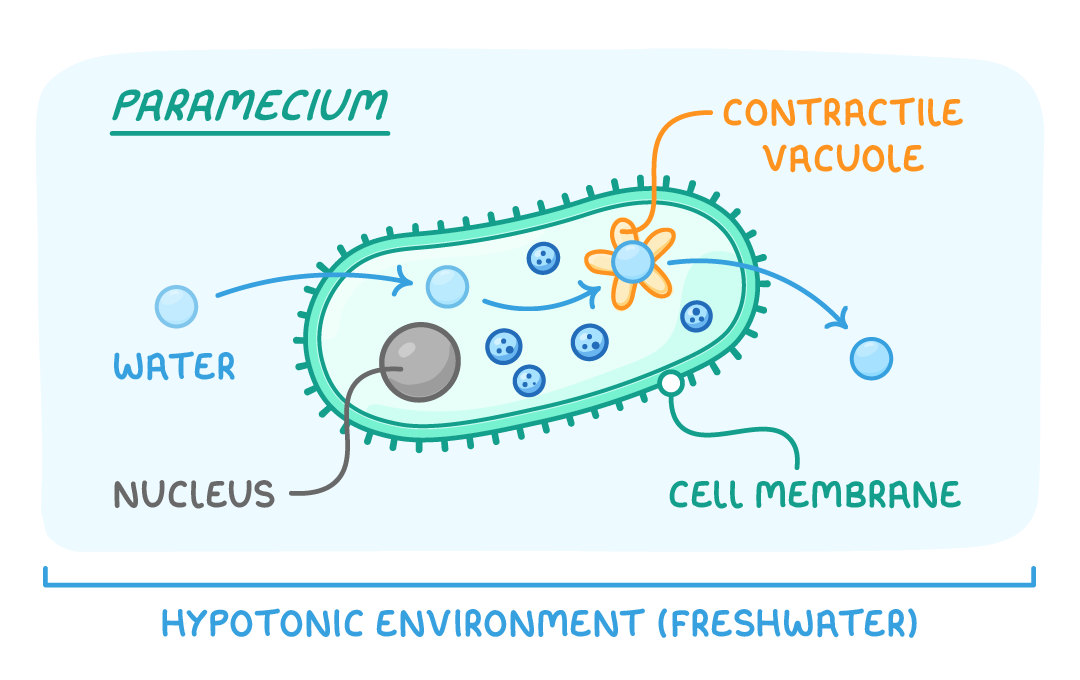
How the contractile vacuole works:
- It actively expels excess water that enters the cell due to the hypotonic external environment, preventing the cell from swelling and bursting.
- The vacuole collects water from the cytoplasm, contracts, and releases it through a pore to the outside, maintaining water balance.
- This mechanism is critical for protists in hypotonic environments, where water constantly moves into the cell via osmosis.
Central vacuole in plant cells
- The central vacuole is a large, membrane-bound organelle in plant cells that occupies much of the cell's volume.
- It stores water, ions, and other molecules, helping to regulate water potential and maintain turgor pressure, which keeps the plant cell rigid and supports the plant's structure.
- In hypotonic conditions, water enters the vacuole, increasing turgor pressure against the cell wall.
- In hypertonic conditions, the vacuole can release water to prevent plasmolysis.
- The central vacuole plays a dual role in osmoregulation and structural support, demonstrating how plant cells adapt to changing water availability.