4.6 - Identities: Class
Social stratification and class identity
Social stratification refers to the way societies are divided into layers or hierarchies based on wealth, power, and status. This division plays a crucial role in shaping personal and social identities, particularly through the concept of social class.
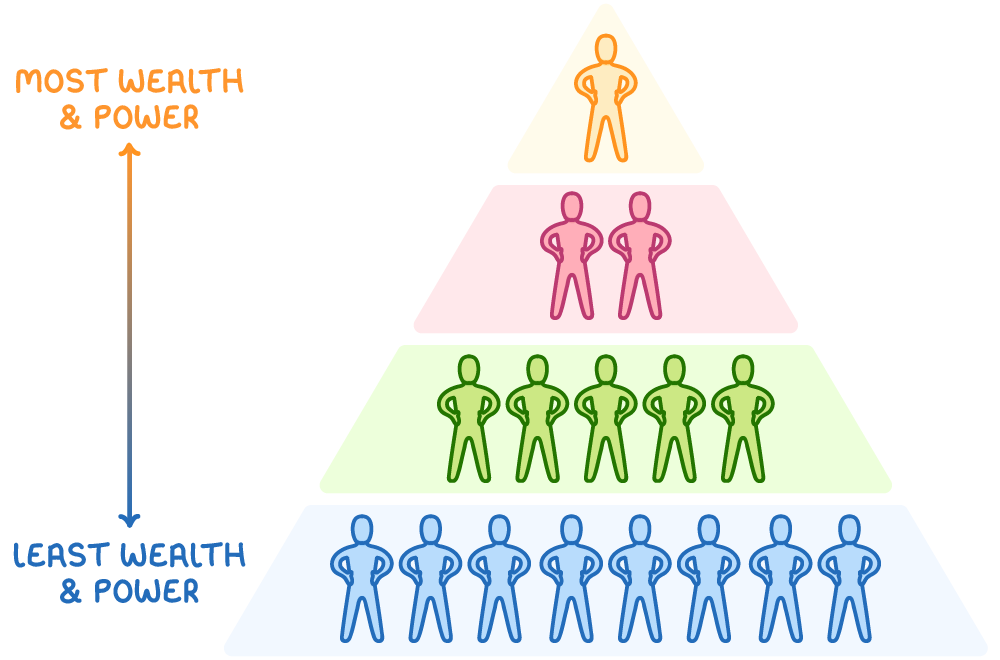
Understanding social stratification
- Hierarchical layers - Societies are organised into strata, with the richest and most powerful at the top, the poorest and least powerful at the bottom, and various levels in between.
- Class as a key factor - In modern Western capitalist societies like the UK, social class is the primary system of stratification, significantly influencing how individuals perceive themselves and are perceived by others.
- Impact on identity - Class identity is a fundamental part of who people are, affecting their opportunities, behaviours, and social interactions.
Different ways of defining social class
Social class can be understood and categorised in various ways, depending on historical, governmental, and sociological perspectives.
Approaches to classifying social class
- Marxist perspective - Karl Marx proposed a binary model with two main classes: the proletariat (workers who sell their labour) and the bourgeoisie (owners of production who control wealth and power).
- Government classification - Historically, the UK census used occupational roles to define class, grouping people based on the type of work they do.
- Sociologists often simplify class into four basic groups based on wealth, occupation, and life chances:
- Upper class - Wealthy and influential, including traditional landowners (aristocracy) and those who have amassed fortunes through business or entertainment. Their wealth is often inherited.
- Middle class - Earn income through non-manual work, such as teachers, doctors, and office-based professionals. This group is expanding due to the rise in non-manual jobs.
- Working class - Rely on manual labour for income, including farm workers and factory employees. They generally have fewer life opportunities compared to the middle class.
- Underclass - Depend on state benefits, encompassing the long-term unemployed and homeless. This group faces the most significant challenges in terms of life chances.
The influence of class culture on identity
Class culture significantly shapes individual identity by instilling distinct norms, values, and behaviours through socialisation processes. These cultural differences often reinforce class boundaries.
How class culture shapes behaviour and identity
- Norms and values - Barry Sugarman (1970) highlighted that middle-class children are socialised to value deferred gratification (planning for the future), aiding their pursuit of education and professional careers, while working-class children are often encouraged towards immediate gratification (living for the present).
- Generational poverty - Charles Murray (1994), a New Right theorist, argued that certain values, such as accepting reliance on state benefits, are transmitted across generations, perpetuating poverty and shaping a specific class identity.
- Social networks in education - John Scott (1991) noted that the upper class utilises elite private schools (like Eton) to build exclusive social networks, which continue into prestigious universities (such as Oxford), reinforcing their high-status identity.
- Educational subcultures - Within state schools, middle-class students often join pro-school groups (e.g., homework clubs) and are placed in higher sets, while working-class students may adopt anti-school attitudes and end up in lower sets, influencing their self-perception and future prospects.
Negative stereotypes and working-class identity
Negative stereotypes about social class can deeply affect how individuals from lower classes view themselves and are treated by others, often reinforcing social inequalities.
Skeggs and Loveday (2012) study
- Method - The study explored how working-class individuals perceive and experience negative stereotyping related to their class identity.
- Results:
- Participants felt blamed for systemic inequalities they were born into, often being labelled as selfish or greedy, while similar behaviours in higher classes were overlooked.
- They strongly identified with values like loyalty and care for others, believing these were less prioritised by middle and upper classes.
- The research found that enduring hardship and accepting class oppression without the power to change it is a central aspect of working-class identity.
- Conclusions - Skeggs and Loveday concluded that middle-class individuals often use negative stereotypes to assert moral superiority over lower classes, maintaining their own privileged positions.
- Evaluation - This study highlights the psychological burden of class-based stigma but may be limited by its focus on subjective experiences, which can vary widely.
Cultural and social capital
The concept of capital, beyond just financial wealth, is crucial in understanding how class positions are sustained and how individuals navigate social hierarchies.
Bourdieu's theory of capital (1984)
- Types of capital:
- Economic capital - Refers to income and wealth.
- Social capital - Involves belonging to influential groups or networks.
- Cultural capital - Encompasses knowledge, skills, and behaviours (like etiquette, language, or appreciation of high culture such as opera) that align with higher social strata.
- Upper class dominance - Bourdieu argued that the upper class preserves its top position by passing down cultural capital, ensuring familiarity with elite norms and practices.
- Middle class aspirations - Middle-class families actively cultivate cultural capital in their children through exposure to literature, theatre, and art galleries to improve their social standing.
- Working class limitations - Working-class families typically lack access to or emphasis on cultural capital, limiting their upward mobility.
- Importance of social capital - Cultural capital alone is insufficient without social capital; middle-class individuals may struggle to advance without the right networks, even if they possess cultural knowledge.
Contemporary views on class identity
While social class has historically been a central determinant of identity, modern perspectives suggest its influence may be diminishing in the face of other factors and societal changes.
Changing influences on identity
- Postmodernist view:
- Many postmodernists argue that identity is now more tied to consumption (how and where money is spent) rather than production (how money is earned).
- Leisure activities are seen as individual choices rather than class-based, with traditional class distinctions in hobbies (e.g., bingo for working class, golf for middle class) becoming blurred.
- Postmodernists also suggest that globalisation and instant access to media have created a mass culture, diminishing distinctions between high and low culture.
- New Right view - Peter Saunders (1990) claims that traditional class divisions have faded in a modern society with equal opportunities, suggesting identity is less class-dependent.
- Fragmentation of working class - Marshall (1988) notes that while many still identify as working class, the decline of traditional industries has fragmented this identity, weakening its collective strength.
- Multiple identity factors - Bradley (1996) argues that class is now just one of several influences on identity, alongside ethnicity, gender, and age, leading to more complex, fragmented personal identities.
While many sociologists continue to explore class differences, particularly between working and middle classes through socialisation agents like family, postmodernists question the relevance of class in the 21st century, proposing it no longer defines identity as it once did.