1.1 - Key Concepts in Sociology
The definition and scope of sociology
Sociology is the academic study of human society, focusing on how it develops, functions, and is organised. It explores the structures, relationships, and behaviours that shape social life.
Key aspects of sociology
- Study of society - Examines the patterns and processes that form the foundation of human interactions and societal development.
- Focus on organisation - Investigates how societies are structured, including the roles of institutions and social groups.
- Development and change - Analyses how societies evolve over time, considering historical and contemporary influences.
Key founding figures and their perspectives
Sociology was shaped by several influential thinkers, often referred to as the 'founding fathers'. Their ideas provide fundamental frameworks for understanding society.
Prominent sociologists and their views
- Karl Marx (1818-1883) - Argued that capitalism creates inequality by oppressing the working class, advocating for a revolutionary change to establish equality among all people.
- Emile Durkheim (1858-1917) - A functionalist who saw society as a system of interconnected institutions, each serving a specific role to maintain stability and harmony.
- Max Weber (1864-1920) - Emphasised the need to study both societal structures (like laws) and individual actions, believing that behaviour is influenced by both external systems and personal emotions or motivations.
Core concepts of culture, socialisation, and identity
Understanding culture as a way of life
Culture refers to the shared way of life of a group, encompassing language, beliefs, norms (accepted behaviours), values (ideas of right and wrong), knowledge, and skills.
Culture differs across regions and over time, for instance, modern British culture contrasts with that of a century ago or with Indian cultural practices. It can strengthen the sense of belonging and unity within a society through shared practices and beliefs.
The process of socialisation
Socialisation is the mechanism through which cultural norms and values are passed from one generation to the next. It begins in childhood with basic behaviours and beliefs, continuing into adulthood through various influences.
Various agents of socialisation contribute to the internalisation of societal values into personal thought patterns:
- Family
- Education
- Peers
- Religion
- Media
- Workplace
Exploring the concept of identity
- Basic identity - Comprises straightforward personal details such as name, age, and physical appearance.
- Social identity - A deeper layer involving how individuals perceive themselves and are perceived by others, shaped by factors like social class, ethnicity, gender, age, sexuality, and social roles (e.g., parent, employee, or friend).
The impact of globalisation on society
Globalisation represents the increasing interconnectedness of the world, breaking down traditional boundaries between nations and cultures through various modern developments.
Key drivers and effects of globalisation
- Technological advancements - Improved communication and technology facilitate global connections and information exchange.
- Rise of transnational corporations (TNCs) - Large companies operating across multiple countries contribute to economic and cultural integration.
- Increased migration - Movement of people across borders enhances cultural exchange and diversity.
- Cultural globalisation - Some sociologists argue that cultures are becoming more uniform worldwide, influencing local traditions and identities.
Social differentiation, stratification, and power dynamics
Social differentiation and its forms
- Societies are split into various categories based on biological traits (e.g., age, sex), cultural aspects (e.g., class, religion), or individual characteristics (e.g., skills or talents).
- Structural differentiation refers to the increasing specialisation of societal institutions, where each develops distinct functions over time.
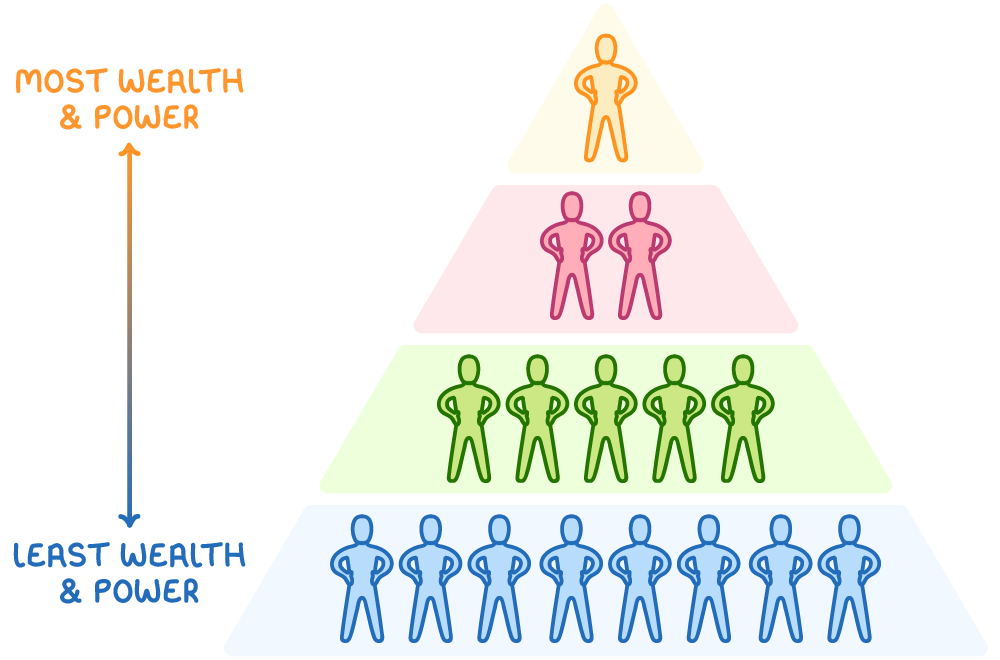
Stratification and hierarchical layers
- Stratification organises society into a hierarchy of layers or strata, often based on social class in Western contexts, but also on status, income, ethnicity, gender, or age.
- The wealthiest and most powerful occupy the top layer, while the least powerful and poorest form the bottom, with numerous intermediate layers in between.
Power and its sources
- Power is the capacity to influence others to act in ways they might not otherwise, often studied in terms of societal balance or imbalance.
- Sources of power:
- Commonly derived from wealth, occupation, or social class.
- Can also stem from gender, religion, or other social factors.
- Some sociological perspectives suggest that those with power maintain their position by controlling societal structures and suppressing those with less influence.