1.2 - Sociological Perspectives & Theories
Functionalism and the role of institutions
Functionalism is a sociological theory that sees society as a system of interconnected institutions, each serving a specific purpose to maintain social harmony. Often referred to as a structural theory, it focuses on how these institutions shape individuals and ensure the smooth operation of society.
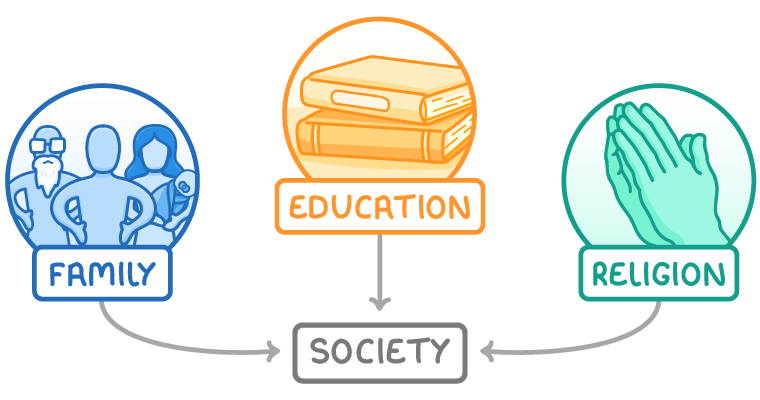
Key ideas of functionalism
- Society as a whole - Functionalists, inspired by Emile Durkheim, believe society is composed of various parts, such as family, education, and religion, each contributing to the overall stability.
- Functions of institutions - Each institution has a role:
- Family socialises children into societal norms.
- Education prepares individuals for adult responsibilities.
- Religion fosters unity through shared beliefs.
- Consensus structuralism - This theory suggests that society is structured to function harmoniously, with institutions working together to avoid conflict and maintain order.
Criticisms of functionalism
- Limited focus on individuals - Interactionists argue that functionalism overlooks personal agency and individual experiences.
- Ignoring power imbalances - Marxists criticise functionalism for neglecting the unequal distribution of power and how it benefits certain groups over others.
Marxism and the role of economic forces
Marxism, developed by Karl Marx, centres on the impact of economic systems, particularly capitalism, on society. It views the economic base (infrastructure) as the foundation that shapes non-economic institutions (superstructure), which in turn influence societal beliefs and values.
Core concepts of Marxism
- Class conflict as central - Marxists see society as divided into two main classes:
- The bourgeoisie, the ruling minority with wealth and power.
- The proletariat, the working majority with limited influence.
- Capitalist exploitation - Workers produce goods sold for profit by employers, but receive only a small portion of the earnings, with most retained by the bourgeoisie.
- Superstructure's role - Institutions like family, education, and religion reinforce capitalist inequalities by encouraging workers to accept their subordinate position, preventing revolt.
- Conflict structuralism - Unlike functionalism, Marxism highlights the inherent conflict between classes as the driving force of societal change.
- Neo-Marxism - A modern adaptation of Marxism, focusing on ideology—sets of ideas enforced by the ruling class to maintain control in contemporary contexts.
Criticisms of Marxism
- Overemphasis on economy - Functionalists argue that Marxism places too much importance on economic structures while ignoring other influences on beliefs.
- Neglect of individual agency - Interactionists suggest it overlooks how individuals actively shape their social world.
- Outdated class focus - Postmodernists claim that social class is less relevant today, with identity now shaped more by personal choices than economic status.
Feminism and gender-based inequalities
Feminism examines society through the lens of gender, asserting that it is patriarchal—dominated by men and structured to serve their interests. It highlights inequalities between genders and seeks to address them through various approaches.
Main strands of feminism
- Liberal feminism - Advocates for equal rights and opportunities within existing societal structures, such as legal reforms to ensure fairness for women.
- Radical feminism - Argues that society itself is fundamentally oppressive to women, requiring a complete overhaul. It sees power imbalances in all relationships, with women expected to be subservient.
- Marxist feminism - Combines Marxist and feminist views, suggesting that women are exploited by capitalist systems controlled by men.
- Structuralist approach - Feminism views society as structured by gender, with systemic barriers maintaining male dominance.
Internal disagreements within feminism
Radical feminists argue that liberal feminists fail to recognise patriarchy in personal relationships, such as within families, focusing only on institutional changes.
Interactionism and individual actions
Interactionism, also known as interpretivism, prioritises the role of individuals in shaping society through their actions and interpretations. Unlike structural theories, it focuses on personal agency and the meanings people attach to social interactions.
Key principles of interactionism
- Individual interpretation - People actively make sense of the world around them, creating culture through their interactions rather than simply being shaped by it.
- Response to structures - While social structures exist, interactionists believe individuals respond to them uniquely, exercising free will and making personal choices.
- Potential for change - Individual decisions can lead to significant societal shifts. For instance, when women chose to work outside the home, it prompted changes in family roles, with men taking on more domestic tasks, as noted in research studies from the early 1990s.
- Action theory - This approach emphasises the active role of individuals over the deterministic view of structural theories like functionalism or Marxism.
Criticisms of interactionism
- Ignoring conflict - Marxists argue that interactionism downplays social conflict and the power disparities between groups.
- Underestimating socialisation - Functionalists believe it neglects the importance of societal norms instilled through socialisation processes.
New Right and postmodernist views on society
Sociological thought extends beyond traditional theories to include perspectives like the New Right and postmodernism, each offering distinct views on societal order and transformation.
New Right and traditional values
- Consensus structuralism - Similar to functionalism, the New Right believes society requires shared values and institutions to maintain order, focusing on family, education, and welfare.
- Nuclear family importance - Theorists argue that the traditional nuclear family—parents and dependent children living together with defined roles (men as breadwinners, women as homemakers)—is vital for social stability.
- Decline in morals - Sociologists like Charles Murray suggest that deviations from traditional family structures threaten moral standards, leading to societal breakdown.
- Criticism from feminists - Feminists oppose the New Right's emphasis on traditional roles, viewing them as oppressive and reinforcing patriarchal structures.
Postmodernism and societal flexibility
- Reaction to modernism - Postmodernism challenges modernist theories (like Marxism and functionalism), which are seen as metanarratives—grand explanations of society rooted in industrialisation and rational thought.
- Increased choice - It argues that contemporary society is less rigid, offering diverse cultures and lifestyles due to globalisation.
- Rejection of universal truths - Postmodernists believe there is no single way to understand society, advocating for multiple perspectives over one dominant theory.
- Criticisms of postmodernism - Functionalists argue it ignores institutional roles, interactionists say it overlooks individual interactions, and Marxists claim it dismisses persistent inequalities.