3.1 - The Research Process
The aims of sociological research
Sociological research seeks to understand human behaviour and societal patterns through systematic investigation. Researchers strive to gather evidence that provides insight into social structures and interactions, though studying people presents unique challenges compared to natural sciences.
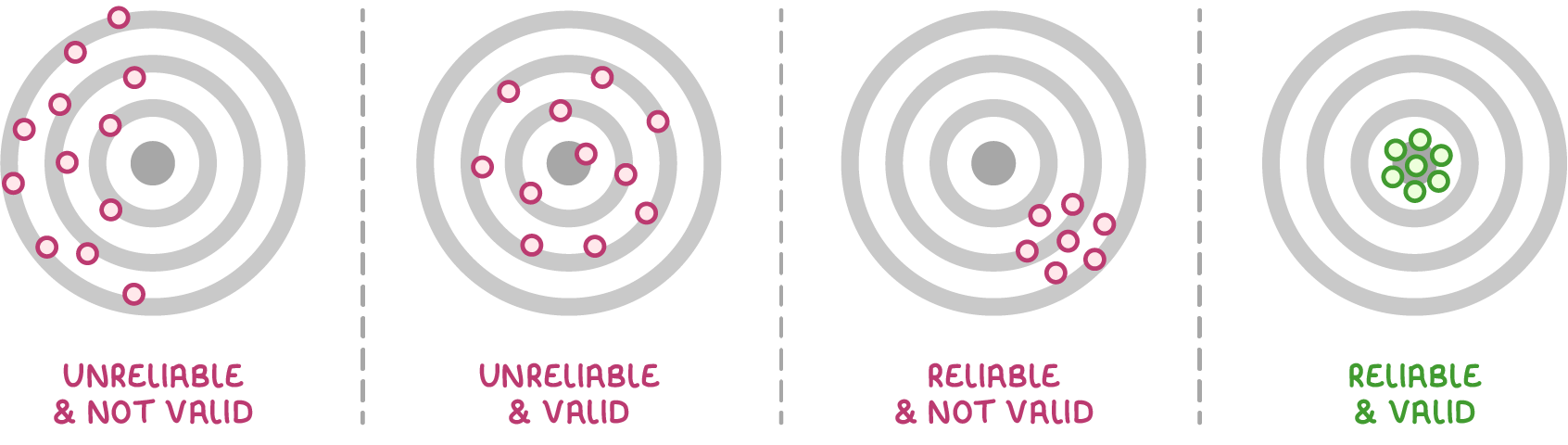
Key objectives in sociological research
- Reliability - Reliability refers to the ability to replicate a study and obtain consistent results using the same methods.
- Validity - Validity ensures the data accurately reflects what is being measured. Even reliable data may not be valid if it doesn't truly represent the reality, such as using unemployment figures that exclude certain groups like students or those unable to work.
- Reasons for invalid data - Data can be skewed if respondents in interviews forget details, exaggerate, or lie about their behaviours, for instance, claiming to recycle more than they actually do. Additionally, asking about past events long after they occurred can lead to distorted memories influenced by current beliefs.
- Representative sampling - Since studying an entire population is impractical, sociologists select a sample that mirrors the broader population in terms of age, gender, class, and ethnicity. A representative sample allows generalisation, meaning findings can be applied to the wider population.
- Objectivity and bias avoidance - Researchers aim to remain impartial, ensuring personal values or preconceptions do not influence the study outcomes.
The use of primary data in sociological studies
Primary data involves information collected directly by the researcher through firsthand methods. This approach allows for tailored research design to address specific questions about society.
Characteristics of primary data collection
- Direct collection methods - Includes techniques such as interviews, questionnaires, observations, and experiments, generating either quantitative (numerical) or qualitative (descriptive) data.
- Advantages of primary data - It is freshly gathered, up-to-date, and can be customised to ensure validity and reliability since it doesn't depend on others' work.
- Challenges in primary data collection:
- Can be costly and time-intensive to conduct.
- May place researchers in risky or unsafe situations.
- Ethical issues arise if participants are not fully informed or do not consent.
- Researcher's personal biases can interfere with the process, introducing bias.
- Access to certain groups or communities may be restricted, limiting the scope of research.
The role of secondary data in sociological research
Secondary data consists of pre-existing information that researchers analyse rather than collect themselves. This type of data is often sourced from various records or media and offers a different perspective on societal issues.
Features of secondary data analysis
- Sources of secondary data - Includes official statistics, personal documents like diaries and letters, memoirs, emails, television documentaries, and newspapers.
- Benefits of using secondary data:
- Quick and straightforward to gather, saving time and resources.
- Facilitates comparison across different societies or historical periods, enabling analysis of past and present trends.
- Does not require informed consent since the data already exists.
- Drawbacks of secondary data:
- May lack validity or reliability due to the original collection methods, over which the researcher has no control.
- Documents might not be authentic, representative, or credible, and official statistics could carry political bias.
- Specific information needed for a study might not be available in existing data.
- While personal values don't affect data collection, they can influence source selection and analysis, and the original researcher's biases may impact the data's validity.
The strengths and limitations of quantitative data
Quantitative data involves numerical information that can be presented in graphs, charts, or tables. It is often used to identify patterns or test theories in sociological research.
Strengths of quantitative data
- Hypothesis testing - Enables researchers to test specific assumptions and explore cause-and-effect relationships.
- Comparative analysis - Allows comparison with other statistics to identify trends over time or differences between societies.
- Ease of analysis - Numerical data is straightforward to interpret using visual tools like bar charts, line graphs, and pie charts.
- Reliability testing - Methods like questionnaires and structured interviews can be repeated to check consistency of results.
- Large-scale representation - Quantitative approaches often involve bigger samples, making findings more likely to reflect the general population.
Limitations of quantitative data
- Distortion of reality - Categories in surveys or questionnaires can oversimplify or misrepresent complex social realities.
- Lack of depth - Numerical data often fails to capture the reasons, meanings, or motivations behind behaviours, missing deeper insights into social interactions.
- Potential for bias - Methods may be chosen to produce desired results, especially in politically sensitive research, skewing the data.
The strengths and limitations of qualitative data
Qualitative data provides detailed, subjective insights into people's thoughts, feelings, and behaviours. It focuses on descriptive accounts rather than numerical summaries, offering a richer understanding of social phenomena.
Strengths of qualitative data
- Insight into social interaction - Offers in-depth descriptions of how people behave and interact in social contexts.
- Understanding motivations - Reveals the underlying reasons and meanings behind actions, providing context to behaviours.
- Flexibility in categorisation - Avoids forcing responses into predefined categories, allowing for more natural and authentic data.
- Trust and sensitivity - Qualitative methods often build rapport with participants, making it easier to explore sensitive or personal topics.
Limitations of qualitative data
- Difficulty in replication - Due to its subjective nature, qualitative studies are hard to repeat with consistent results, reducing reliability.
- Small-scale focus - Research often involves fewer participants, meaning findings may not be representative of the wider population.
- Subjectivity concerns - Critics, such as positivists, argue that qualitative data lacks credibility because it is open to interpretation and bias.
- Risk of misinterpretation - Researchers may misunderstand or misrepresent the perspectives of the individuals or groups being studied.