7.3 - Thermionic Emission
- 1
The process of thermionic emission
- 2
The structure and function of an electron gun
- 3
Applications of electron guns
- 4
Calculating the speed of electrons in a magnetic field
Thermionic emission
Thermionic emission is a fundamental process in which electrons are emitted from a heated metal surface. This phenomenon forms the basis for many electronic devices, including electron guns.
Key points about thermionic emission:
- It occurs when a metal is heated, causing its free electrons to gain thermal energy.
- With sufficient energy, electrons can overcome the metal's work function and escape from its surface.
- The emitted electrons can then be manipulated using electric and magnetic fields.
Structure and function of an electron gun
An electron gun is a device that produces a focused beam of electrons through thermionic emission and subsequent acceleration.
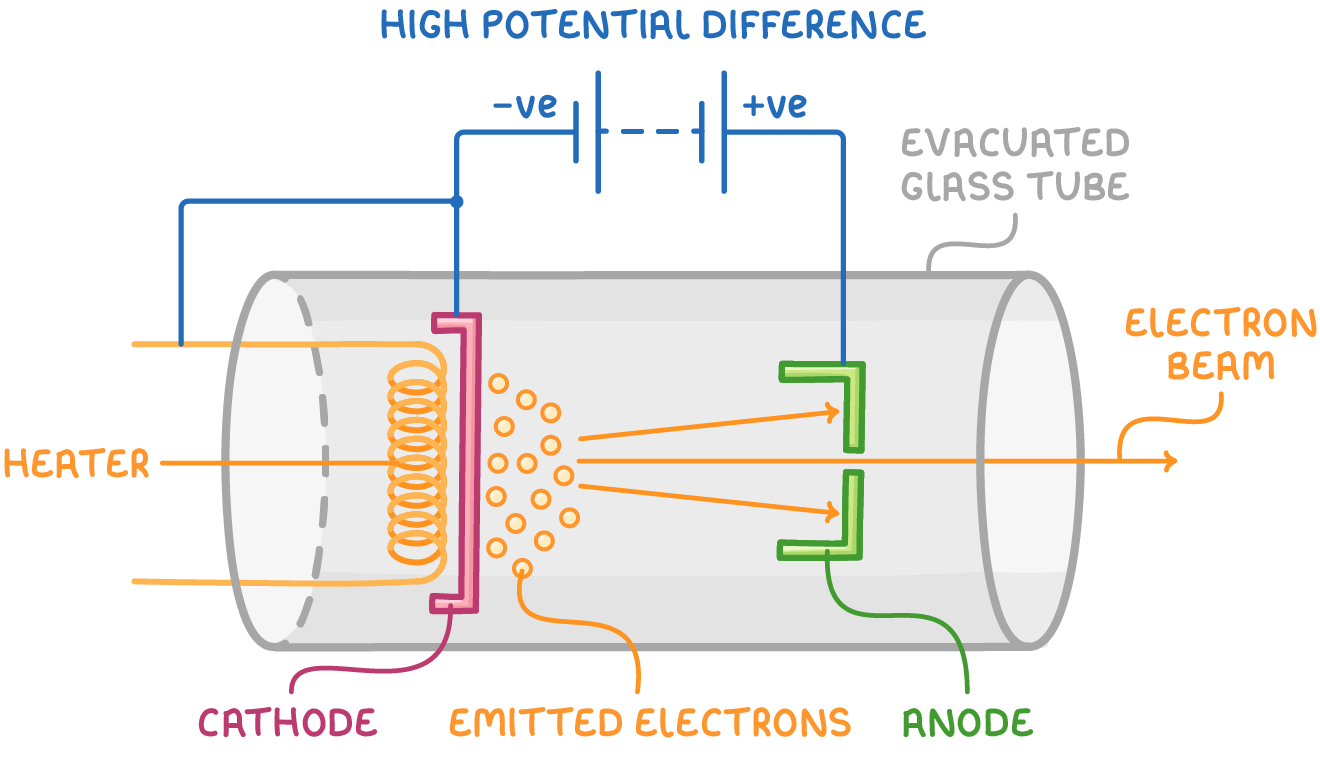
Key components and their functions:
- Cathode - Heated metal surface that emits electrons.
- Anode - Positively charged electrode that attracts and accelerates electrons.
- Evacuated tube - Prevents electron collisions with air molecules.
- High potential difference - Creates an electric field to accelerate electrons.
How an electron gun works:
- The cathode is heated, causing thermionic emission of electrons.
- The electric field between the cathode and anode accelerates the electrons.
- Some electrons pass through the anode's aperture, forming a narrow beam.
- Beyond the anode, electrons move at constant velocity due to the absence of an electric field.
Applications of electron guns
Electron guns find use in various scientific and technological applications:
- Electron microscopes - For high-resolution imaging of small structures
- Cathode ray tubes - In older television and computer monitors
- Particle accelerators - For studying subatomic particles
- Electron beam welding - For precise joining of materials
In many applications, magnetic fields are used to further manipulate the electron beam, such as focusing it onto a sample in an electron microscope.
Calculating Electron Speed in a Magnetic Field
When electrons from an electron gun enter a perpendicular magnetic field, they follow a circular path. We can calculate their speed using the following equation:
Where:
- v = electron speed (m s^-1^)
- B = magnetic field strength (T)
- Q = electron charge (C)
- r = radius of circular path (m)
- m = electron mass (kg)
Worked example - Electron speed calculation
An electron beam enters a 0.050 T magnetic field perpendicular to its motion. The electrons travel in a circular path with a radius of 2.1 x 10^-2^ m. Calculate the speed of the electrons.
Step 1: Identify known values
- B = 0.050 T
- Q = 1.60 x 10⁻¹⁹ C
- r = 2.1 x 10⁻² m
- m = 9.11 x 10^-31^ kg
Step 2:Formula
Step 3: Substitution and correct evaluation