7.4 - Particle Accelerators
- 1
Linear accelerators: structure and function
- 2
Circular accelerators: principles and types (cyclotrons and synchrotrons)
- 3
Key equations for particle motion in magnetic fields
- 4
The role of relativistic effects in high-energy particle acceleration
Why do we need particle accelerators?
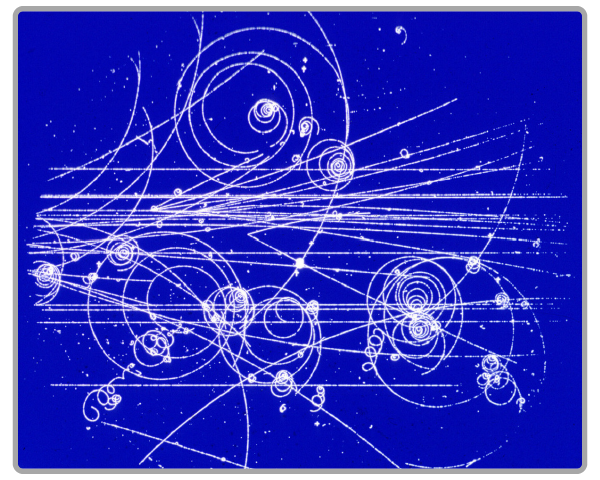
Particle accelerators are crucial tools in modern physics, allowing scientists to probe the fundamental structure of matter. By colliding particles at extremely high energies, researchers can:
- Investigate the internal structure of subatomic particles like protons and neutrons
- Create and study new particles that may only exist at high energies
- Test theories of particle physics and potentially discover new physics
At lower energies, particles simply bounce off each other without revealing their internal structure. High-energy collisions are necessary to break particles apart and uncover their constituents.
Linear accelerators (LINACs)
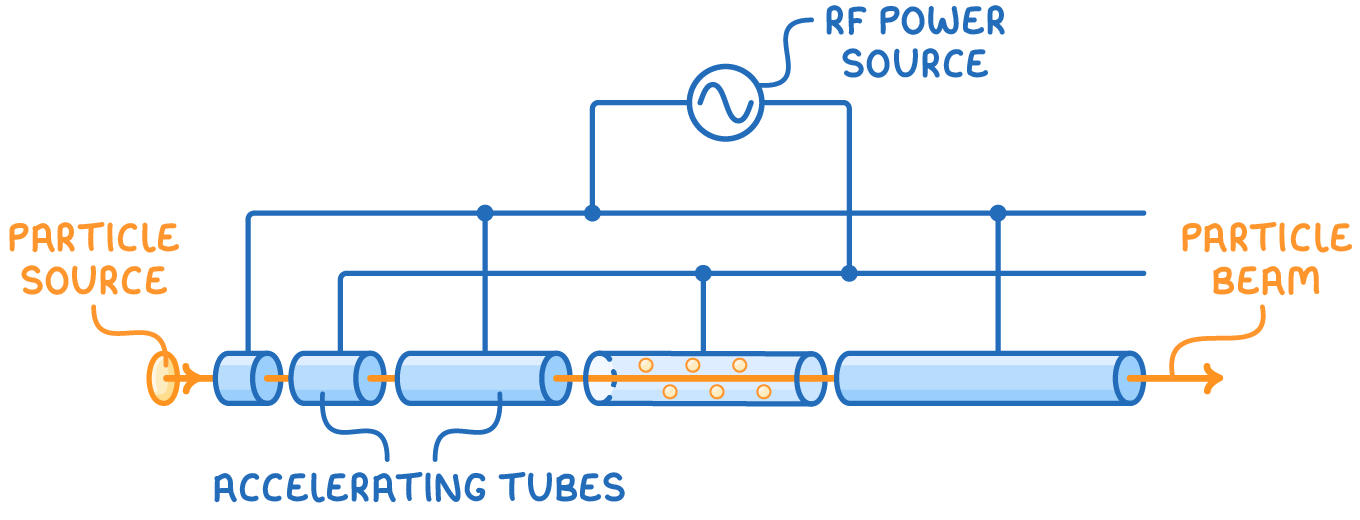
Linear accelerators, or LINACs, use electric fields to accelerate charged particles in a straight line.
Structure and Operation:
- Particle source - Electrons are typically generated by an electron gun or cathode, while protons or ions may come from an ion source.
- Accelerating tubes - A series of hollow metal tubes of increasing length, often made of copper.
- Radio frequency (RF) power source - Provides the alternating voltage, typically in the microwave frequency range (around 3000 MHz).
- Vacuum system - Maintains an ultra-high vacuum within the accelerator to prevent particle collisions with air molecules.
Acceleration Process:
- Particles enter the first tube.
- As they approach the gap between tubes, the RF voltage changes polarity.
- Particles are repelled from the tube they're leaving and attracted to the next tube.
- This process repeats through successive tubes, with each stage adding more energy.
- The increasing length of tubes accommodates the increasing speed of particles, ensuring they arrive at each gap at the correct phase of the RF cycle.
The energy gain ΔE for a particle of charge q passing through a potential difference V is:
ΔE = qV
Where:
- E = energy gained by particle (J)
- q = charge of particle being accelerated (C)
- V = accelerating potential difference (V)
Advantages of LINACs:
- Can accelerate a variety of charged particles
- Produce high-quality, well-focused beams
- Easier to inject and extract particles compared to circular accelerators
Limitations:
- Require significant physical space for high energies
Types of circular accelerators
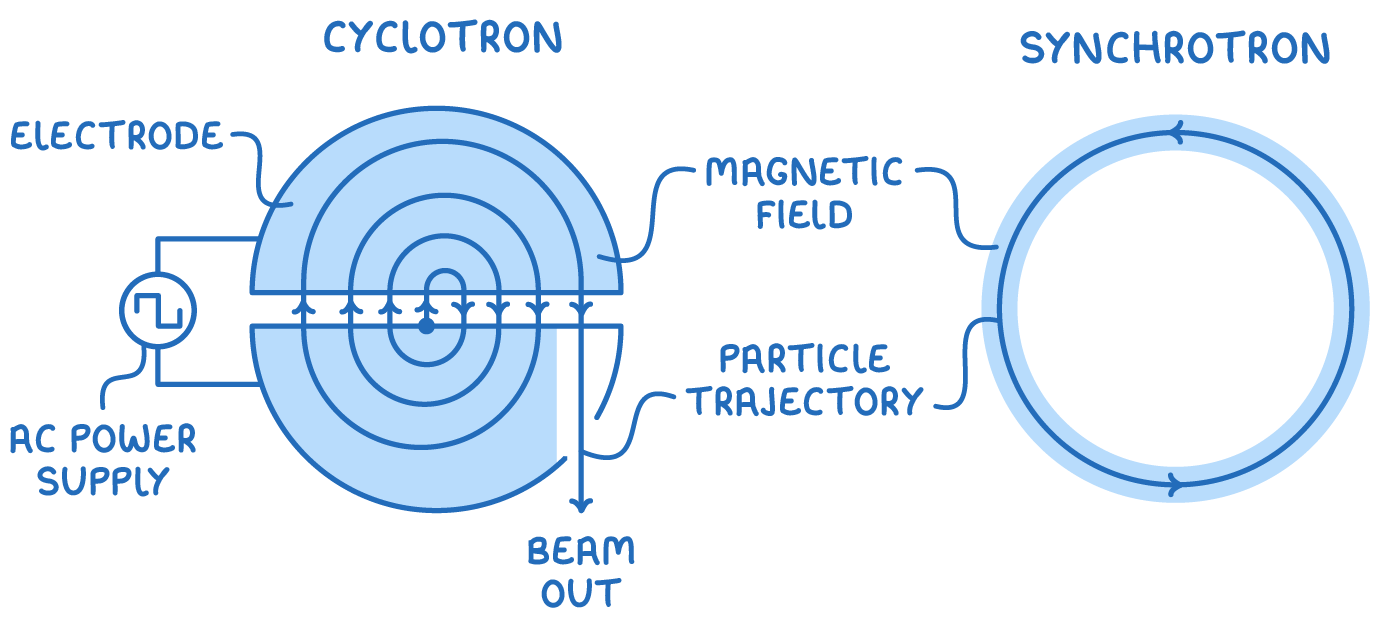
Cyclotrons:
- Use two D-shaped electrodes ("dees")
- Particles accelerated across the gap between dees by an alternating electric field
- Magnetic field causes particles to follow a circular path when inside each dee
- Frequency of voltage alternation must match particle rotation frequency
- As particle speed increases, radius of path increases
Synchrotrons:
- Use varying magnetic field strength
- Keep particle path radius constant
- Can achieve higher energies than cyclotrons
Radius of path in cyclotron
When inside the dees of a cyclotron, a charged particle experiences a force due to the magnetic field which acts perpendicular to the direction of motion. This causes the particle to follow a circular path.
The force on the charged particle due to the magnetic field is given by:
F = B Q v
Where:
- F = force (N)
- B = magnetic field strength (T)
- Q = charge of particle being accelerated (C)
- v = velocity of particle being accelerated (m s^-1^)
As the particle is travelling in a circular path, the particle must be experiencing a centripetal force. The centripetal force keeping the charged particle in a circular path is due to the magnetic field. Equating the two forces gives:
Where:
- m = mass of particle (kg)
- r = radius of circular path (m)
The radius of the circular path is therefore given by:
Relativistic effects in particle acceleration
At very high speeds approaching the speed of light, relativistic effects become significant and the particle mass appears to increase.
The cyclotron frequency must be adjusted to compensate for these relativistic effects:
Where:
- f = cyclotron frequency (Hz)
- c = speed of light (m/s)
This relativistic correction is crucial for accurately timing particle acceleration in high-energy accelerators.