8.6 - Human Rights
The concept and importance of human rights
Human rights are the basic principles and values that belong to every human being. They ensure fundamental freedoms.
Historical development of human rights
Human rights have evolved over time as societies have fought for recognition of basic entitlements. For example, historical movements have secured women's right to vote and workers' rights to fair pay and reasonable working hours. This leads to a broader understanding that rights should apply universally.
Emergence of universal human rights
The idea of universal human rights, which apply to everyone everywhere, gained momentum in the 20th century. International agreements formalised these rights, and in some cases, they are protected by law.
Challenges in upholding human rights
Despite international agreements, human rights are not always met for many people worldwide.
The Universal Declaration of Human Rights
The Universal Declaration of Human Rights (UDHR) represents the first global agreement on human rights, established to prevent atrocities like those during the Second World War. It was adopted by the United Nations (UN) in 1948, an international organisation set up in 1945 to promote peace and cooperation among nations.
Creation and purpose of the UDHR
The UN formed a Commission on Human Rights to define a set of universal rights. This commission compiled a list of entitlements, which member countries adopted as the UDHR. The goal was to foster peace by protecting these rights globally.
Key features of the UDHR
The UDHR consists of 30 articles outlining equal, inalienable rights protected by law.
Examples include:
- Right to life
- Freedom from slavery or torture
- Right to education
Although not legally binding, meaning it cannot enforce rights through courts, the UDHR has influenced national constitutions and served as a tool to condemn abuses.
Criticisms of the UDHR
While the UDHR is presented as universal, it faces significant challenges regarding its applicability and use. These criticisms highlight cultural and political tensions in global human rights.
Arguments against universality
Not all countries fully endorsed the UDHR when it was adopted. For instance, the Soviet Union and Saudi Arabia abstained from voting. Critics argue it is biased towards Western culture and values, potentially imposing these on diverse societies with different beliefs and moral systems.
Cultural and religious concerns
Saudi Arabia abstained because certain articles, such as the right to freedom of religion, conflicted with Islamic teachings.
Political misuse of the UDHR
Since the 1990s, some countries have invoked the UDHR to justify interventions in other nations' affairs, often through military action or economic sanctions like trade restrictions, aid cuts, or investment blocks. This has raised concerns that the declaration is used as a political tool rather than a neutral framework for rights protection.
The European Convention on Human Rights
The European Convention on Human Rights (ECHR) was developed to safeguard rights across Europe following the Second World War. It was signed in 1950 by members of the Council of Europe and came into force in 1953.
Key articles in the ECHR
The ECHR includes 18 articles, some drawn from the UDHR.
Examples include:
- Right to a fair trial
- Freedom from discrimination based on characteristics like sex, race, or religious beliefs
It also addresses Europe-specific issues, such as the abolition of the death penalty.
Enforcement of the ECHR
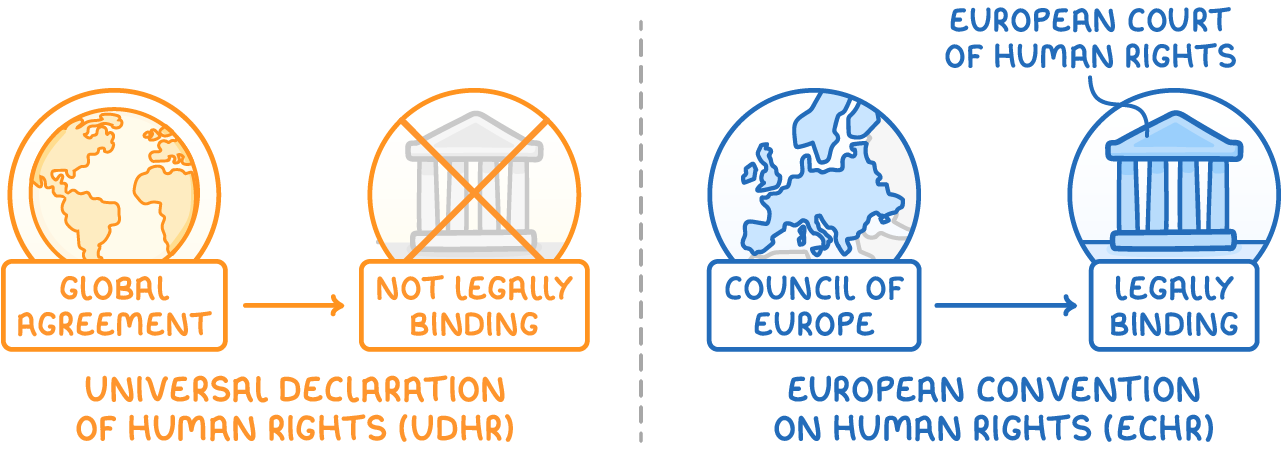
Unlike the UDHR, the ECHR is legally binding, allowing enforcement through legal systems. The Council of Europe established the European Court of Human Rights in 1959. This court enables citizens to challenge rights infringements, making the convention actionable.
Recent developments with the ECHR
In 2022, Russia withdrew from the ECHR. Some in Russia viewed it as undermining their national constitution and sovereignty.
The Human Rights Act in the UK
The UK integrated most ECHR rights into its national law through the Human Rights Act in 1998.
Implementation and benefits
The act allows UK citizens to defend their rights in UK courts, rather than appealing to the European Court of Human Rights. It requires all new UK laws to respect human rights and mandates public authorities, such as councils and schools, to consider these rights in their operations.
Criticisms of the Human Rights Act
Some critics argue the act grants excessive influence to the European Court of Human Rights over UK laws, potentially eroding UK sovereignty. This perspective gained traction during Brexit discussions, emphasising tensions in the UK's relationship with European institutions.
The Geneva Convention and rights during conflict
The Geneva Convention protects human rights in times of war and conflict. Its principles originated in 1864 with a treaty to safeguard wounded soldiers and civilians, initiated by the founder of the Red Cross.
Establishment and scope
The modern Geneva Conventions were established in 1949 at a diplomatic conference, following the Second World War. They have been signed by 196 countries and regulate warfare to minimise harm to civilians and prisoners of war. Prohibited actions include terrorism, torture, taking hostages, and sexual assault.
The International Criminal Court
The Geneva Convention laid the foundation for the International Criminal Court (ICC), located in The Hague, Netherlands. The ICC prosecutes individuals for severe international crimes, such as war crimes and genocide.
A notable case in international criminal justice involved Charles Taylor, former president of Liberia, who was tried by the Special Court for Sierra Leone for war crimes in Sierra Leone's civil war, including recruiting child soldiers.
Challenges in enforcing the Geneva Convention
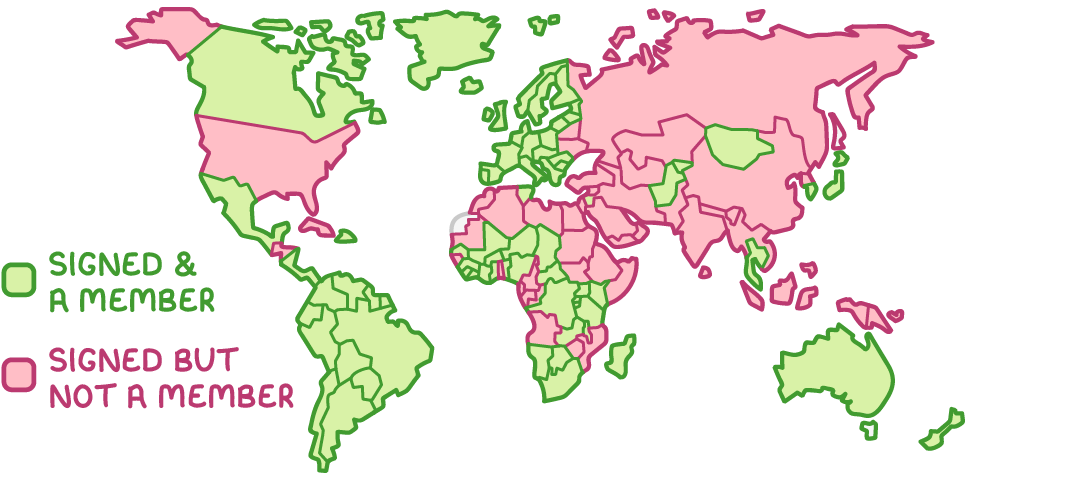
Proving crimes at the ICC is difficult due to evidence-gathering issues, so many cases do not reach trial. Although 196 countries signed the convention, only 123 are ICC members. Violations persist, with reports of torture in more than 140 countries, showing enforcement gaps.