8.7 - International Variation in Human Rights
Countries advocating for human rights
Certain countries position themselves as strong supporters of human rights on the global stage, speaking up about human rights in international forums. The G7 is a group of seven wealthy nations that together account for over 50% of global net wealth, and its aim is to solve global problems.
The UK's approach to defending human rights
- Leadership in promotion - The UK sees itself as a world leader in upholding rights like democracy and freedom of speech. It has publicly criticised actions such as China's introduction of censorship laws in Hong Kong, which reduced freedom of expression.
- Legal measures - In 2020, the UK introduced the Global Human Rights Sanctions Regulations, a law allowing sanctions against countries or individuals abusing citizens' rights. This tool helps pressure violators through economic penalties.
- International condemnation - At a 2022 G7 meeting, the UK, along with other G7 members, condemned Russia's invasion of Ukraine, believing it to be illegal and unjustifiable.
Countries prioritising economic development
In some nations, economic growth takes precedence over fully protecting human rights. Countries may claim that economic development is essential to fulfil fundamental rights, as poverty can prevent access to education or healthcare. In global forums, these nations defend their stance by highlighting how development benefits citizens overall, even if it involves short-term rights trade-offs.
India's example of development versus rights
India, a major emerging economy, illustrates this tension. It is the world's second-largest consumer of coal, which drives its economic growth.
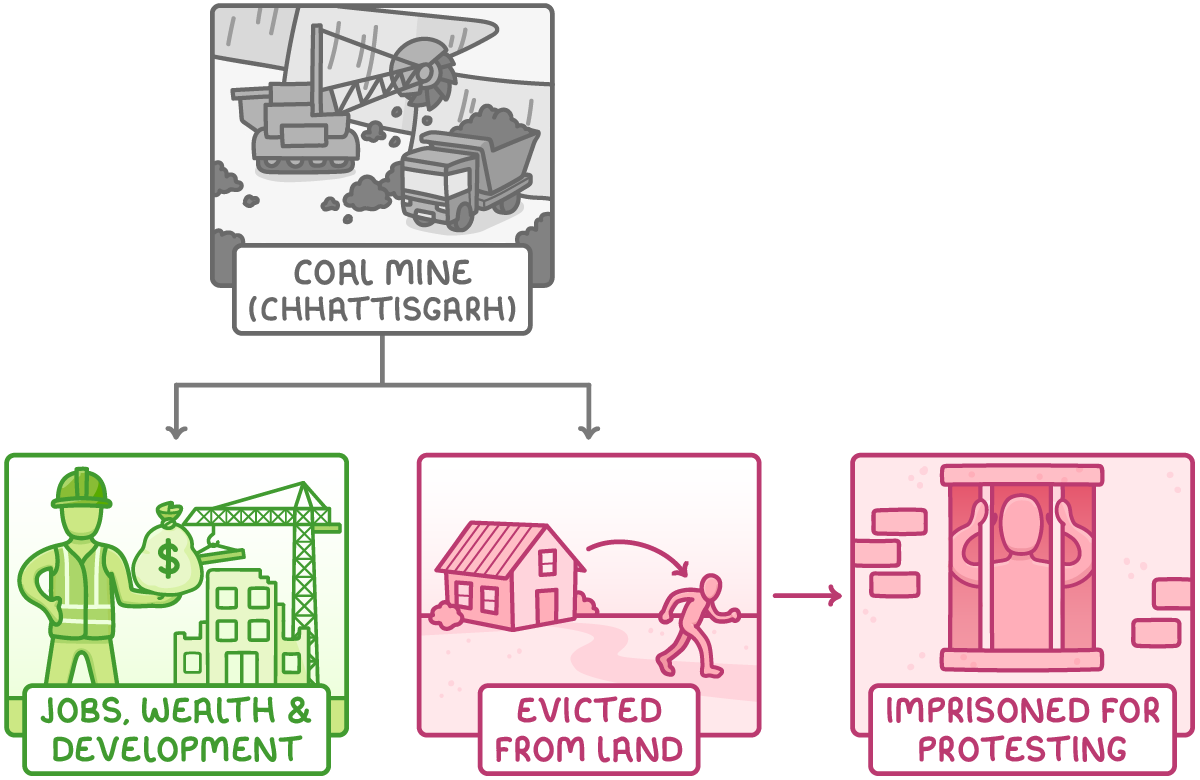
Resource exploitation and its consequences:
- In regions like Chhattisgarh, coal mine development has led to the eviction of indigenous communities from their lands, threatening their right to adequate housing and cultural preservation.
- Some community members have been imprisoned for protesting these evictions and have reported police mistreatment, infringing on rights to peaceful assembly and fair treatment.
- Indian ministers argue that coal mining brings wealth, jobs, and development to these communities and the nation as a whole, prioritising economic benefits over immediate rights concerns.
This case highlights how economic priorities can conflict with human rights, especially for vulnerable groups.
Democracy in superpowers and emerging powers
Superpowers (dominant global nations like the USA or China) and emerging powers (rapidly growing economies like Brazil or India) show varying degrees of democracy. Over time, some have transitioned from totalitarian regimes (where one party or leader has total control) or dictatorships (rule by a single authoritarian leader) to more democratic systems.
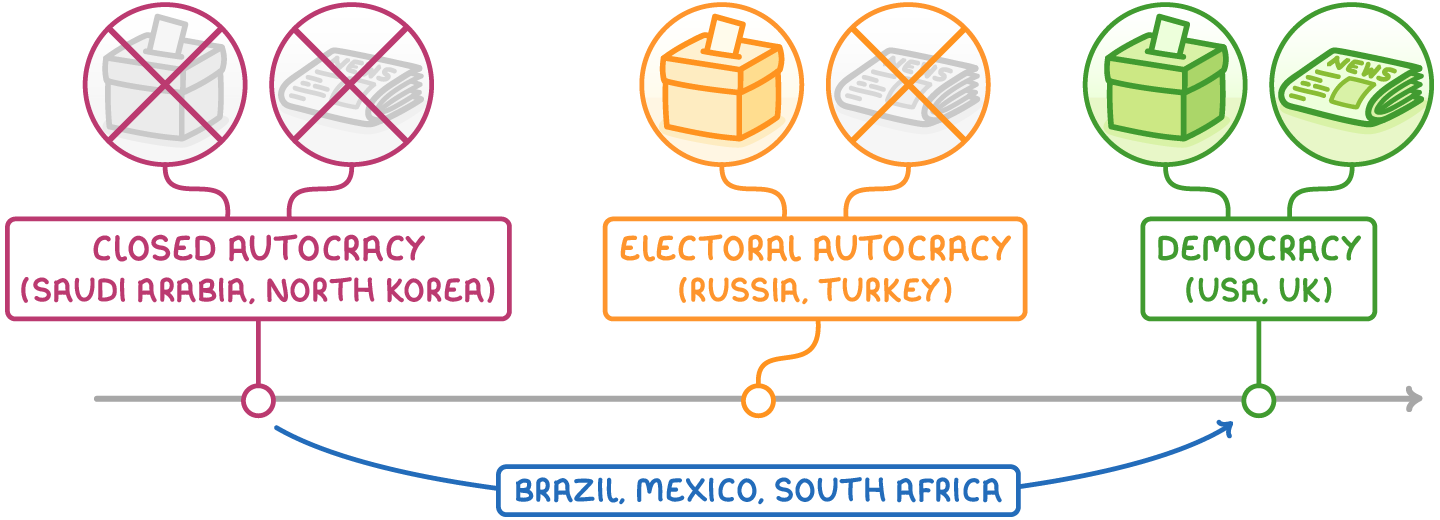
Transitions to democracy
- Recent changes - Emerging powers such as Brazil, Mexico, and South Africa have become democracies in the last 50 years, often alongside economic reforms. This shift can improve rights by allowing greater citizen participation.
- Variability in practice - Even among democracies, the ease of exercising rights differs. Freedom of speech, for instance, enables people to share ideas without government interference, but in less democratic systems, governments may censor criticism on social media or in newspapers.
Global patterns in democracy age and types (2021)
Democracies vary in maturity, and some countries remain autocracies (systems with limited or no citizen input).
Based on 2021 data:
| Category | Description | Examples |
|---|---|---|
| 0–18 years | Young democracies, recently established | Parts of Eastern Europe and Africa |
| 18–30 years | Relatively new, still developing institutions | Some Latin American and Asian nations |
| 30–60 years | Mid-aged, with established but evolving systems | Countries like South Korea or South Africa |
| 60–90 years | Mature democracies with long-standing traditions | Many Western European nations |
| 90–173 years | Oldest democracies, deeply embedded | USA, UK |
| Closed autocracy | No right to elect head of state | Saudi Arabia, North Korea |
| Electoral autocracy | Right to elect leader, but limited freedoms | Russia, Turkey |
In closed autocracies, power is highly centralised with no elections. Electoral autocracies allow voting but restrict other rights, showing how democracy levels directly affect human rights fulfilment.
Authoritarian systems and their impact on rights
An authoritarian system concentrates power in a central authority, giving the government extensive control over citizens' lives and behaviours. This contrasts with democratic systems, where power is distributed and rights are protected through constitutions and elections.
China's authoritarian system
China has been ruled by the Chinese Communist Party since 1949. Under Chairman Mao until 1976, it underwent massive social and economic changes under absolute power. Since then, China has opened to global trade but remains authoritarian.
Comparison of authoritarian and democratic systems (2022)
| Aspect | China (Authoritarian) | Germany (Democratic) |
|---|---|---|
| Governing party | Chinese Communist Party | Social Democratic Party (in coalition) |
| Elections | Held, but only high-ranking officials vote for president | Everyone over 18 votes for parliament |
| Freedom of speech | Limited; 'great firewall' restricts internet access, and laws deter criticism, leading to self-censorship by journalists | Protected by constitution, including press freedom |
| Other human rights | Criticised internationally, e.g., treatment of minorities like Tibetans and Uyghur Muslims | Strongly protected, e.g., accepting refugees in 2015–17, though with some challenges like attacks on refugees |
These differences show how authoritarian systems can limit rights, while democracies tend to safeguard them more effectively.
The role of corruption in threatening human rights
Corruption occurs when those in authority abuse their power for personal gain, such as politicians favouring friends with jobs or officials accepting bribes. This misconduct can erode trust and allow rights violations to go unpunished.
How corruption affects human rights
- Enabling illegal activities - Corrupt officials might ignore crimes, like accepting bribes to overlook abuses, allowing infringements on rights without consequences.
- Link to democracy - Corruption risk is often lower in democratic countries, where transparency and accountability mechanisms are stronger.
Global corruption risk levels (2022)
The Global Corruption Index assesses risk based on factors like reported experiences of corruption, with scores from 0 (very low) to 100 (very high):
| Risk Level | Description | Examples |
|---|---|---|
| 0–20 (very low) | Minimal corruption, strong institutions | Denmark, New Zealand |
| 20–40 | Low to moderate risk | UK, Japan |
| 40–60 | Moderate risk, some vulnerabilities | Brazil, India |
| 60–80 | High risk, widespread issues | Russia, Mexico |
| 80–100 (very high) | Severe corruption, systemic problems | Venezuela, Somalia |
High corruption risks threaten human rights by undermining justice systems and allowing powerful individuals to exploit others without repercussions.