8.3 - Health & Development
Health as a key part of human development
Health plays a central role in human development. However, health outcomes are not uniform – they differ greatly between countries and even among groups within the same country.
Why health varies globally
Health variations arise because of unequal access to clean environments, effective medical care, and healthy lifestyles. International organisations, such as the United Nations (UN), track these differences to measure how health varies between countries and between different groups of people within a country.
Key measures of health and life expectancy
To assess health in the context of human development, experts use specific indicators. Life expectancy, infant mortality, and maternal mortality are among the most common measures used to compare health between countries and identify inequalities within them.
Definitions of key health measures
- Life expectancy at birth - The average number of years a person is expected to live from birth.
- Infant mortality rate - The number of deaths of babies under one year old per 1000 live births.
- Maternal mortality ratio - The number of women who die from pregnancy- or childbirth-related causes (up to 42 days after birth) per 100 000 live births.
Comparing health measures between countries
| Measure | Calculation | UK (example) | Zambia (example) |
|---|---|---|---|
| Life expectancy at birth (2020) | Average age a person can expect to live to | 81 years | 64 years |
| Infant mortality rate (2020) | Deaths under 1 year old per 1000 live births | 4 | 42 |
| Maternal mortality ratio (2017) | Deaths from pregnancy/childbirth issues per 100 000 births | 7 | 213 |
These figures show that people in wealthier countries like the UK generally live longer and face fewer early-life risks than those in poorer countries like Zambia.
Factors affecting health in developed countries
In developed countries, most people have reliable access to basic needs such as clean water, sanitation, and sufficient food. This leads to lower rates of infectious diseases. Instead, non-communicable diseases (such as heart disease and cancer) are more prevalent. Health patterns here are shaped by choices, economic status, and healthcare systems.
Main influences on health patterns
Three key factors explain why health varies even in affluent settings.
Lifestyles:
- Unhealthy habits, such as poor diet, lack of exercise, or being overweight, increase the risk of non-communicable diseases like certain cancers and heart disease.
- These issues are more common in developed countries.
Deprivation:
- Wealthier individuals can afford better housing, nutritious meals, active pursuits, and superior medical care.
- As a result, they often enjoy better health and longer life expectancy compared to poorer people in the same country.
Medical care:
- Some countries provide free universal healthcare funded by taxes, ensuring access for all.
- In others, like the USA, treatment is paid for directly or through insurance, which can cost thousands (e.g., $7500 for a broken leg without coverage). This means that the quality of medical care people receive can depend on their finances.
- Even in systems with free care, such as the UK's, quality varies by area, and wealthier people may opt for faster private services.
Global patterns of non-communicable diseases
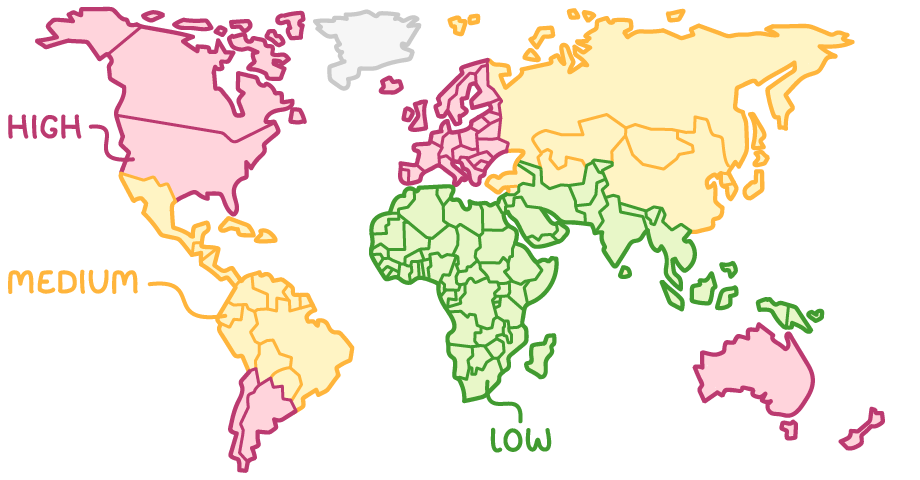
Breast cancer mortality rates illustrate health challenges in developed regions. Age-standardised rates (adjusted for population age differences) are higher in North America, Europe, Australia, and parts of South America, while lower rates are seen in much of Africa and Asia.
Factors affecting health in developing countries
Developing countries often experience higher rates of illness and death, primarily due to infectious diseases such as cholera, tuberculosis (TB), and HIV/AIDS. These spread more easily where basic needs are unmet, leading to elevated infant and maternal mortality.
Uneven access to basic resources explains why certain diseases persist
- Clean water and sanitation - Lack of toilets, washing facilities, or safe drinking water allows diseases like cholera to spread rapidly. This contributes to infant mortality; for example, one in five newborn deaths could be avoided with clean water and hygienic care.
- Nutritious food - Malnutrition weakens the immune system, making people more susceptible to illness and less able to recover. It also raises maternal mortality risks, as undernourished pregnant women face greater dangers during childbirth.
Global patterns of infectious diseases
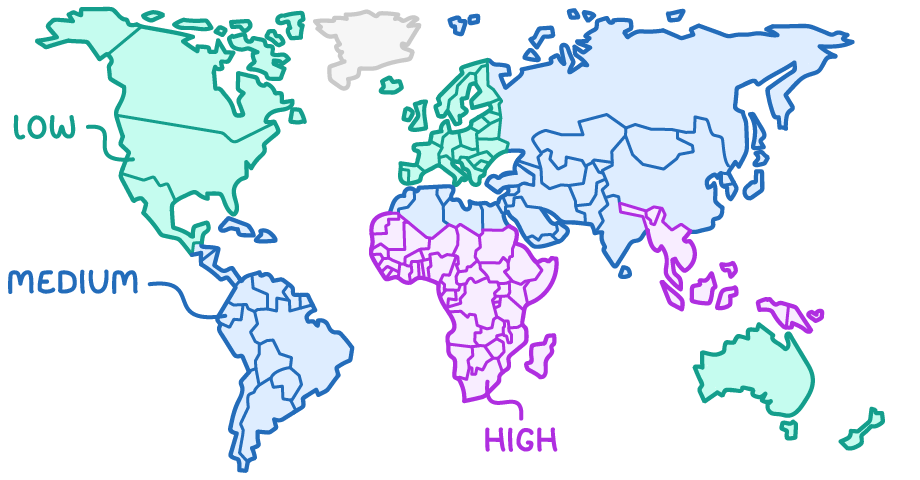
Tuberculosis rates highlight concentrations in developing regions. New cases per 100 000 people are highest in Sub-Saharan Africa and parts of Southeast Asia, while rates are much lower in North America, Europe, and Australia.
Inequalities driving health variations within countries
Health inequalities in the UK
In the UK, health and life expectancy differ by region, income, and ethnicity, often linked to deprivation.
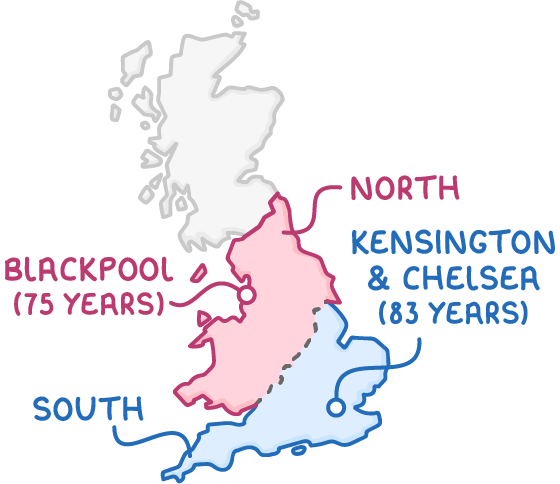
Regional and economic differences:
- People in affluent areas live longer; for example, boys born in Kensington and Chelsea (2012–2014) have a life expectancy of 83 years, compared to 75 years in deprived Blackpool.
- This illustrates the North-South divide – greater wealth and investment in the south contrast with deprivation in the north.
Ethnic variations:
- South Asian people or those of South Asian descent have higher rates of coronary heart disease than White British people.
- Ethnic minorities are more likely to live in deprived areas, limiting their ability to afford healthy lifestyles.