8.14 - Measuring Success of Military Intervention & Aid
Successes and failures of development aid
Development aid aims to address issues like poverty, disease, and inequality, but its impact can be mixed. In some cases, it leads to significant improvements in health and human rights, while in others, it fails to deliver promised benefits and may even exacerbate problems.
Relative success: Tackling Ebola in West Africa
The Ebola outbreak from 2014 to 2016 affected countries like Liberia, Guinea, and Sierra Leone, resulting in around 28,000 cases and 11,000 deaths. Ebola is a highly contagious and deadly virus, with a mortality rate of about 50%, spreading rapidly in areas with poor sanitation. The main affected areas included widespread outbreaks in Guinea, Sierra Leone, and Liberia, with limited cases in Nigeria and isolated ones in Senegal and Mali.
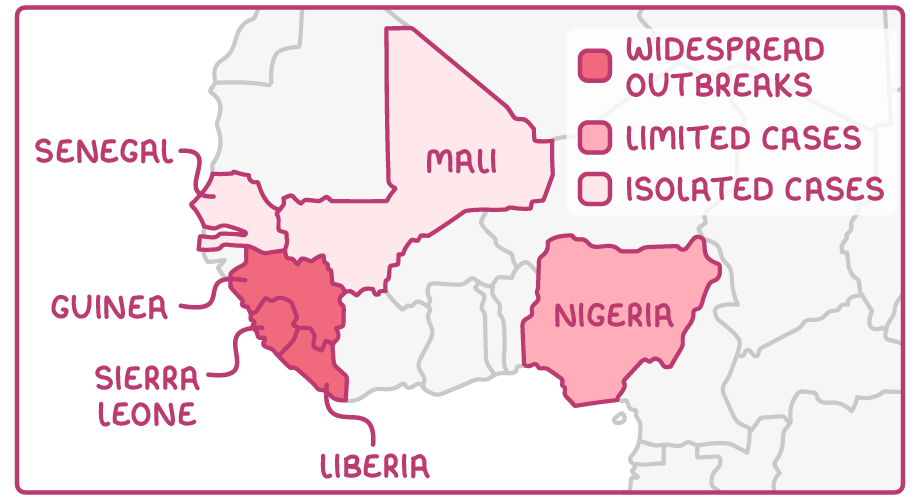
International response:
- The World Health Organisation (WHO) coordinated efforts.
- Governments and NGOs, such as Doctors Without Borders, provided medical staff, equipment, and funding.
- The UK pledged £427 million, including troops to build treatment centres and support for vaccine development.
Outcomes:
- The intervention slowed and eventually stopped the spread.
- A vaccine was developed, aiding control in later outbreaks, such as in the Democratic Republic of the Congo in 2020.
Criticisms:
- Some, including Doctors Without Borders, argued the response was too slow and hampered by local governments' reluctance to share data on virus spread.
- Despite debates, the overall effort is seen as a relative success in containing a major health crisis.
Relative failure: Development interventions in Haiti
Haiti, a developing country in the Caribbean, has received substantial aid, particularly after disasters like the 2010 earthquake and 2016 hurricane.
Key project example: Caracol Industrial Park
- Funded by the USA at a cost of US$300 million, the park aimed to attract industrial investment and create jobs in northern Haiti.
- Despite investments, Haiti remains poor and disaster-vulnerable.
- The park failed to generate the promised employment, and plans for a nearby port were abandoned.
- As of 2022, farmers displaced for the project reportedly still await compensation.
Broader criticisms:
- Aid has been accused of increasing Haiti's dependency on donors, who prioritise high-profile projects over systemic issues like corruption reduction.
- This has left the country worse off in some respects, highlighting how aid can fall short of promoting sustainable development.
Impact of development aid on inequality
Development aid's effect on inequality is complex, sometimes reducing it but often increasing it, leading to disparities in health care access and life expectancy.
Examples of aid's effects on inequality
- Increased inequality in Zambia - Zambia receives over US$1 billion in annual aid, yet income inequality has risen, making it one of the world's least equal countries. This has widened gaps in health care and life expectancy between rich and poor.
- Decreased inequality in Mali - Mali also receives more than US$1 billion yearly, but inequality has fallen. Using the Gini coefficient (where a higher score means more inequality), Mali's score dropped from 50 in 1990 to 36 in 2018, showing aid's potential to promote greater equity when effectively targeted.
Development aid in superpowers' foreign policy
Superpowers often use development aid strategically as part of foreign policy to enhance their global influence, rather than solely for altruistic reasons. Success is measured by gains in alliances and access.
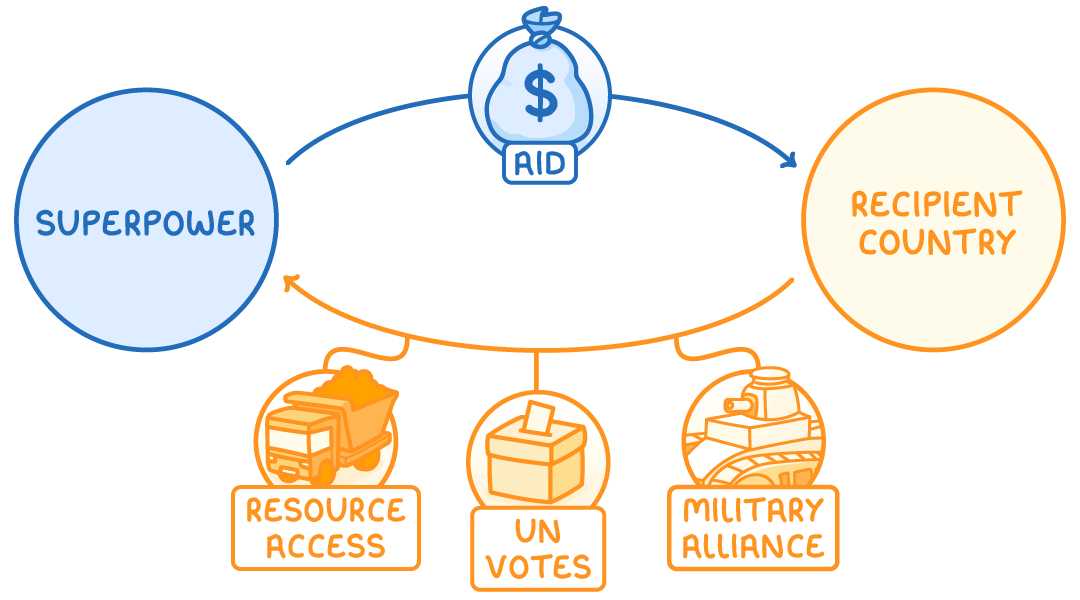
Ways superpowers judge aid success
- Access to resources - Aid funds infrastructure in developing countries to exploit needed resources, with conditions ensuring low-cost access for the superpower.
- Political support - Recipient countries are incentivised to back the superpower internationally, such as in United Nations (UN) votes.
- Formation of military alliances - Aid, including military support, encourages countries to join alliances like the North Atlantic Treaty Organisation (NATO), strengthening the superpower's strategic position.
Costs of military interventions for human rights and sovereignty
Military interventions have shifted from purely geopolitical motives to include humanitarian ones, but they often result in loss of sovereignty (a country's independent control over its affairs) and human rights abuses.

Benefits of non-military interventions
Non-military interventions, such as peacekeeping missions, often prove more effective than military ones in protecting human rights and promoting development, sometimes combined with limited military action.
Consequences of non-intervention
Choosing not to intervene can allow atrocities to occur, with ripple effects on human rights, politics, and the environment.