8.1 - Globalisation & Migration
What is migration?
Migration refers to the movement of people from one place to another, which can significantly alter population sizes and structures beyond changes caused by birth and death rates. This movement can occur within a country or across international borders, and it is driven by various factors that either encourage people to leave their current location or attract them to a new one.
Migration decisions are often influenced by a combination of negative and positive elements.
Push and pull factors in migration
- Push factors - These are unfavourable conditions in a person's current location that encourage them to leave, such as conflict, food shortages, or limited employment opportunities.
- Pull factors - These are appealing aspects of a potential destination that draw people in, including better job prospects or an improved standard of living.
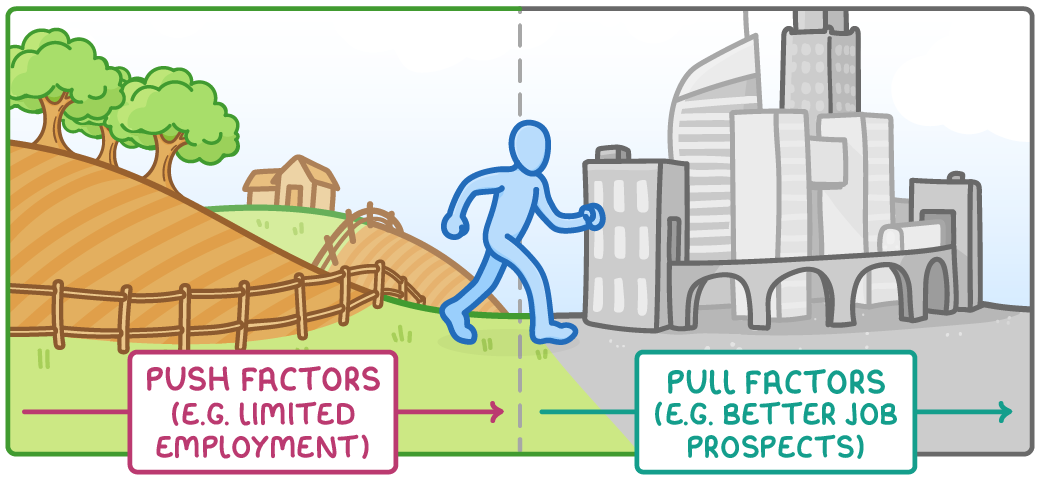
Understanding these factors helps explain why certain regions experience high levels of out-migration while others see significant inflows.
How globalisation increases migration
Globalisation is the process of increasing interconnectedness between countries through trade, communication, and cultural exchange. This has led to a rise in migration by making it simpler for people to travel and stay informed about opportunities elsewhere, fostering stronger links between nations.
Economic shifts caused by globalisation
- Globalisation has transformed the global economy, creating new patterns of job distribution that drive migration.
- This 'global shift' describes the relocation of economic activities, such as manufacturing, from developed countries (like those in North America and Western Europe) to emerging and developing countries, particularly in Asia. Meanwhile, high-level functions like research and development or consultancy services have become concentrated in developed countries.
- Employment opportunities have increasingly clustered in urban areas, leading to rural-urban migration where people move from countryside regions to cities in search of work.
- Higher earnings in developed countries and urban settings act as strong pull factors, encouraging migration to these locations.
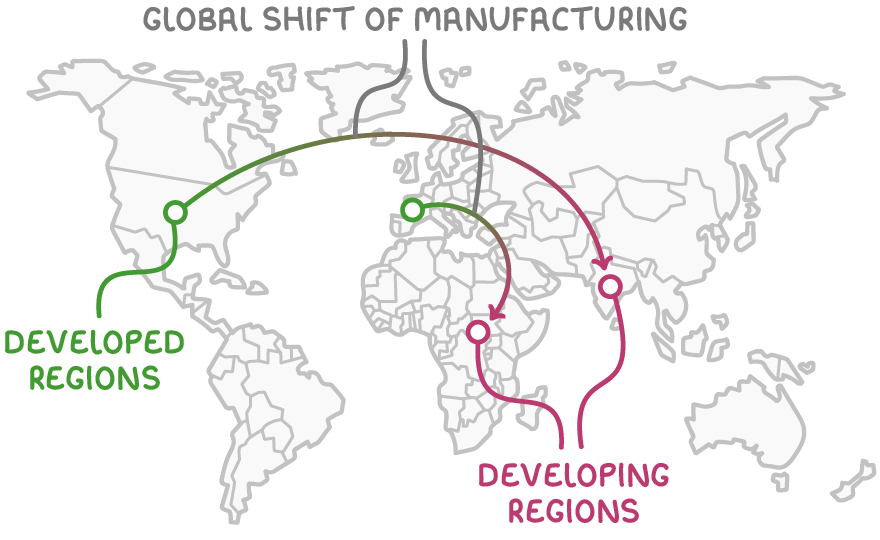
These changes highlight how globalisation creates uneven economic opportunities, prompting people to relocate for better prospects.
Case study: Rural-urban migration in China
China provides a clear example of how globalisation has accelerated internal migration, particularly from rural to urban areas, driven by rapid industrial growth.
Background and causes
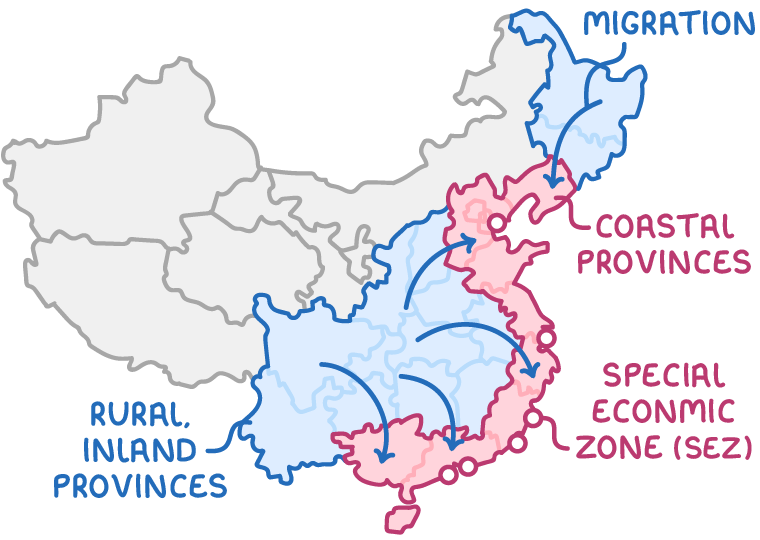
In the late 1970s, China opened up to international trade, which spurred massive expansion in its manufacturing sector. Special Economic Zones (SEZs) were set up along the coast to attract transnational corporations (TNCs), leading to booming industries in cities like Shanghai and Guangzhou.
Patterns of migration
- Migration flowed from poorer inland provinces and rural areas to coastal cities, where better-paid jobs in growing industries were available.
- Between 1990 and 2005, inland central provinces experienced net outflows of people, often exceeding 8 million in some areas, while coastal provinces saw net inflows, sometimes above 8 million.
- Key destinations included major urban centres, with arrows on migration maps typically pointing from inland blue-shaded outflow regions to coastal red-shaded inflow areas.
Scale and impact
- In 1989, about 30 million rural migrants worked in China's cities.
- By 2008, this number had grown to around 140 million, reflecting the pull of urban economic opportunities.
This case illustrates how globalisation, through trade liberalisation and industrial concentration, can trigger large-scale internal movements.
Case study: Migration in the EU-Schengen area
The European Union (EU) and Schengen Agreement demonstrate how political and economic aspects of globalisation facilitate cross-border migration by reducing barriers to movement.
Background and policies
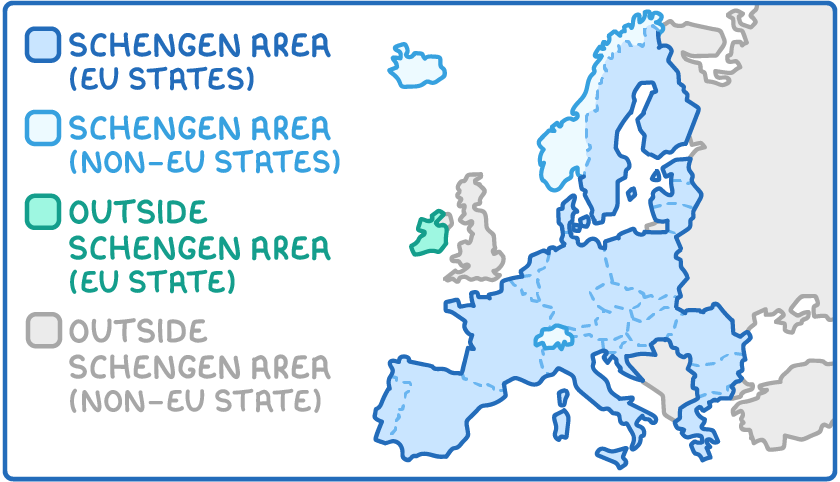
As part of globalisation, the EU has promoted free movement among its member states, allowing citizens to live, work, and study in other countries without needing visas or permits. The Schengen Agreement, involving 29 European countries, further eases travel by eliminating passport checks and visa requirements within the area.
Patterns of migration
- Western European countries, being more globalised, offer more skilled jobs and higher wages compared to Eastern Europe, driving migration flows.
- For example, in 2020, nearly 200,000 Romanians migrated to Germany, attracted by economic opportunities.
- The Schengen area covers most of Western and Central Europe, including some non-EU states like Norway and Switzerland, while others like Ireland remain outside.
Historical development
The Schengen Agreement began in 1985 with five countries and has expanded, reflecting globalisation's role in integrating economies and labour markets.
This example shows how policy changes under globalisation can increase international migration by making borders more permeable.
How national policies affect migration
International migration involves people moving temporarily or permanently to another country, with immigrants being those who settle permanently. The extent of such migration in a country is shaped by its engagement in the global economy, trade involvement, and specific migration policies.
Factors influencing migrant population size
- Countries deeply integrated into the global economy, like Singapore, often encourage migration for certain groups, resulting in a higher proportion of migrants.
- In contrast, isolated nations such as North Korea impose strict rules on movement, leading to very low migrant numbers.
Global migration statistics
In 2020, there were about 281 million international migrants worldwide, representing roughly 3.6% of the global population living outside their birth country.
Variations between countries in the proportion of migrants
- The USA hosts the largest absolute number of migrants but a moderate percentage relative to its population.
- Qatar has a much higher proportion, with migrants making up nearly three-quarters of its residents.
These differences underscore how policies and economic openness determine migration levels.
Case study: Immigration policies in Japan
Japan's approach to migration highlights how even highly globalised economies can maintain restrictive policies, though recent shifts show adaptation to demographic challenges.
Historical policies
Japan has traditionally enforced tight immigration controls through laws like the Immigration Control and Refugee Recognition Act, which limited job access and long-term stays for foreigners. This resulted in a low migrant population; in 2017, only 2.1% of the population lacked Japanese nationality.
Population composition in 2017
| Nationality | Percentage |
|---|---|
| Japanese | 97.9% |
| Chinese | 0.6% |
| Korean | 0.4% |
| Filipino | 0.2% |
Recent changes
Facing an ageing population and labour shortages, Japan has relaxed some restrictions in recent years. This allows more working-age individuals, particularly skilled workers in sectors like construction, farming, and health care, to enter the country.
This evolution demonstrates how internal pressures can lead to policy adjustments, even in historically closed systems.