8.8 - National Variation in Human Rights
Variations in access to human rights
Human rights are principles that protect basic freedoms and dignities for all people, intended to apply universally. However, within individual countries, access to these rights can differ significantly between groups. This often stems from systemic discrimination, where powerful groups restrict the rights of others based on characteristics such as ethnicity, religion, gender, or race. Such discrimination can be deliberate or arise unintentionally from societal structures.
Factors contributing to unequal access
- Social group dynamics - Members of minority groups, like ethnic or religious minorities, frequently experience fewer rights compared to dominant groups. This creates imbalances in power and opportunity.
- Post-colonial influences - In countries with a history of colonialism, one group may have been favoured, leading to ongoing inequalities and sometimes violence.
Example of ethnic inequalities in Rwanda
- Rwanda illustrates how colonial history can exacerbate rights variations.
- The country has three main ethnic groups: Hutu, Tutsi, and Twa.
- Initially colonised by Germany and later controlled by Belgium after the First World War, the Tutsi were given preferential treatment, including access to education and power, while Hutu were denied similar opportunities. This fostered resentment.
- Growing tensions led to a Hutu rebellion, forcing many Tutsi to flee.
- In 1994, an extremist Hutu group initiated a genocide targeting Tutsi and moderate Hutu, resulting in massive loss of life.
- Twa people face ongoing discrimination, and are excluded from survivor benefits provided to Tutsi and lack rights, resources, and representation as an ethnic minority.
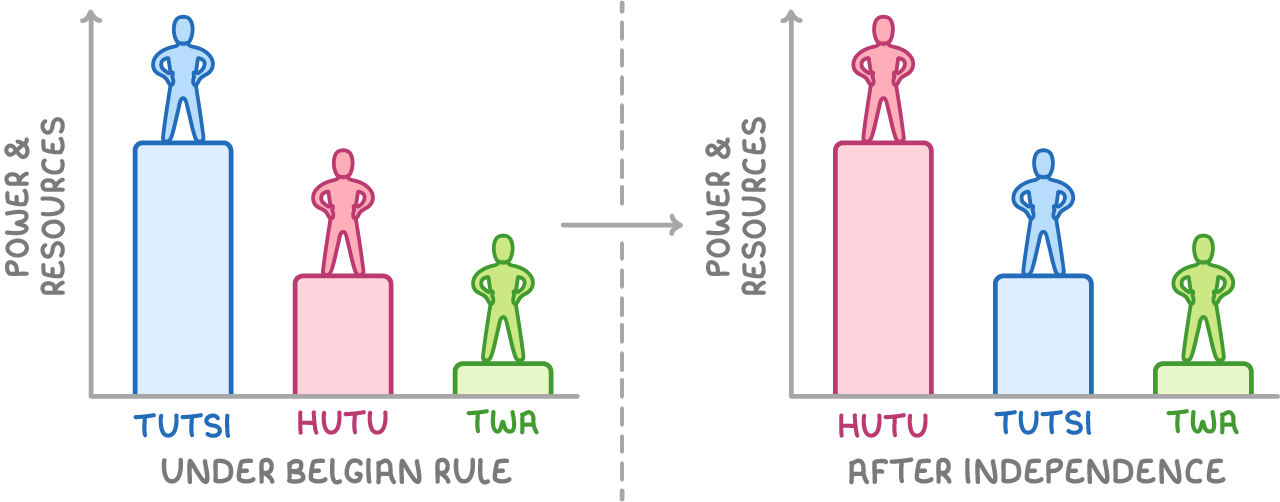
These events highlight how historical power imbalances can lead to severe violations of human rights, including the right to life and equality.
Lack of rights and lower human development
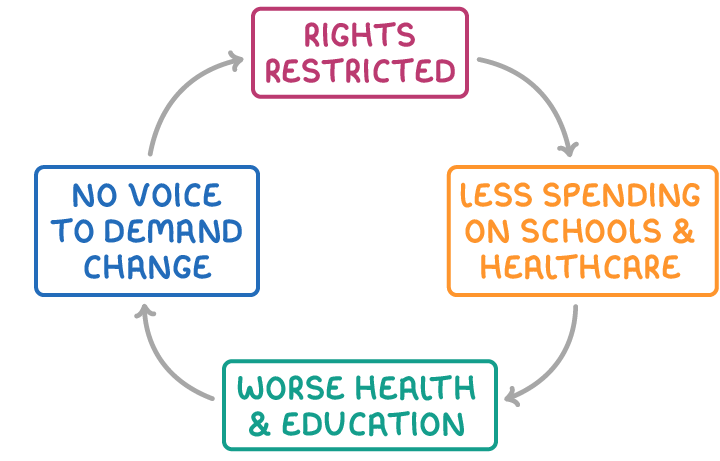
When groups face restricted rights, it often results in reduced human development, which refers to improvements in people's well-being through better health, education, and living standards. Systemic discrimination limits access to essential services, as governments may under-invest in infrastructure for marginalised communities. This creates cycles of disadvantage, where poorer health and education outcomes reinforce inequality.
Impacts on marginalised groups
- Limited service access - Discrimination can mean less funding for schools, healthcare, and other facilities, making it harder for affected groups to exercise rights like education and health.
- Barriers to advocacy - Without full rights to free speech or assembly, these groups struggle to protest or demand improvements.
- Higher risks - Marginalised people may face increased dangers, such as higher rates of arrest or violence from authorities.
Campaigns for equal human rights
Throughout history, oppressed groups have organised campaigns to secure recognition and enforcement of their human rights by governments. These efforts often aim to achieve equality in areas like voting, employment, and education. Success varies by country and group, sometimes leading to legal changes, though challenges persist.
Key examples of rights campaigns
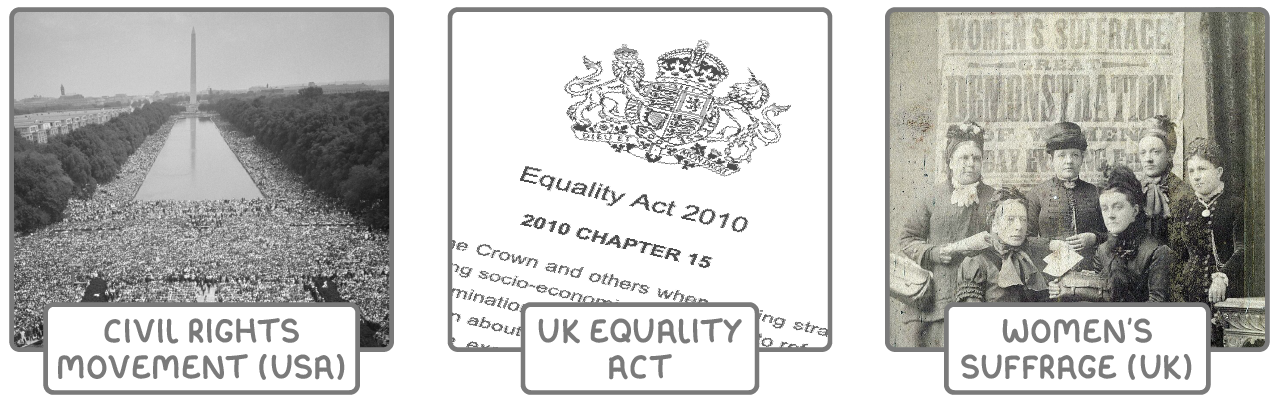
- Civil rights movement in the USA - African Americans campaigned for equality with white Americans, using marches and protests. A notable event was the 1963 march in Washington D.C., which highlighted demands for equal rights.
- Equality Act in the UK (2010) - This law made it illegal to pay men and women differently for the same work, addressing gender discrimination. However, a gender pay gap of over 8% in 2022 indicates ongoing issues.
- Women's suffrage movement in the UK - Campaigners fought for women's voting rights, with figures like Emmeline Pankhurst now celebrated as national heroes. Their efforts became a key part of UK history.
These campaigns demonstrate how collective action can drive legal and social progress, though full equality often requires continued effort.
Case study: Gender equality in Afghanistan
Afghanistan provides a stark example of how political instability affects women's rights. The country has endured approximately four decades of conflict, including civil wars and foreign interventions, influencing gender equality.
Historical context and Taliban influence
- Taliban rule (1996–2001) - The Taliban, enforcing a strict interpretation of Sharia law (Islamic legal principles), imposed severe restrictions on women, denying access to education and senior government roles, and exposing them to high levels of violence.
- Post-2001 progress - After a US-led intervention collapsed the regime, advancements occurred, such as girls' school attendance rising from very few in 2001 to almost 3.2 million by 2012. However, progress was slow due to lingering laws and high dropout rates.
- 2021 Taliban resurgence - The Taliban regained control, including the capital Kabul, leading to increased violence and discrimination against women, reversing prior gains.
Current challenges
- Education bans - The Taliban banned girls from secondary schools across most of the country, extending this in March 2022, creating uncertainty for female education.
- Ongoing concerns - Political instability hinders lasting progress, as noted by human rights organisations.
Campaign efforts
Women, supported by men, have protested against restrictions like education bans. Non-governmental organisations (NGOs) and intergovernmental organisations (IGOs) like the United Nations (UN) advocate strongly for women's rights.
This case shows how regime changes can drastically alter rights access, with campaigns playing a vital role in pushing for improvements.
Case study: Ethnic rights in Australia
Australia's Indigenous peoples, including Aboriginal and Torres Strait Islander groups, have long faced discrimination, resulting in poorer health and education outcomes compared to other Australians. Indigenous women are particularly vulnerable to domestic violence.
Key campaigns and government responses
- 'Closing the Gap' campaign (2008) - Launched by health authorities and NGOs, this initiative aims to achieve health equality by 2030 through improved services and support.
- 'Women's Voices' campaign - Focused on promoting Indigenous women's rights by providing platforms for them to express needs and concerns.
- Government actions and outcomes - In response, measures led to successes like an over a fifth increase in high school completion rates for Indigenous children from 2008 to 2020.
Persistent issues
- Ongoing racism - Research indicates widespread prejudice; in 2021, around 40% of Indigenous peoples experienced racial prejudice, compared to only 20% of other Australians.
- Human development gaps - Indicators such as life expectancy and literacy rates remain lower for Indigenous groups.
This case highlights the role of targeted campaigns in addressing ethnic inequalities, though systemic racism continues to impede full equality.