8.9 - Defence of Human Rights
Types of geopolitical interventions
Geopolitical interventions occur when countries or organisations step into the affairs of another nation to address human rights abuses. These interventions aim to encourage better protection of rights, punish violations, or support movements for improvement. They can vary in approach, from economic measures to military actions, each with its own methods and potential impacts.
Main forms of geopolitical interventions
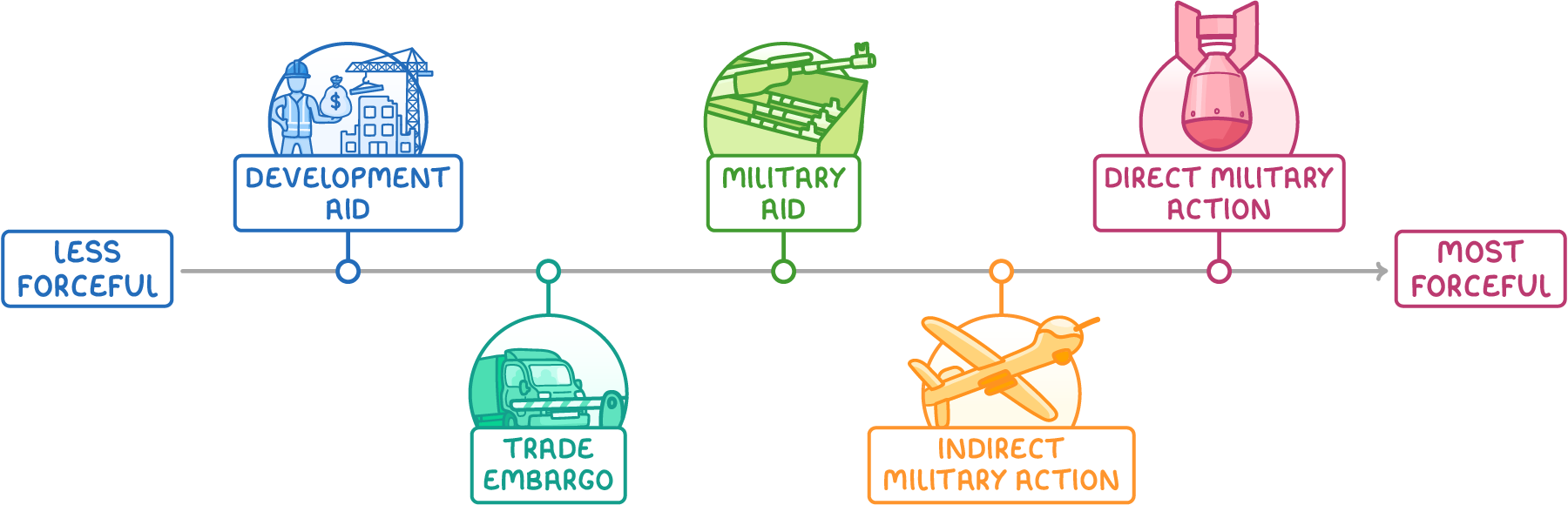
| Type of intervention | Description | Example |
|---|---|---|
| Development aid | This involves providing financial support, resources, or expertise to boost a country's development, which can help meet citizens' basic needs like healthcare and education. Aid may be conditional, meaning it's only given if the recipient improves its human rights record. | In 2010, donors pressured Malawi by threatening to withdraw aid after the country prosecuted individuals for attempting same-sex marriage. This led to the pardoning of the convicted couple, though Malawi's laws criminalising same-sex conduct remain on the books. |
| Trade embargo | This restricts or halts trade with a country to pressure it into ending human rights violations, often targeting specific goods that could enable abuses. | In 2011, EU countries imposed an embargo on Iran, limiting trade in military equipment amid concerns over nuclear development and potential human rights restrictions. |
| Military aid | This supplies weapons, training, or funding to support forces combating human rights abuses, such as aiding groups against dictatorships. Aid can also be withdrawn to enforce better practices. | The USA has funded and trained Philippine security forces, but in 2020, it threatened to cut this aid due to new laws curbing freedom of speech. |
| Indirect military action | This provides funding, equipment, or advisors to one side in a conflict without direct troop involvement, aiming to resolve disputes that threaten human rights. | In 2006, the USA backed Ethiopia's invasion of Somalia to help end regional conflicts and stabilise the area. |
| Direct military action | This uses armed forces, such as airstrikes or ground troops, often coordinated by groups like NATO or the UN, to directly halt severe abuses. | In 2011, NATO conducted bombing campaigns in Libya to support rebels overthrowing an oppressive regime during the civil war. |
These interventions can overlap or be combined, but their success depends on factors like international cooperation and the targeted country's response.
Human rights in Western negotiations
Western governments often position themselves as defenders of human rights by publicly criticising violations in other nations. They integrate human rights into diplomatic tools, such as aid conditions or trade agreements, to promote global standards. However, this approach has drawn debate over its motivations and consistency.
Key ways human rights are used as a negotiating tool
- In aid and trade deals - Governments may link financial assistance or trade benefits to human rights improvements, such as allowing investigations into labour abuses under agreements like the US-Mexico-Canada Agreement.
- As justification for military action - Human rights concerns have been cited to support interventions, for instance, in the 2011 Libya operation to remove an oppressive leader.
Criticisms of this approach
While these efforts can drive positive change, they face significant critiques. For example, some argue that Western countries apply human rights standards selectively, ignoring their own issues while condemning others. This is seen as hypocritical, such as when Australia criticised Russia's actions in Ukraine but faced accusations over its treatment of asylum seekers.
Additionally, interventions can be driven by self-interest, like securing access to resources, rather than pure concern for rights. The 2003 invasion of Iraq, discussed later, is often cited as an example where oil interests may have played a role.
Finally, such actions challenge national sovereignty, which is a country's right to govern itself without external interference. Critics claim this reflects ongoing colonial attitudes, where powerful nations override others' independence.
Approaches to human rights interventions
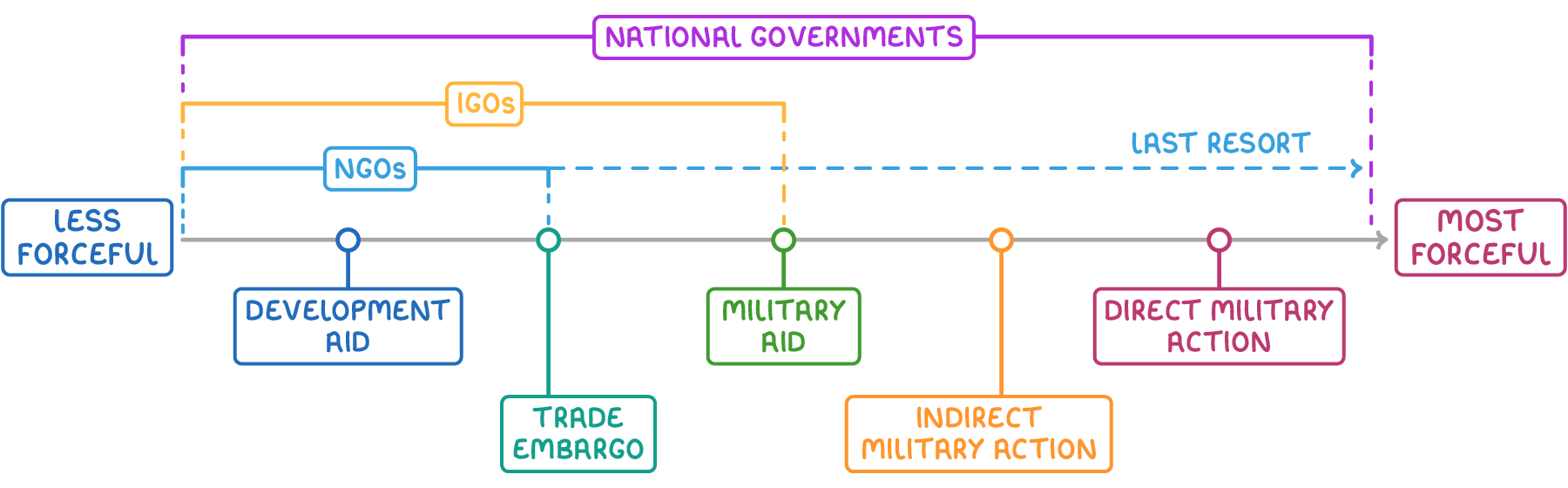
Various groups, including governments, intergovernmental organisations (IGOs), and non-governmental organisations (NGOs), approach human rights interventions differently based on their resources, goals, and principles. Each intervention type has advantages and drawbacks; for instance, economic sanctions might pressure change without violence but could harm civilians' access to essentials, while military options risk casualties.
Preferences and methods of key groups
- National governments - Their choices depend on power levels. Superpowers, with vast resources, are more likely to use military interventions. Less powerful nations might focus on diplomatic pressure or aid conditions.
- Intergovernmental organisations (IGOs) - Groups like the UN and EU prefer non-violent methods, such as public condemnations, aid with conditions, or trade embargoes. The UN deploys peacekeeping forces to maintain stability rather than engage in offensive actions.
- Non-governmental organisations (NGOs) - These emphasise peaceful advocacy. Organisations like Amnesty International and Human Rights Watch monitor abuses, run campaigns, and lobby governments through petitions to free political prisoners or push for reforms. They urge IGOs and governments to apply political pressure and view military intervention as a last resort, only for extreme cases like genocide.
These differences mean that even in clear cases of abuse, consensus on the best response is rare, leading to varied global strategies.
Case study: The USA's invasion of Iraq
The 2003 invasion of Iraq serves as a key example of direct military intervention justified partly on human rights grounds. Led by the USA as part of the 'war on terror', it aimed to dismantle Saddam Hussein's regime, which was accused of widespread atrocities, including the deaths of hundreds of thousands of Iraqis. The USA also claimed Iraq was developing weapons of mass destruction, posing a broader threat.
Background and justification
The intervention lacked UN approval but received support from allies like the UK. Proponents argued it was necessary to end oppression and prevent global risks. However, critics, including mass protests in cities like London, accused the USA of ulterior motives, such as securing oil reserves in the Middle East.
Results and impacts
The invasion successfully removed Hussein, but it triggered a prolonged war with severe consequences.
Human rights and development effects:
- The conflict displaced a substantial number of Iraqis from their homes.
- It devastated infrastructure, including healthcare and education systems.
Broader outcomes:
- While it ended a dictatorial regime, the war led to ongoing instability and civilian casualties.
- There remains debate over whether the human rights gains justified the costs.
This case highlights the complexities of military interventions, where intended protections can result in unintended harms to human rights and national development..