8.11 - Impacts of Economic Development
Superpowers, TNCs and resource exploitation
Economic development in poorer countries often involves extracting natural resources such as minerals or timber. This process is frequently driven by superpowers and transnational corporations (TNCs), which are large companies operating across multiple countries. These entities pay for access to resources, providing funds that help the host countries build their own industries and further exploit local assets. However, this exploitation can lead to significant environmental harm, which in turn affects human rights.
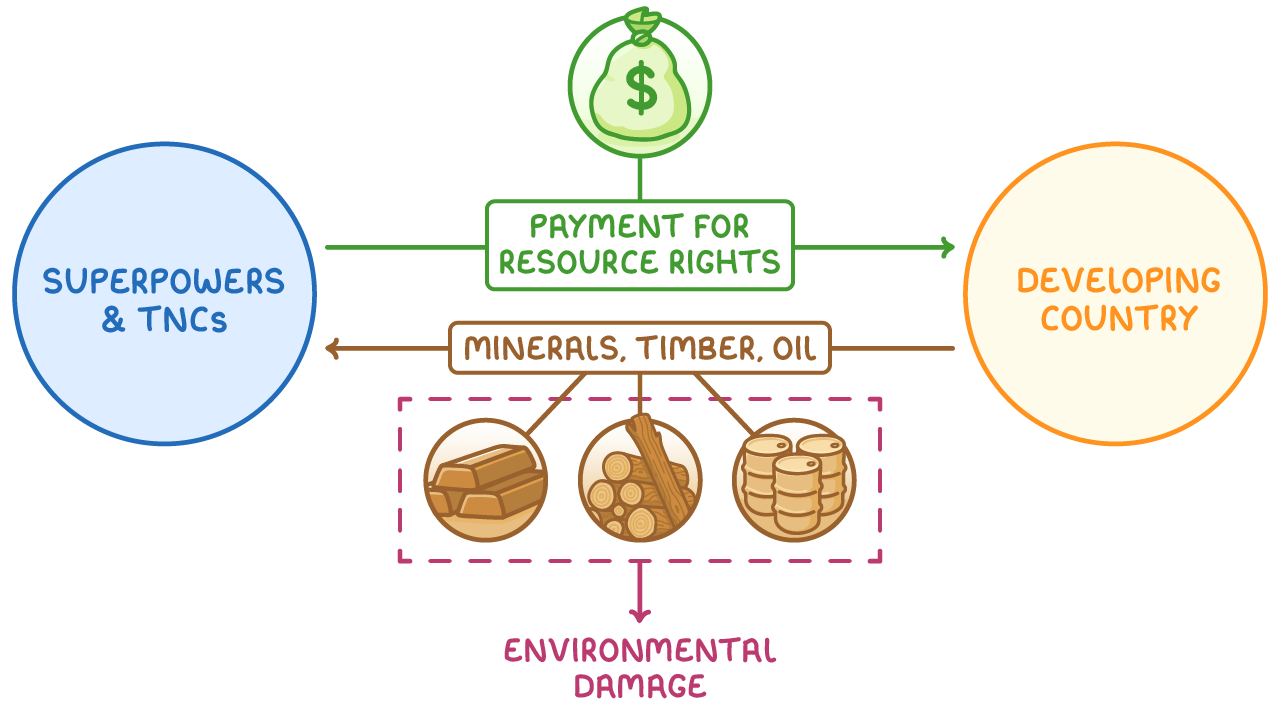
How exploitation supports development
- Superpowers and TNCs invest money in exchange for resource rights, enabling poorer nations to expand their economies.
- The income generated allows countries to develop infrastructure, promoting overall growth.
- Despite these benefits, the focus on rapid extraction often overlooks long-term environmental sustainability.
Environmental damage and minority displacement
Many untapped natural resources are located in remote, rural regions of developing countries. These areas are often home to minority groups, including indigenous peoples who have lived there for generations. Extracting resources through activities like deforestation, which is the large-scale removal of trees, or mining can force these communities to relocate, violating their basic rights.
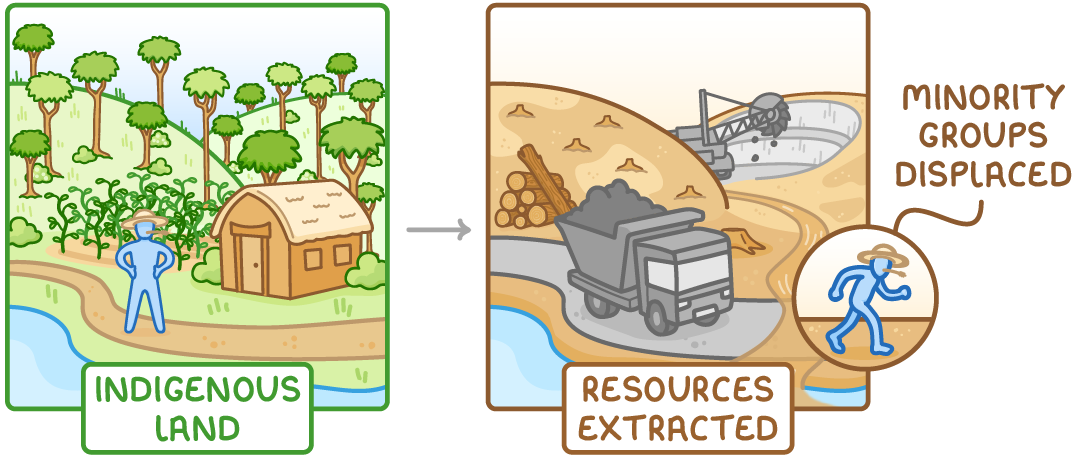
Impacts on indigenous and minority groups
- Loss of land rights - Groups are displaced from areas they rely on for farming or other livelihoods, ignoring their legal or traditional claims to the territory.
- Cultural erosion - When people have strong ancestral ties to their land, forced removal disrupts cultural practices and heritage, as the environment holds sacred or symbolic value.
- Livelihood threats - Displacement reduces access to essential resources like fertile soil or water, making it harder for communities to sustain themselves through traditional activities.
Pollution and its unequal effects
As countries pursue economic growth, industrial activities often generate pollution that contaminates air, water, and soil. This environmental degradation not only harms ecosystems but also disproportionately affects certain social groups, exacerbating inequalities.
Unequal distribution of impacts
Minority groups and poorer communities often have limited freedom of speech or political power to oppose developments, such as new factories or mines near their homes. This means they tend to experience the worst of these problems.
Case study: Oil exploitation in the Niger Delta
Nigeria provides a clear example of how resource exploitation can drive economic growth while causing environmental and human rights issues. The Niger Delta, a coastal region in southern Nigeria, contains vast oil reserves that have been tapped since the 1950s, contributing significantly to the country's wealth.
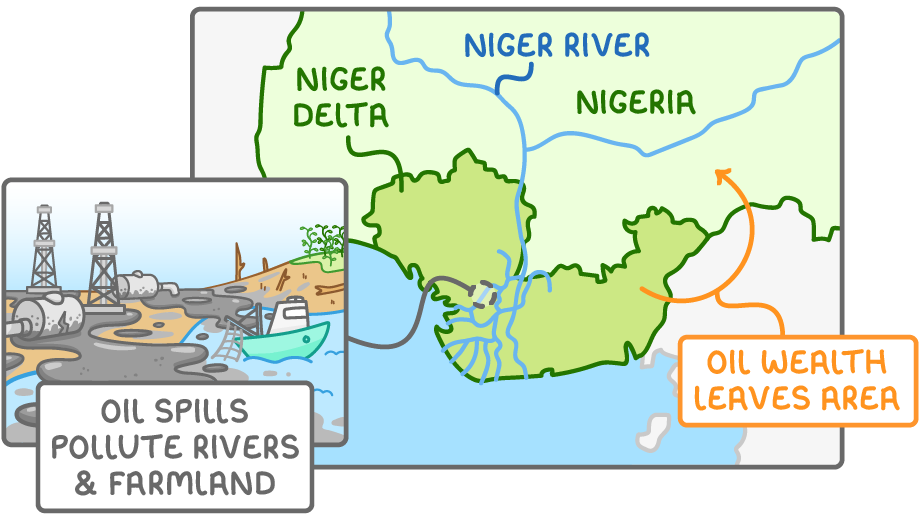
Background to oil exploitation
- Oil extraction is primarily carried out by TNCs, which have helped make Nigeria one of the richest nations in Sub-Saharan Africa through oil sales.
- The region is home to minority ethnic groups, such as the Ogoni people, who view the land and rivers as sacred elements of their culture.
- Local communities depend on the environment for fishing and farming, which form the basis of their livelihoods.
Environmental and social impacts
- Land loss and pollution - Oil drilling has resulted in the seizure of community lands, while frequent oil spills have polluted wells, rivers, and soil, threatening food and water security.
- Development disparities - Although Nigeria's overall GDP has grown, human development indicators, such as access to education and healthcare, remain low in the Niger Delta compared to other parts of the country.
- Human rights abuses - Conflicts over resources have escalated into violence; for instance, in 1993, protests against a new oil pipeline were met with attacks by military police and security forces.
Details of the 1993 conflict
- Local communities demonstrated against the pipeline.
- The response involved violent suppression, leading to over a thousand deaths.
- Villages were destroyed, displacing more than 30,000 people and leaving them homeless.