8.2 - Causes of Migration
Types of migrants and reasons for migration
Migration involves people moving from one place to another, often across international borders, driven by various factors. These factors can be categorised as push factors, which are negative aspects encouraging people to leave their home area, or pull factors, which are positive aspects attracting them to a new location. Understanding these helps explain why migration occurs and the different categories of migrants involved.
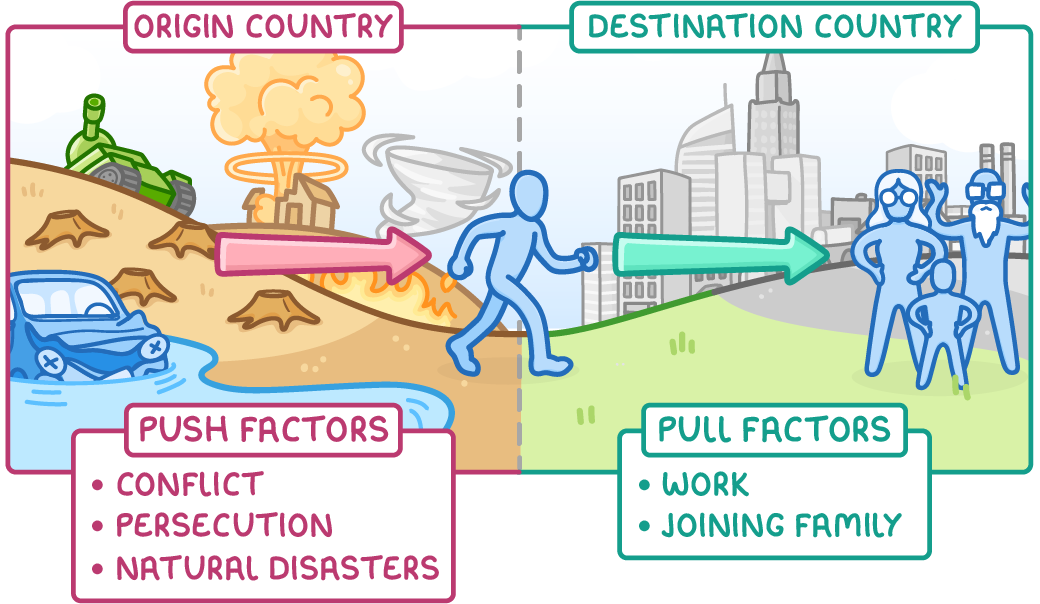
Main types of migrants
- Refugees - Individuals forced to leave their country due to persecution, conflict, or environmental changes such as natural disasters, and who cannot safely return.
- Asylum seekers - People who have fled their country and are applying for refugee status; they gain formal protection only after proving their fear of returning home is justified.
- Economic migrants - Also called voluntary migrants, these are individuals who relocate to another country primarily for work opportunities or to join family members already settled there.
Most migration is driven by economic reasons, with people seeking better jobs or family reunification, rather than forced circumstances like those faced by refugees or asylum seekers.
Push and pull factors influencing migration
Push and pull factors vary depending on the migrant's situation and can lead to different types of migration. These factors often combine, leading to long and hazardous journeys as people seek safer or more prosperous lives.
Key migration examples and challenges
Real-world examples illustrate how push and pull factors drive large-scale migration, often involving significant risks and difficulties upon arrival. One prominent case is the movement across the Mediterranean Sea, highlighting the dangers faced by those fleeing conflict or persecution.
Migration across the Mediterranean
Thousands of refugees and migrants attempt to cross the Mediterranean to reach Europe each year, driven by push factors like war and human rights abuses.
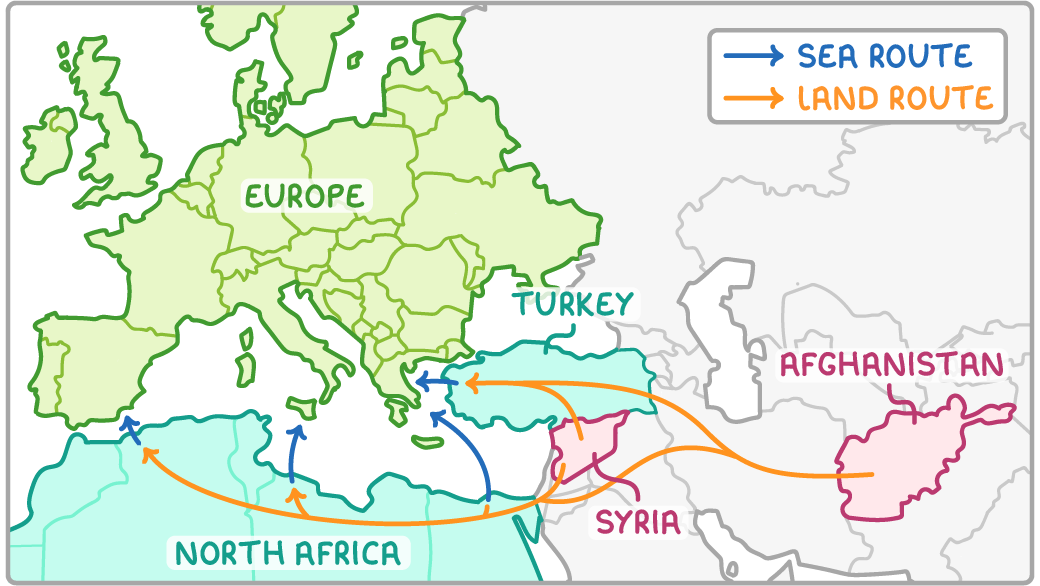
Key details of Mediterranean migration:
- Many originate from conflict-affected countries such as Syria and Afghanistan, seeking asylum in Europe.
- In 2015, over 60% of those crossing were escaping war-torn regions, while others fled human rights violations for safer societies.
- In 2021, more than 123,000 arrivals reached Europe's Mediterranean coast from Turkey and North Africa.
- The route is extremely perilous, with around 3,200 people dying or going missing in 2021 alone, and nearly 25,000 fatalities since 2014.
Upon reaching Europe, migrants often encounter challenges including unhygienic living conditions, insufficient shelter, and resistance from authorities, compounding the difficulties of their journeys.
Neoliberal policies and their impact on migration
Neoliberalism is an economic philosophy that promotes minimal government interference in markets to enhance efficiency and growth. It emphasises the free movement of key economic inputs: goods, capital, and labour. This approach can influence migration by encouraging policies that facilitate the flow of people across borders.
Core neoliberal policies
Neoliberal policies aim to create a free market society where resources move efficiently in response to supply and demand, potentially benefiting all citizens through increased wealth generation.
Three main neoliberal policies:
- Free trade - Allows goods to be exchanged between countries without tariffs or restrictions, boosting economic exchanges.
- Deregulated financial markets - Removes laws on investing and moving money, enabling easier capital flows.
- Open borders - Permits people to move between countries without visas or border checks, facilitating labour mobility.
These policies can enhance economic efficiency by allowing labour and skills to shift to where they are most needed, supporting industry growth and responding to market demands.
Economic benefits of open borders
Open borders under neoliberalism can lead to economic advantages, as workers migrate to areas with labour shortages, promoting efficiency and growth.
Controversies around open borders
Open borders spark debates about national sovereignty, which refers to a country's control over its borders and affairs. Critics argue that unrestricted migration diminishes the significance of borders and challenges national identity by allowing diverse nationalities and cultures to mix freely. This has fuelled discussions in many countries about the extent to which borders should be open to migrants.
Events influencing migration patterns
Various events can alter migration patterns by changing the main source areas (origins of migrants) and destination areas (where they head to). These events disrupt lives and economies, prompting people to move in search of safety or opportunities, and their impacts are likely to evolve with global changes like climate change.
Types of events affecting migration
- Environmental events
- Natural disasters, such as floods or earthquakes, displace people by destroying homes and resources.
- Climate change is expected to increase these pressures in vulnerable regions.
- Economic events
- Recessions or job shortages push economic migrants towards areas with better employment prospects, higher wages, improved education, and overall quality of life.
- Political events
- Wars or conflicts force mass displacements, shifting source and destination patterns.
- For example, Syria transitioned from a destination for Iraqi refugees in the 2000s to a source of refugees after its civil war began in 2011, with over 6.8 million Syrians fleeing abroad.
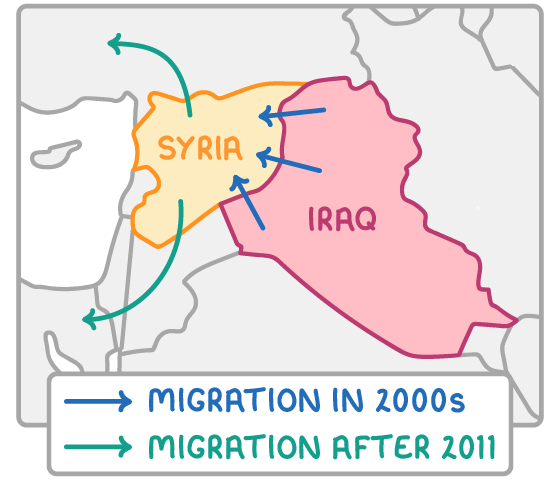
Economic migration policies and debates
Certain policies actively promote economic migration by allowing unrestricted movement of labour, which some economists view as essential for economic growth. These policies enable people to relocate where their skills are in demand, often more efficiently than government-directed allocations.
Freedom of movement policies
Industries can attract needed workers by offering higher wages, drawing economic migrants to fill gaps.
Examples of freedom of movement:
- Within the UK - No restrictions exist on internal movement, leading to about 1.1 million people relocating significant distances in England and Wales annually; young, skilled individuals often move to cities for jobs, while older people shift to rural areas.
- Regional agreements - The European Union (EU) and Schengen Agreement permit free movement and work across member countries, encouraging economic migration.
However, such policies are not global, as concerns about national sovereignty arise. For instance, some argued that the UK's EU membership compromised its control, leading to Brexit to reclaim border authority and future direction.
Debates on global open borders
While freedom of movement boosts efficiency by matching labour to demand, it remains controversial. Proponents highlight economic growth, but opponents fear it erodes national identity and sovereignty, prompting ongoing debates about balancing migration with national interests.