8.3 - Consequences of Migration
Factors affecting the ease of migration
Migration involves people moving from one country to another, often across international borders. However, not everyone faces the same challenges when trying to migrate. Various factors influence how straightforward or difficult this process can be, shaping who can move and under what conditions.
Key influences on migration accessibility
- Nationality - A person's country of origin plays a major role in their ability to travel and settle abroad. Some nationalities benefit from fewer restrictions due to international agreements.
- Income - Financial resources determine whether individuals can afford the costs associated with migration, such as travel and official fees.
- Skills - Certain abilities or qualifications can make it easier to gain entry into a host country, as some nations prioritise skilled workers.
These factors create inequalities in migration opportunities, meaning some groups can move more freely while others encounter significant barriers.
Role of nationality and border controls
Border controls are rules and checks that countries use to manage who enters their territory. The strictness of these controls varies between nations.
How nationality affects migration ease:
- Countries with strong passports allow their citizens to access more destinations without needing advance visas, simplifying travel and potential migration.
- International agreements, such as those between certain nations, can remove the need for visas altogether, promoting freer movement.
- In contrast, citizens from countries with weaker passports face more restrictions, limiting their migration options.
Example data on visa-free destinations:
The Henley Passport Index (2022) ranks countries by the number of destinations their citizens can visit without obtaining a visa in advance. This highlights global disparities:
| Country | Number of destinations |
|---|---|
| Japan | 193 |
| USA | 186 |
| South Africa | 105 |
| The Philippines | 67 |
| Haiti | 49 |
| Afghanistan | 27 |
Citizens from countries like Japan have far greater freedom to migrate compared to those from Afghanistan, where options are severely limited.
Impact of income on migration
Income levels directly affect the practicality of migration, as moving often involves substantial expenses.
Challenges for lower-income migrants:
- Costs include transport tickets, visa application fees, and sometimes legal assistance.
- Those with limited funds may turn to illegal routes, often relying on people smugglers, which increases risks such as exploitation or dangerous journeys.
- Wealthier individuals can more easily cover these expenses and navigate official processes, making migration smoother for them.
This economic barrier means that migration is often more accessible to those from higher-income backgrounds, perpetuating global inequalities.
Influence of skills on migration policies
Many countries design their immigration systems to attract talented individuals, using skills as a key criterion for entry.
Skills-based immigration systems:
- Some nations, like Australia, employ a points-based system to evaluate potential migrants based on their qualifications, work experience, and language abilities.
- Higher-skilled applicants are prioritised and granted entry, as they are seen as valuable contributors to the economy.
- Skilled migrants may secure employment in the host country before arriving, which simplifies obtaining a visa and settling in.
This approach favours educated or experienced workers, while less-skilled individuals may find it harder to migrate legally.
Increasing cultural and ethnic diversity
When people migrate, they bring their backgrounds, traditions, and perspectives to the host country. This process enhances the mix of nationalities, cultures, and ethnic groups within a society, leading to greater diversity.
Processes of cultural integration and adaptation
Integration refers to the way migrants blend into the host society's dominant culture while potentially influencing it in return.
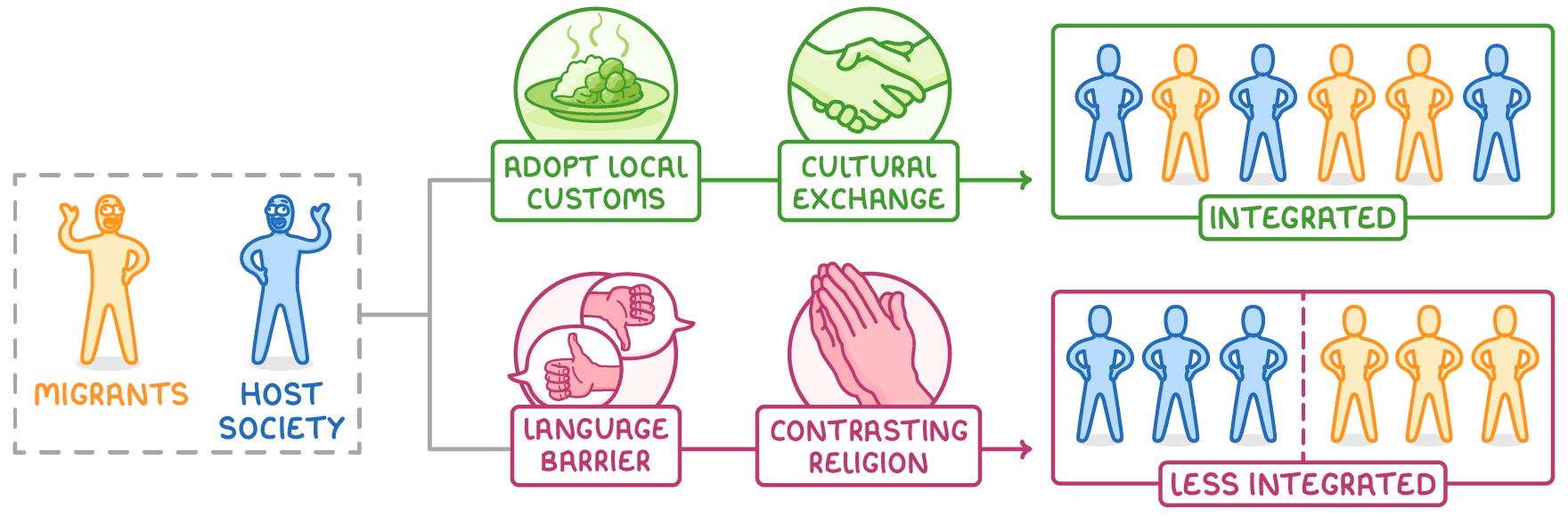
Ways migrants integrate:
- Adopting local customs, such as participating in national festivals or modifying traditional recipes to use local ingredients and suit local tastes.
- Sharing elements of their own culture, which the host population may adopt, creating a two-way exchange. For example, a migrant group's cuisine might inspire popular restaurant chains in the host country, like Wagamama, which draws from Asian influences.
Factors leading to less integration:
- Significant cultural differences, such as language barriers or contrasting religious practices, can make it harder for migrants to fully adjust.
- In these cases, migrant groups may preserve their distinct identities, forming communities that maintain their original traditions rather than fully assimilating.
As migration increases, these dynamics contribute to a richer, more varied cultural landscape in the host country.
Differing perceptions of migration's impacts
Migration sparks varied opinions about its effects on society, the economy, and culture. Some view it as beneficial, while others see it as a challenge that requires stricter controls. These differing views can create political debates and influence policies.
Perceptions of migration
Perceptions often depend on personal experiences, media portrayals, and economic conditions.
Common positive perceptions:
- Migration enriches societies by introducing new ideas, skills, and cultural elements.
- It can boost economic growth through labour contributions and innovation.
Common negative perceptions:
- Concerns include strain on public services, job competition, or cultural changes that some feel threaten national identity.
- These views can lead to calls for limiting migration to protect local resources and traditions.
Such disagreements often fuel political tensions, as seen in debates over border policies and international agreements.
Case study: Migration within the EU
The European Union (EU) provides a key example of how migration policies and perceptions interact. The EU promotes free movement of people between member states, allowing citizens to live and work in any member country without visas.
Key features of EU migration
In 2015, about 4% of EU-born individuals were living in a different EU country from their birthplace. This mobility is facilitated by the absence of internal border controls for EU citizens.
Migration patterns in the EU:
- Germany receives the most EU migrants. In 2019, nearly 600,000 people from other EU states moved to Germany, making up 40% of its total immigration.
- Perceptions vary widely: in 2018, 62% of Swedes believed migrants strengthen their country, compared to just 10% of Greeks.
Political impacts: The Brexit example
Differing views on migration contributed to significant political events.
The 2016 UK EU referendum:
- Some UK voters were concerned about unrestricted EU migration and supported leaving the EU to regain control over borders.
- 51.9% voted to leave, leading to the UK's official exit in January 2020.
This case illustrates how migration perceptions can drive major policy shifts.
Case study: Migration from Mexico to the USA
Migration between Mexico and the USA highlights cross-border movements and the debates they generate. Mexico is a major source of migrants to the USA, with many seeking better opportunities.
Overview of Mexico-USA migration
Around 11 million Mexican migrants live in the USA, representing approximately 25% of all US migrants. They include both low-skilled workers and professionals, often settling in border states like California and Texas.
Characteristics of Mexican migrants:
- Many are young, with an average age of 31 upon arrival in 2017, helping to bolster the USA's working-age population.
- The US-Mexico border features physical barriers, such as fences, separating densely populated areas in Mexico from sparser regions in the USA.
Positive perceptions of Mexican migration
| Aspect | Positive perceptions |
|---|---|
| Social | Migrants pay taxes, supporting services like health care, transport, and education. |
| Economic | They fill labour gaps in sectors like agriculture and construction, contributing 4% to US GDP in 2011. |
| Cultural | Mexican influences, such as food and language, have integrated into US society (e.g., 13% of Americans speak Spanish). |
| Demographic | Young migrants support ageing populations by working and paying taxes. |
Negative perceptions of Mexican migration
| Aspect | Negative perceptions |
|---|---|
| Social | Around 5 million are undocumented, making regulation difficult for the government. |
| Economic | Some believe migrants take jobs desired by Americans. |
| Cultural | Concerns that migrants do not adopt US culture, potentially threatening American identity. |
| Demographic | Fears that growing migrant numbers could make white Americans a minority (50% viewed this negatively in 2018 surveys). |
Political consequences
Migration from Mexico has become a key election issue. For instance, in 2016, Donald Trump won the presidency partly by promising a 2,000-mile border wall to curb illegal entries. This reflects how perceptions can shape national policies and debates.