8.4 - Nation States
The definition and characteristics of nation states
What is a nation state?
A nation state is a defined territory recognised as an independent and sovereign entity by its own citizens and by other countries. Examples include the United Kingdom, Botswana, India, Venezuela, and New Zealand, all of which are acknowledged as distinct nation states.
Variations in size and composition
Nation states vary in their internal makeup. Some consist of citizens who are very similar to each other, united by the same language, ethnicity, and culture. Others encompass diverse groups. The diversity within a nation state is shaped by factors such as migration patterns and the level of isolation.
Factors influencing diversity within nation states
Diversity within a nation state, encompassing variations in ethnicity, language, religion, and culture, is shaped by elements such as geographical location, migration patterns, and government policies. Factors like isolation or connectivity can influence this diversity.
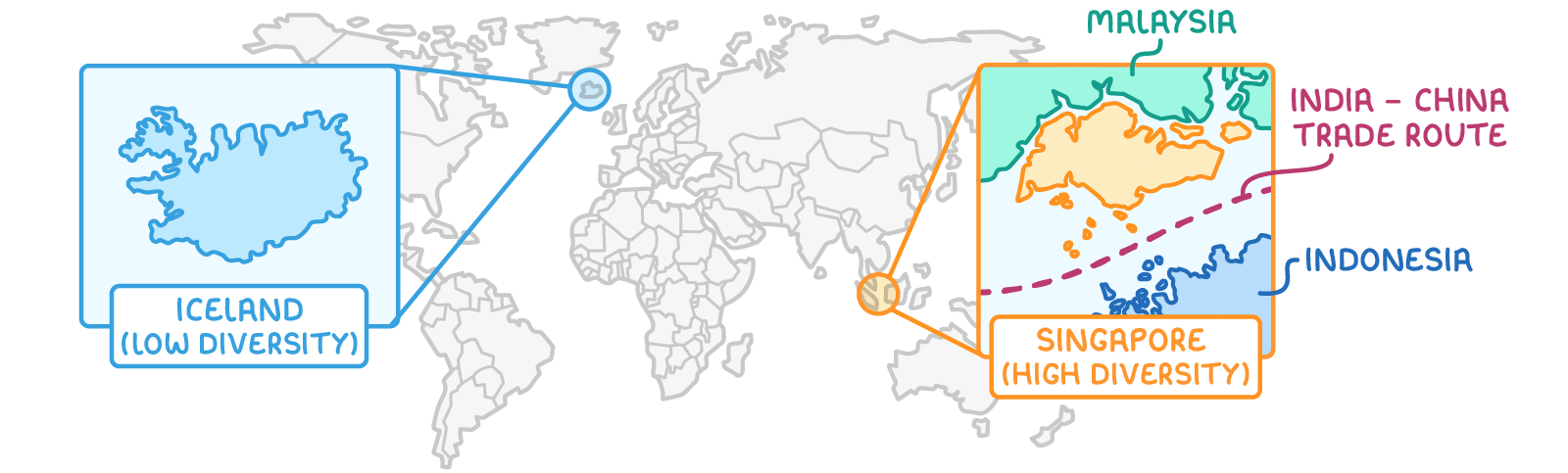
Causes of low diversity
Geographical isolation acts as a barrier to migration, reducing the influx of new groups and preserving cultural uniformity. Policies that promote integration, such as language requirements for citizenship, can further maintain homogeneity.
Case study: Low diversity in Iceland
Iceland exemplifies a nation state with limited diversity due to its remote location and historical policies.
Key features of Iceland's population:
- Ethnic composition - Approximately 93% of the population is ethnically Icelandic, with roots tracing back to Viking settlers.
- Religious and linguistic unity - Up to 70% of Icelanders belong to the Lutheran Church, while around 96% speak Icelandic as their primary language.
Reasons for homogeneity:
- Iceland's position as a small island in the mid-Atlantic has historically made migration difficult, particularly before planes were common.
- Government policies have maintained cultural unity by encouraging integration; for example, until 1996, immigrants were required to adopt Icelandic names, and citizenship still demands a basic proficiency in Icelandic.
Causes of high diversity
Central locations on trade routes facilitate migration and cultural exchange, leading to mixed populations. Historical events, such as colonisation and economic growth, can attract workers from various regions, enhancing ethnic, linguistic, and religious variety.
Case study: High diversity in Singapore
Singapore demonstrates how location and history can foster a multicultural society.
Key features of Singapore's population:
- Ethnic makeup - There is no dominant Singaporean ethnicity; the population includes people of Chinese, Malay, Indian, and other origins.
- Linguistic and religious diversity - Residents speak multiple languages and dialects, including English, Mandarin, and Malay, and follow various religions such as Buddhism, Christianity, and Islam.
Reasons for diversity:
- Singapore's strategic position between Malaysia and Indonesia, on key trade routes linking India and China, has encouraged migration over centuries.
- As a former British colony that gained independence in 1965, Singapore's economic expansion attracted labour from neighbouring countries, both before and after independence.
How geography and history shape national borders
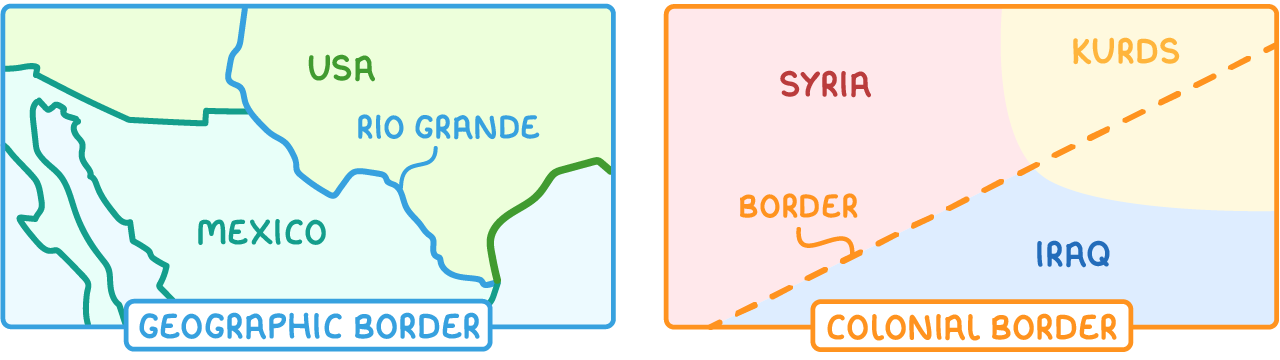
Role of physical geography in border formation
Many borders align with natural obstacles that act as barriers.
Examples of physical borders:
- Rivers, such as the Rio Grande separating the USA and Mexico.
- Mountain ranges, like the Pyrenees between Spain and France.
Influence of history and colonialism
Borders frequently result from historical negotiations, conflicts, or treaties over territory and resources. During the colonial era, European powers redrew maps in colonised regions, often using straight lines that disregarded local ethnic, religious, or linguistic groups, as well as terrain. This has led to questions about border legitimacy.
Case study: The Iraq border and its impacts
The border between Iraq and Syria illustrates how colonial decisions can create lasting tensions.
Historical context:
- In 1916, the UK and France created the Sykes-Picot Agreement, which divided parts of the Middle East, establishing a boundary that roughly matches the modern Iraq-Syria border.
- This agreement overlooked ethnic and religious groups, leaving some, like the Kurds, as minorities across multiple countries including Iraq, Iran, Syria, Turkey, and Armenia.
Consequences:
- The Kurds, divided by these borders, have had limited political power, contributing to calls for an independent Kurdish state.
- The agreement favoured certain groups, such as Sunni Muslims, over others, fuelling decades of conflict.
- Disputes have involved groups like the Islamic State (ISIL), which challenge existing borders and undermine national sovereignty.
Contested nation states and borders
Not all nation states are recognised by other countries, and agreements on borders are not always reached. This can lead to tension or conflict between countries and result in significant population movements.
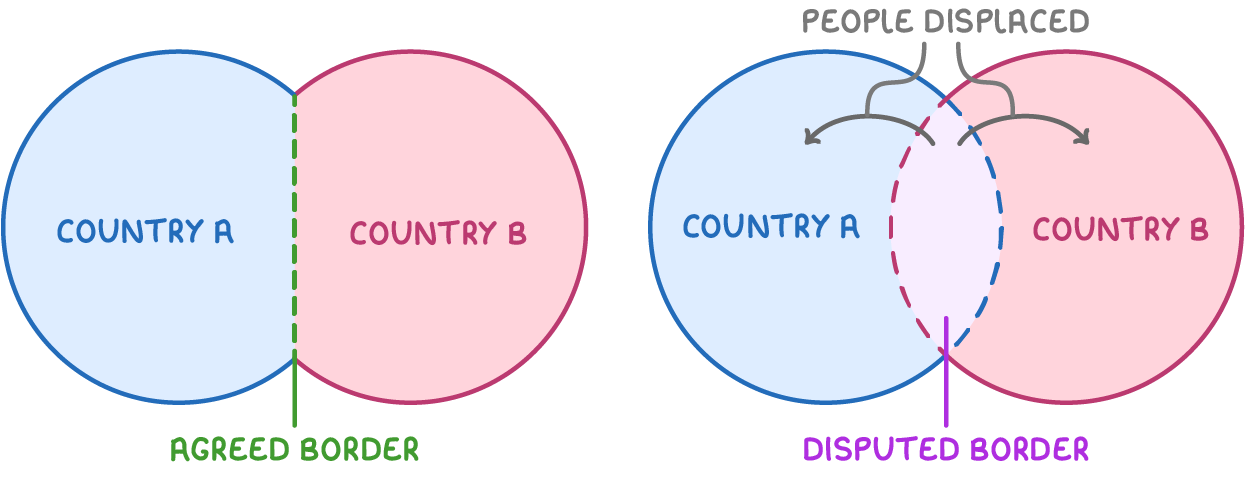
Impacts of contested borders
When borders or sovereignty are disputed, it can result in armed conflicts, population displacements, and strained international relations. People may migrate to escape violence or to align with preferred nation states.
Case study: The Ukraine-Russia border conflict
The border between Ukraine and Russia has been a flashpoint due to territorial annexations and invasions.
Key events:
- From 1783 to 1954, the Crimean Peninsula was part of Russia; it transferred to Ukraine in 1954, and Ukraine gained independence in 1991.
- In March 2014, Russia annexed Crimea, seizing military bases and the regional parliament with support from pro-Russian separatists.
- Armed conflict erupted in April 2014 in the Donbas region of eastern Ukraine.
- The situation escalated in 2022 with Russia's full invasion of Ukraine, leading to over 7.8 million Ukrainian refugees recorded across Europe by the end of that year.
Case study: Conflict between China and Taiwan
Taiwan's status as a nation state is contested by China, creating ongoing geopolitical tensions.
Historical background:
- During the Chinese Civil War (1946–1949), China's nationalist government was defeated by the Communist Party and retreated to Taiwan in 1949.
- The nationalists claimed continued leadership over all of China, planning to reclaim the mainland, but the Communist government in Beijing views Taiwan as part of China and denies its sovereignty.
Current tensions:
- China refuses diplomatic relations with countries that recognise Taiwan, limiting Taiwan's global influence; fewer than 20 countries officially acknowledge it, and organisations like the United Nations do not treat it as a sovereign nation.
- Military actions, such as missile tests and exercises in the waters between China and Taiwan, raise the risk of conflict.
- The USA, while not recognising Taiwan, has increased visits there, heightening tensions despite opposing Taiwanese independence.