8.5 - Nationalism
Defining nationalism
Nationalism is a strong sense of loyalty and attachment that people feel towards their country, often accompanied by the belief that their nation is superior to others.
Key characteristics of nationalism
- Sense of identity - It fosters a shared feeling of what it means to belong to a particular nation, based on factors like language, culture, history, or territory.
- Superiority belief - Nationalists may view their nation as better than others, which can justify actions like expansion or domination.
- Historical impact - Nationalism has led to both unity within countries and rivalries between them, influencing wars, colonisation, and independence movements.
Rise of nationalism in the 19th century
In the 19th century, nationalism grew rapidly in Europe, fuelled by conflicts over borders and a desire for national identity. Countries like Britain, France, and Germany competed fiercely, which strengthened people's sense of what it meant to be part of their nation. This era saw nationalism extend beyond Europe, driving colonial expansion as European powers believed their superiority entitled them to control other regions.
How nationalism contributed to European conflicts
European nations fought over national borders, heightening rivalries. For example, disputes between Britain, France, and Germany reinforced distinct national identities, such as the differences between being British, French, or German. This competition escalated into a race for power, measured by military strength, resources, and colonial possessions.
Nationalism and colonial expansion
European countries expanded empires in Asia and Africa, viewing colonised peoples as inferior. This mindset justified imposing European authority, culture, and language. The competition peaked in the late 19th century during the 'Scramble for Africa', where nations vied for control of African territories to boost their status and resources.
Nationalism and the British Raj in India
Britain's colonial activities in India exemplify how European nationalism led to domination and, ironically, sparked local nationalist responses. One of Britain's goals during the Scramble for Africa was to secure routes to India, highlighting its strategic importance.
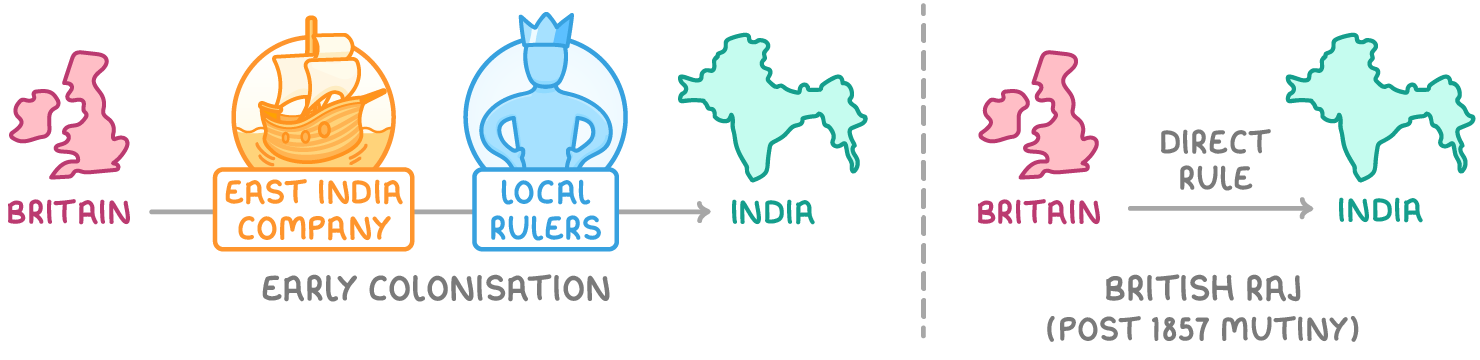
Early colonisation of India
- Britain’s colonisation of India grew out of trade and indirect control.
- The East India Company, a British trading organisation founded in 1600, made agreements with local rulers to manage trade and territories.
- This approach allowed Britain to expand influence without full direct governance.
The shift to direct British control
- In 1857, Indian soldiers employed by the East India Company rebelled against British officers, triggering widespread violence.
- In response, the British government took direct control, establishing the British Raj – a period of formal rule over India.
- Local rulers swore allegiance to Queen Victoria, and Britain maintained order through military force while promoting its culture, such as by creating English-language schools with a curriculum focused on European history and values.
Emergence of Indian nationalism
- Many Indians resented British colonialism, especially educated young men denied opportunities in areas like the civil service.
- This dissatisfaction led to discussions about Indian independence.
- In 1885, the Indian National Congress formed, growing into a major nationalist movement.
- It advocated for self-governance by Indians, using tactics like boycotting British goods and schools, as well as organising uprisings.
- Interestingly, Britain's imposition of its nationalism helped foster a unified Indian nationalism in opposition.
Post-World War II independence movements
The end of the Second World War in 1945 marked a turning point for colonialism. European powers, weakened by war and debt, could no longer fully control their empires. This created opportunities for nationalist movements in colonies, leading to the creation of many new independent nation states over the following decades.
Factors enabling independence
War devastation left colonisers like Britain and France economically strained, increasing their reliance on colonial resources while reducing their ability to suppress unrest. Nationalist groups in colonies gained strength, often supporting each other across regions. In 1947, India and Pakistan achieved independence after negotiations with Britain, setting a precedent for others.
The 'wind of change' in Africa
The 1960s saw a wave of African independence, described by British Prime Minister Harold Macmillan as the 'wind of change' blowing through the continent. In 1960 alone, over a dozen countries gained freedom. Some transitions, like Ghana's, were peaceful, while others, such as Kenya's, involved violence between nationalists and colonial authorities.
Outcomes of African independence:
- Independence movements often collaborated, building momentum as more countries succeeded.
- Colonisers eventually accepted the shift but left without establishing stable governments, leading to instability and civil wars in many new nations.
Timeline of African independence
African countries gained independence at varying times, reflecting the gradual dismantling of empires.
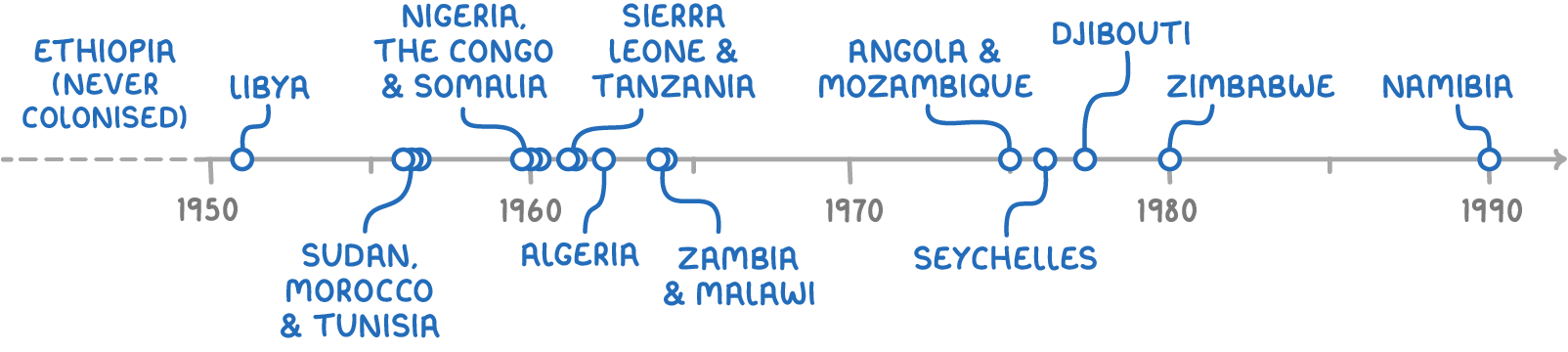
| Period | Examples of countries gaining independence |
|---|---|
| 1949 or earlier | Ethiopia (never colonised) |
| 1950-1959 | Libya, Sudan, Morocco, Tunisia |
| 1960 | Nigeria, Democratic Republic of Congo, Somalia |
| 1961-1964 | Sierra Leone, Tanzania, Algeria, Zambia, Malawi |
| 1970-1975 | Angola, Mozambique |
| 1976-1979 | Seychelles, Djibouti |
| 1980 or later | Zimbabwe, Namibia |
This timeline shows the rapid pace in the 1960s, with many nations forming from former colonies.
Negative consequences of independence
While independence brought hope for peace and prosperity, it often led to challenges. Colonial borders were drawn for the colonisers' convenience, not to reflect unified nations, resulting in diverse groups being forced together. Colonisers sometimes encouraged divisions to prevent unified resistance, making post-independence governance difficult and sparking conflicts.
Challenges in new nations
New countries frequently included varied social, ethnic, or religious groups with differing views on leadership and governance. This disunity often caused internal strife, leading to social upheaval, economic setbacks, and environmental damage.
Case study: Conflict in Sudan and South Sudan
Sudan and South Sudan provide a stark example of how colonial legacies and regional differences can lead to prolonged conflict after independence. Sudan was colonised by Britain in the 1890s and ruled jointly with Egypt from 1899 to 1955, gaining full independence in 1956.
Regional differences in Sudan
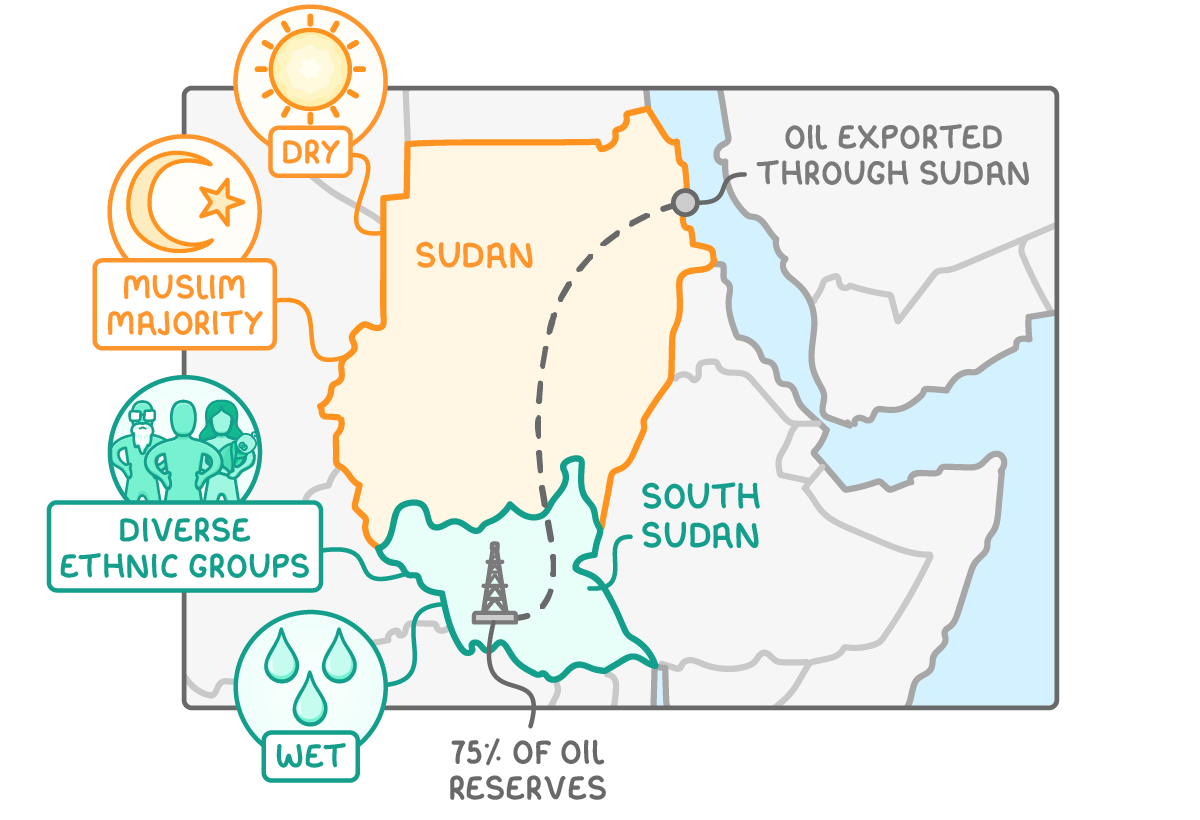
The country combined two distinct areas:
- Northern Sudan
- Dry climate
- Mostly Muslim, Arabic-speaking population
- Higher human development levels
- Southern Sudan
- Wetter, more fertile climate
- Diverse ethnic groups (e.g., Dinka and Nuer) and mixed religions (e.g., Christians and Muslims)
- Rich resources, such as approximately 75% of the region's oil reserves
- However, the south has the world's lowest Human Development Index
Path to division and conflict
Before independence, southern leaders sought autonomy, but this was denied, escalating tensions. Civil wars erupted from 1955 to 1972 and again from 1983 to 2005 between the government and the Sudan People's Liberation Army. In 2011, South Sudan became independent, but disputes over oil continued, as transport infrastructure runs through Sudan. Additional conflicts included violence in Darfur (western Sudan) and a 2013–2020 civil war in South Sudan between ethnic groups supporting rival leaders.
Impacts of conflicts
These wars have caused widespread devastation.
Social impacts:
- Around 400,000 people died in South Sudan's 2013–2018 civil war, with nearly 4 million displaced.
- Reports from non-governmental organisations (NGOs) highlighted abuses like civilian killings, sexual assault, and looting.
Economic impacts:
- South Sudan spent over half its 2013 budget on the military, and its 2018 GDP per capita was around 30% of what it would have been without conflict.
- Sudan's Darfur conflict cost nearly US$90 billion from 2003 to 2017, diverting funds from education and health and hindering development.
Environmental impacts:
- Both countries face desertification.
- Conflicts worsen this by degrading land near refugee camps, while political instability prevents sustainable development efforts.